Showing posts with label Dungeons and Dragons. Show all posts

Sunday, 21 December 2025

My Experience of D&D through the Editions


art by Jeff Easley

This post is my opinion based on my own experiences and is not intended to be a definitive history. 

I have recently gotten hold of a PDF of the Holmes Basic edition of D&D. For those that don’t know, this was the edition that was intended to smarten up and clarify Original D&D (the three white books), then encouraged players to move on to Advanced D&D, yet was also the direct ancestor of Moldvay Basic D&D, which is the set I first had and was my introduction to this hobby. I was going to write about just Holmes Basic and what can be borrowed from it in my B/X D&D Mystara campaign, but I’ve ended up thinking about all editions of D&D. 

My Feelings on the Matter

I think a lot of people can get defensive and close-minded about editions. In my 40 years in the hobby I have seen a number of edition wars, waged in the Forum pages of Dragon Magazine, the early Usenet forums on the nascent world wide web and of course other online places like Reddit, EN World and various blogs. One thing that irks me is when people decide quite arbitrarily what is or is not “proper” D&D. This is often based on what edition they grew up with and played with their friends when they were discovering  the game. I think it’s quite normal and natural to have a favourite edition, and that is probably going to be influenced by nostalgia. I myself wrote this blog because I wanted to get back to Moldvay Basic D&D, which I was given for Christmas 1982. It still is my favourite edition. But I try not to confuse nostalgia with being the “correct” edition, especially when talking to others. 

I have always acknowledged that D&D is always changing. It has ever since it was first published. There are those who denounce the the three supplements to the white booklets, Supplement 1: Greyhawk, Supplement 2: Blackmoor & Supplement 3: Eldritch Wizardry as deviating from “proper D&D” which should be the three booklets (Men & Magic,  Monsters & Treasure, Underworld & Wilderness Adventures) and nothing else. Thieves? Variable damage dice for weapons? Different hit dice for classes?  Bah! Newfangled nonsense!. And I believe the game will continue to evolve. 5.5E probably won’t be the final edition. That doesn’t mean I will definitely play 6th or 7th edition if and when they are published, but I’ll try to have an open mind about them and not be bitter about WotC abandoning MY edition, or resentful to those who play the new ones. Players and DMs who prefer the older editions can still continue with the books they already have - the two downsides are that firstly WotC (or whatever publisher) won't be putting out more support for that edition; secondly new editions will split the fan base and a large number of players will move along to the new edition, reducing the number of potential players for the old edition. 

I also think it is quite reasonable to like or dislike rules and mechanics within each edition. Some will veer towards the crunch-heavy side (5E and 3.5E spring to mind) while others will go for as rules-lite as possible (OD&D or its OSR imitators).  Rules vs Rulings is often a matter of taste rather than objective quality. Sometimes the size of the books is more dependent on the options available rather than explaining the underlying mechanics - new races, feats, classes, subclasses, prestige classes, kits, spells, equipment, magic items and the like can all add to the page count.  And I have seen lots of discussions (sometimes heated) about the pros and cons of different mechanics and rules, usually on the internet. 

WotC can piss people off. And as a big corporation they have made some bad business decisions. That Pinkerton incident (yes I know it was about Magic the Gathering, not D&D, but it is still the same corporation) will haunt them for a long time. Good - they deserve to be reminded of it. And that attempt to rewrite the OGL did not go down well with anybody else. But I don’t think we should look at TSR through rose-tinted glasses either. Gary Gygax’s treatment of Dave Arneson, Lorraine Williams ousting of Gary in turn, TSR’s ferocious approach to amateur D&D work on the early web all show that big businesses will behave like big businesses. I remember on the Usenet forums before TSR went bankrupt it was regularly referred to as T$R, and some players were regularly advocating piracy as T$R didn’t deserve their money. Despite all these corporate shenanigans I have not been put off from buying TSR or WotC products as long as I am interested in the actual product. Other people can boycott WotC if they want, and I’m not going to argue with them. But I don’t have to join in either. 

My personal experiences with D&D Editions

OD&D (Gygax & Arneson, 1974): I do have the PDFs, but I have never actually played it. Seeing as I don’t have Chainmail rules, I don’t think I’ll even try as it looks like a disorganised mess. But I do know that other people still play it and that retroclones of it have done well. 

Holmes Basic D&D (Eric J Holmes, 1977): Like I said earlier, I have recently acquired the PDF. It is interesting and is the branching point for B/X from AD&D. I probably won’t use anything in it but it is nice to read as an important part of D&D history. The presentation and explanation has greatly improved from OD&D.  

B/X D&D (Moldvay, Cook, Marsh, 1981): The first rules I owned (the magenta Basic D&D box with Keep on the Borderlands), and the rules I played with in prep school (ages 10-12). Very formative years, and lots of nostalgia. I still like the relative lightness of the rules even if I have sometimes found the race-as-class idea somewhat restrictive. 

BECMI D&D (Frank Mentzer, 1983): I was given Mentzer's Expert boxed set rather than the Cook/Marsh one, with the Larry Elmore cover. I reckon BECMI is so close to B/X that they are effectively the same edition though with very different presentations - perhaps Basic D&D 1.5. I also have the Companion rules and the Masters Rules (though the Masters Rules are only as a PDF). Honorable mention goes to the Rules Cyclopedia, the most complete game in one book that I own, and it is often the D&D book  I take on holiday. Incidentally this is the edition I used to play D&D with nephews and nieces a long time ago (we had a week's holiday together and they were between 8 and 12 I think - the oldest is now 26). 

1st Edition AD&D (Gary Gygax, 1977+): This is what I started playing at boarding school, particularly the earlier half (age 13-15). Again lots of nostalgia during formative years. I had nearly all the hardback books.  The fact that it was Advanced, not Basic, made us feel more grown-up.... There are things about this edition that I still enjoy and refer to, such as the appendices in the back of the DMG. 

2nd Edition AD&D (David Zeb Cook, 1989): The later years of boarding school (age 16 to 17) saw the introduction of 2E and my D&D friends and I switched. There was of course the assumption that newer is better, but we ended up playing a mash-up of 1E and 2E, with older modules, assassins, monks and half orcs making their appearances in our 2E games.  I still like how 2E clarified the rules, improved the Ranger and Bard classes, actually had a consistent mechanic for surprise and was a little less arbitrary than Gary’s 1E. However, it was also somewhat less flavourful and played it a bit too safe (I was disappointed at the initial lack of devils & demons, though they were brought back later). I bought more 2E books at university (including Dark Sun, Planescape and lots of Forgotten Realms books) but at university I never really found a group I was comfortable playing with. 

3rd Edition D&D (Monte Cook, Skip Williams, Jonathan Tweet, 2000): I bought a lot of the books but I didn't get to play much - this was definitely a dry period, where I spent a lot of time world-building and dreaming of creating great adventures and supplements but never getting them further than my hard drive. There were some things about this edition I really liked, but others I was less enthusiastic about. One of the great things was the Open Game License which allowed all sorts of third-party products including adventures, settings and even whole games based off D&D, which led to retro-clones and the OSR. The thing I least liked about this was the increasing complexity  - the skills system, calculating monster XP, the massive bloat in terms of feats and prestige classes. A lot of my world building and unpublished adventurers ended up summarising NPCs as race, class & alignment rather than doing proper stat blocks, which could get really big for high level characters. 

4th Edition D&D (Rob Heinsoo, James Wyatt, 2008): I skipped this one. I did actually buy the three core books but on perusing I decided I didn’t like it. I didn’t even get to try the mechanics - I was put off by the radical changes to things like races, alignment, adding new classes & races, dropping established ones and telling players and D&Ds  “Don’t bother trying to convert your old campaign to 4E, just start a new campaign with these new classes, races & cosmology”. And I just went “Nope.” The best thing that 4th Edition did was to push me towards the OSR (Old School Revival) where I found retroclones such as OSRIC, Swords & Wizardry and of course my favourite, Labyrinth Lord, which led me back to Basic D&D. To be fair there wasn't much opportunity for actual play during this period either. However, I became more active on the internet, including joining EN World,  Dragonsfoot and the now-defunct Goblinoid Games forum. And of course I started my blog during this period. 

5th Edition D&D (Mike Mearls, Jeremy Crawford, 2014): I bought the core books fairly early on, soon after each one was released, but I didn’t get to play until a few years ago at a board games cafe. Since then I’ve played more 5E than almost any other edition. The current edition always has a competitive edge over out-of-print editions, and although I was hoping to run a B/X game, the demand was for 5E. It turns out to be a pretty good, decent system - the campaign would not have lasted 2 years if I thought the rules were complete crap. It is more rules-intensive than B/X or AD&D, but not intolerably so. The campaign I have been running has recently ended unexpectedly. This is sad, but I do not regret the time and effort I spent running it. The two years or so DMing the campaign has meant I have gotten used to 5E and perhaps even some confidence in running it. Beforehand I had the books but really didn’t know what it felt like to play: Now I do. 


Saturday, 26 July 2025

Descent into Avernus Homebrew #3: Camp Knucklebone and the Yugoloth Camp

This is continuing the short series about some of the material I have come up with to make the published adventure Descent into Avernus: Baldur’s Gate run more smoothly.  The adventure as published is good but there are significant gaps that I feel need filling in. 


My map of Camp Knucklebone

Camp Knucklebone

One important missing item is a map of Camp Knucklebone. This is a camp in Avernus run by a night hag called Mad Maggie, who oversees a band of redcaps with a pair of kenku and a few imps. The camp and what goes on there is given decent explanation in the book but crucially there is no map, so I have decided to fix this.
I’m sure others have done neater, more professional maps than this: this was not done with this blog in mind but purely for my players who I DM for. Nonetheless it has the basics, including 
  • A) Forge Wagon: This is where smithing is carried out by the redcaps and kenku. It has a trailer with a portable forge, while to one side of the wagon are a pair of anvils. Inside are various blacksmithing and metal-casting tools. 
  • B) Maggie’s Wagon: This large gypsy-style covered wagon is her home and includes various books, potions, wardrobes and other personal belongings. It is motorised rather than drawn by animals. Mickey the Flesh Golem can often be found guarding this wagon, making sure that nobody else enters. 
  • C) Watch Tower: typically manned by a pair of redcaps
  • D) Gatehouse manned by 6 redcaps
  • E) Maggie’s Happymobile, a customised Scavenger vehicle. 
  • F) Infernal War Machine: There are several of these around the camp, all of them Scavengers.  
  • G) Hospitality Wagon. This is where the PCs can stay. Enough visitors end up in Camp Knucklebone that it is sensible to have a wagon spare. It is quite spartan but has 6 human-sized bunks and 2 closets.  
  • I) Kenku Wagon: This is where the two kenku Chukka and Clonk live. It is full of shiny and curious odds and ends the kenkus have collected. 
  • J) Redcap oversized trikes. These are Devils Ride infernal war machines used by the redcaps. 
  • K) Workshop Wagon: Along with the forge wagon (A) this is where much of the mechanical work takes place. 

The Yugoloth Camp

This is a short side-trek I threw together to give the PCs something to do at Camp Knucklebone. Mad Maggie, the night hag who runs Camp Knucklebone has agreed to help restore the memories of Lulu the hollyphant. I decided that as well as the ritual described in the adventure with its dream sequences, a potion of mind restoration was needed, to be brewed by Maggie and drunk by Lulu. Lulu lost her memory after being dowsed with water from the Styx, which washes away memories of all who drink or bathe in it, except for a few select creatures that have adapted to thrive in the Styx. One species that can swim in the Styx while retaining their memories are the Hydroloth - frog-like yugoloths. Maggie would like the brain of one of them to brew into this potion of mind restoration. However, they are very tough (for 7th level PCs) and I don't have the sourcebook for them (Mordenkainen's Book of Foes). So I decided that this one was already dead. But its compatriots were still alive and angry. 

Thus the Yugoloth camp is found on the banks of the Styx, a few hours drive from Camp Knucklebone. Incidentally I decided that this is when the PCs, travelling on a borrowed Scavenger war machine encountered Raggadragga the wereboar warlord and his motorised retinue. (the PCs managed to deter his band by casting Darkness on the cockpits of the pursuing vehicles). 
The camp has recently been attacked and overwhelmed by the forces of Hell.  When the PCs reach the camp, it is obvious that a battle has taken place - there are fiendish corpses littering the ground around a rough barricade of scrap iron right next to the river. One war machine is completely destroyed, while two more have crashed into the barricade. Significant encounters are indicated on the map above.
a) 2 mezzoloths, paranoid and battle crazed, attack anything not a yugoloth
b) the dead hydroloth the PCs are seeking is actually outside the barricade - it was trying to escape into the river Styx when it was cut down. Fortunately its brain case is intact, and it is a simple if sickening matter to cut its head open and remove the brain, or just take the whole head back
c) This Tormetor, an infernal war machine larger than the scavenger, was abandoned by the forces of Hell. A slain barbed devil is still slumped in the drivers seat, its head on the ground next to the vehicle. The machine is not working at the moment but it can easily be towed back to Camp Knucklebone to be repaired back to full function (which is what my PCs did). 
d) A dead nycaloth is fallen here. It carries a satchel that includes instructions from its Arcanaloth superiors and a collection of gems worth 2000gp. 

I admit there is really only one combat encounter here (the two mezzoloths) but more could be added as needed. And of course travelling to and from this camp will have its own risk of encounters (such as Raggadragga). 


Friday, 8 November 2024

Random thoughts on Lore and Canon

I’ve been thinking a bit about canon and lore. Not just Mystara but all sorts of fictional universes. And I feel the urge to ramble on about it, really for my own satifaction of getting it out of my head and onto a page, though other readers might find something here. 

One of the YouTube videos I’ve watched and enjoyed is Greyhawk Grognard talking about the World of Greyhawk showing vs telling. There he explains why he prefers the Greyhawk approach of seeing lore in practice in adventures rather than having it explained in a sourcebook like a Wikipedia article. It just so happens that Greyhawk has its own wiki, but I may be diverging from the point. I agree that if canon is stifling creativity then yes bare bones is better. But at least for a DM preparing for a game, sourcebooks and other forms of  published lore are all optional. If you feel it is stifling creativity, you are treating it with too much reverence. 

The overall approach I’ve taken is that in a D&D game lore and canon is fine as long as it helps rather than hinders the game at the table. The DM is free to take or leave whatever published or official setting material they want for the adventures they want to run. As you can tell by my blog, that includes ignoring, changing or adding to published worlds. I’ve taken Karameikos pretty well as published in Gaz1, then added some new stuff on top. Conversely with Ierendi I have only kept the map and Ierendi Island from Gaz4. Everything else has been overhauled for a completely different feel, shifting from Mystara’s Disney Land to Mystara’s Lankhmar. As for Norwold, I have kept the general situation but then added a whole new aspect to it (the Arvorians) that is a major new faction of bad guys with their own character classes and world-ending plans. And I have completely ignored Wrath of the Immortals, keeping the campaign set at AC 1000 (the same time the gazetteers are set), because I still want Alphatia to be a sprawling, dysfunctional empire of super-powerful archmages and not just a big gap in the ocean. 

Don’t get me wrong - sourcebooks are great. Campaign settings are great. The most obvious benefit is they present large chunks of adventure-related stuff (NPCs, maps, locations, groups, ideas for adventures, monsters etc) that save the DM a lot of time and effort in preparing for a game session.  Creating a world from scratch is a major task - just ask Professor Tolkein. It can be done  - see the earlier incarnation of this blog, from 2011 to 2013 when I was detailing my homebrew world Kaelaross. But borrowing someone else's usually works just as well. 

There is a secondary benefit at least with some books, namely that they are fun to read in and of themselves. Many of the ideas need not be immediately applicable to your game table. I’m sure that a lot of RPG sourcebooks are bought because of this, and I have a lot of books on my gaming shelf that I probably won't use in an actual game session, but which are still cool to have and read, and just explore the lore of the respective world for its own sake

This lore for its own sake can also apply to homebrew worlds where a DM can easily get carried away with adding details, background and history without worrying whether it is relevant to the adventures they are running. This is absolutely fine, and for some would-be DMs, especially those who have trouble getting an acutal gaming group together, it is the main form their interest in D&D manifests. I have spent years in this “perpetual preparation” mode, or world-building for the fun of it. This is fine as long as there is an awareness that this is really just personal entertainment, and unlikely to become a major RPG product on Drivethru RPG. As it is, some of my previous perpetual preparation has actually been posted on this blog, which is better than being binned. 

In developing Mystara I still generally use the published books as the starting point, particularly the gazetteers, and if I have not described how I have changed or added to a particular realm (I have not really tackled Alfheim, Glantri, the Five Shires, Atruaghin Clans or the Northern Reaches), you can generally assume the gazetteer for it is still the default. And for a lot of the places I have focused on (Ylaruam, Karameikos, Darokin etc) most of the material in the gazetteers is still true - I have added to it rather than overwritten it. 

Even if I am not using a world as a whole, I can certainly borrow published stuff from it. I have borrowed the Eldreth Veluuthra from the Forgotten Realms to create the Elvish Truebloods in Karameikos. Warhammer Fantasy has heavily influenced the Cult of Chaos and Chaos Warriors, as well as Warpstone morphing into Eldritch Crystals. And I have converted numerous monsters from the Fighting Fantasy books to Basic D&D stats for use in adventures in Mystara rather than Titan. Heck, I’ve got a number of RPG books on my shelf that I haven’t played but I’ll still flick through for ideas and inspiration (Earthdawn, Ars Magica, the Dying Earth, WHFRP and various GURPS books). 

Popular fictional universes, whether Star Wars, Star Trek or Lord of the Rings, have great fan followings. And because they are shared, they can be discussed, opined on and speculated about by fans, initially through face to face conversations or magazines, but more recently the internet and social media has given fandom whole new channels to connect. This is where canon becomes important - a shared understanding of what that universe is like, what are the major characters and events and locations are , becomes the starting point for fan discussions. Saying that in your version of Star Wars, Leia is not Luke’s sister and therefore the awkwardness of when they kiss (particularly on Hoth in Empire Strikes Back) is eliminated might be more comfortable to you, but other fans will point to canon (in this case Return of the Jedi) and say “No, you are wrong, this is what is said in the film.” In these circles fan-fic may make temporary changes within itself, but canon remains canon. At the game table I can be as cavalier as I like with published settings, but on the interwebs I am dealing with people who take this a lot more seriously. 

FOMO, Kudos and the shame of getting something wrong within these communities can all drive the urge to know as much about canon as possible. The more obscure the better as long as sources can be provided. Those who know all there is to know about Star Wars, or Tolkein’s Middle Earth are regarded (at least within the communities) as sages or scholars. 

In forums about RPG settings this difference between “fan-fic” (i.e. each GM’s version of a published setting) and “canon”, (such as the gazetteers and other Mystara material published by TSR) can cause friction if the distinction is not kept. I don’t think many on forums are so strict and rigid that they will object to DMs customising the setting to fit their game table, but when asked questions about the setting, most fans will look to canon and try to give the canonical answer. Giving a fan-fic answer is frowned on unless specifically asked for. The published material is still considered the shared universe, and therefore it gains a level of importance and perhaps reverence among fans that non-fans would find surprising. 


Then there is the matter of how much or how little is published. Forgotten Realms is the behemoth of D&D settings, from 1st Edition AD&D (remember the gray box?) through to the latest hardback 5E adventures set in the Realms that often include bits and pieces of lore (I’m currently running Baldur’s Gate: Descent into Avernus, and about a quarter of the book is a guide to the city of Baldur’s Gate). I’m sure if you add the various sourcebooks, adventures and fiction for the Forgotten Realms together over the years you would have close to a thousand products. How the hell is a new DM supposed to deal with that? The simple answer is they are not supposed to deal with it all. They just start with what they need to run an adventure. My not-too-serious approach to published settings means I see a thousand published books of ideas, inspiration and help for running a game. All of those published Forgotten Realms items are entirely optional, never required reading. As with Mystara I take what I want, and change or ignore the rest. 

Going back to Greyhawk I know that a lot of people reckon that the World of Greyhawk boxed set (or even just the folio) was enough and that TSR/WotC should not have messed up Gary Gygax’s creation with the 2nd Edition From the Ashes boxed set or the 3rd Edition Living Greyhawk gazetteer. Perhaps they have a point and those later publications made changes that old fans deeply disapproved of. But it meant that players who started with 2nd and 3rd edition had a chance to start with the Greyhawk setting and reminded other more established players that Greyhawk was still active. If it had not been for these later versions of Greyhawk, there would be far fewer Greyhawk fans than there are today. TSR/WotC was never going to keep publishing the gold box for the next twenty years. And I understand that Greyhawk is back in the new 2025 DMG for 5.5E as an example setting. Do you have to buy it? No. But I am quietly pleased as I hope it will introduce a new generation of D&D players to Gary’s world, rich with the history of early D&D.  Some cynics may grumble at WotC putting out yet another sourcebook that may cover something that was looked at in only the previous edition. Guess what? You don’t have to buy it! I suppose one silver lining in releasing different versions of a single setting for each edition is that it keeps that setting in the awareness of players and DMs who keep an eye on the product schedule. Similarly it is quite reasonable to only focus on settings that you are actually interested in, regardless of hype from adverts, social media or friends at your table. I’ve never been too invested in Dragonlance, Al-Qadim or Birthright - I feel that Mystara, Greyhawk and Forgotten Realms cover all my gaming needs. FOMO and misplaced enthusiasm around newly released products is not as powerful as it used to be, though it still gives me the urge to buy new stuff. 

If a player at my table knows a lot about the Forgotten Realms, or Mystara or whatever world I’m using, they might say “No, this thing is not like that. I read it here that it should be like this.” Is the DM required to go along with the player who may be correct from a canonical point of view?  No - at the game table the DM has the final say, especially about the campaign setting. The straightforward answer is to tell the player that in this game the setting is a bit different. A more subtle, and perhaps diplomatic way, is to actually use the player as a source of ideas and world-building. I have no problem with players helping out with developing a setting in a game as long as they don’t bend things to give themselves unfair advantages or insider knowledge their characters should not know. Characters will know quite a lot about the world they live in and may well have a general knowledge that covers at least some of the topics in the campaign’s introductory sources (Greyhawk’s gold box, Forgotten Realms Grey Box, Mystara gazetteers’ players section). Players bouncing these bits of knowledge and ideas off you in a collaborative way can make the process more fun and easy. 

Thank you for letting me ramble on. Rant over.

Addendum: Jordan Sorcery has released a video that covers the same topic, and I agree with almost all of what he says. Like him I take a fairly relaxed view of canon. 

Monday, 19 February 2024

My Odd Relationship with Megadungeons

Big dungeons are a major part of D&D - it's in the name of the game "DUNGEONS & Dragons". The earliest games were Dave Arneson encouraging the first player characters to explore the ruins of Castle Blackmoor, and Gary Gygax likewise had Castle Greyhawk. I'm sure those more knowledgeable than me about the early days at Lake Geneva could expound further. These were the foundations on which this mighty hobby was built. Even today 50 years later old-school grognards yearn for the eventual publication of Gygax's original Castle Greyhawk. MAR Barker had his underworlds beneath the ancient cities of Tekumel and Ed Greenwood gave us Undermountain below the city of Waterdeep. And with the rise of firstly the OGL (Open Game License) and then the OSR (Old School Revival) many other creators have offered their megadungeon creations. 

Here I should make a distinction between megadungeons and regular-sized dungeons. The generally accepted definition of a megadungeon is one that forms the backbone of a campaign - the PCs are not expected to properly clear it out but return to it time and time again, exploring a bit further and a bit deeper with each expedition and each experience level gained. Other dungeons are typically visited only once, and if the dungeon is of modest size the PCs may well investigate all the rooms and kill all the hostile inhabitants.  But megadungeons have similarities to wilderness environments - they are big and expansive enough that the dungeon as a whole can never be completely explored or cleared of monsters. 

Regular readers of this blog will notice that in the posts where I detail a dungeon with actual monsters, traps and treasure, they are not megadungeons. This is partly because of the nature of a blog - I don't think detailing a megadungeon level with hundreds of encounter areas is really feasible for a blog that I hope to post on each fortnight. But it is also indicative of my own motivation and focus - I enjoy creating dungeons but only in fairly short bursts. As such moderate sized dungeons of around 20 encounter areas suit me better. Beyond 30 encounters I will start getting bored, tired and running out of ideas - others might not be impressed with my lack of focus but that's just how my mind works (or fails to work after a while). The three tags for this blog that illustrate this are:

However, I still like the idea of a megadungeon. There is still both a sense of nostalgia, treading in the footsteps of the founders of this hobby along dark and winding passages (prodding with a 10' pole regularly) and also a sense of exploration and wonder. Although some DMs and authors want their dungeons to have verisimilitude and to make sense at least within the fantasy game world, others view dungeons as free from that constraining logic - hence the "funhouse" dungeon where anything can be encountered as long as it is challenging and entertaining. The idea of the dungeon being a form of Mythic Underworld, connected to but not quite part of the "normal" campaign world on the surface, is an idea that has been discussed and expounded on various forums and social media platforms. Another concept that could apply to both smaller dungeons and megadungeons is the idea of dungeons as infestations, which I sometimes use. 

My compromise between my short attention span and my sense of wonder of megadungeons has emerged as blog posts that talk about various megadungeons in broad overview but not detailing specific encounters. Basically there are megadungeons in my Mystara campaign, but I'm not going to go through them room by room. Off the top of my head, the ones I have posted about so far in this iteration of the blog are:

Enthusiastic DMs are more than welcome to have a go at mapping and detailing these for use in actual adventures. 

Another compromise that so far has not been published on the blog is the idea of dungeon sections like geomorphs that can be linked up to form a larger map. Since each section only holds a certain number of rooms and encounter areas, detailing it seems less overwhelming than staring at a map with 200 or more rooms (Ed Greenwood's Undermountain maps from the 2E boxed set spring to mind). Here are some dungeon sections from an aborted attempt to completely redo Quasqeton. I didn't get far with it (I detailed the rooms for the first two sections) but the concept of dungeon sections is still valid. 


One thing I am aware of is that player attitudes towards dungeons can vary. Systematically exploring an underground dungeon for treasure and magic items is a very nerdy, slightly obsessive, activity.  Kill the monster, search for treasure, move on to the next encouter (checking for traps and secret doors all the time). Although there is verbal interaction between party members, they generally only interact with the DM's world by combat and puzzle-solving. And I think this is one of the reasons why I have kept the fully mapped and keyed dungeons here relatively short; because I don't know what players might think about megadungeons, which aren't to everybody's taste. Maybe they are properly old-school, happiest when kicking down dungeon doors and fighting the orcs guarding that chest. But I have also encountered enough players to know that some enjoy banter with townsfolk, finding out about local politics and perhaps getting involved in schemes and business ventures. For them everything should be in moderation, including dungeons. And even though a party could leave a megadungeon for an above-ground adventure, there may be players who quietly roll their eyes at being directed back to the same dungeon when there is an entire fantasy world to explore. 

Of course I'm not going to lay down any rules (and you would quite rightly ignore them if I did). But I hope that enough readers share elements of my viewpoint that you will continue to follow this blog and would be interested to hear your views on megadungeons in the comments below.  

Saturday, 17 September 2022

Koriszegy Keep


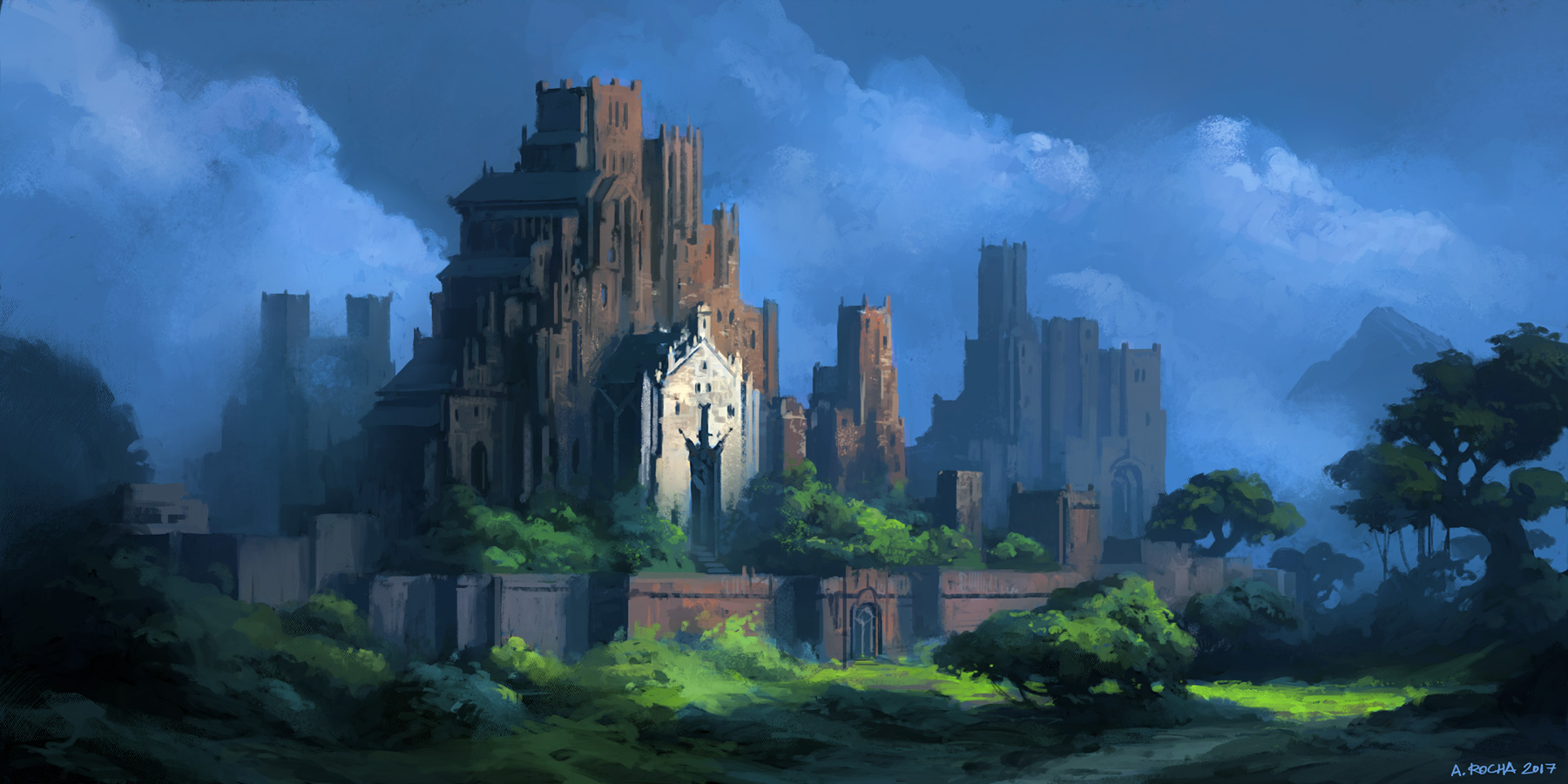
art by andreasrocha, source

Official Version

Koriszegy Keep is only one of two ruins to be described in Gaz1: The Grand Duchy of Karameikos, making it one of the few official dungeons to exist in the Grand Duchy. In the Gazetteer it gets a short write-up.
"Koriszegy Keep: One of the famous haunted places of Karameikos is Koriszegy Keep, which was once the seat of power of the Traladaran Koriszegy family. As legend has it, some 200 years ago a great calamity befell the Koriszegys, breaking down their walls and destroying their family, and people who wander too close to the ruin often disappear. The legend is true; those centuries ago, the head of the family tried to forge a pact with evil forces and, for his trouble, was changed into a vampire - but cursed so that he could never leave his own castle for more than a day."
 The gazetteer goes on to detail 8 areas on two simple maps. 

This Blog's Version

In my version of Mystara I will keep the background but expand the site so that it becomes a proper dungeon. 
The vampire is Baron Balthazo Koriszegy, and as the gazetteer says, he tried to make a pact with dark forces of Chaos. In his arrogance he demanded more power than would be offered to chaos warriors, chaos clerics or twisted summoners. He thought that as the ruler of south-western Traldar he should be entitled to becoming a Chaos Prince. The powers of Chaos had a different opinion. 

As he was transformed into a vampire, a massive lightning storm erupted over the castle, shattering walls, turrets and windows. In his rage and frustration of what was happening to him the newly vampiric Balthazo Koriszegy went on a bloodthirsty rampage through the castle, killing all those who did not flee. He slew his own wife and eldest son, while his two young daughters escaped with their nanny to the relative safety of Luln. It is believed they renounced the Koriszegy name and thus the lineage ended. 

In matters of architecture Koriszegy Keep has been left in ruins. As well as the main keep there is an outer wall with various towers and turrets and a gatehouse, all of which are in serious disrepair. Although some of them still have roofs, Balthazo does not consider these outer buildings sufficient shelter from sunlight, and only visits them at night. The main keep is still intact below the uppermost floor and sunlight cannot reach the first three storeys. Beneath the keep there are the dungeons, excavated by animated undead under the direction of the Baron after his transformation. 

Baron Balthazo Koriszegy is quite mad and perpetually dreams of conqering southern Karameikos, which he sees as reclaiming his original lands and maybe adding some more by right of conquest. Those who dispute his claim or point out that he is trapped in his castle will provoke a murderous rage. At other times he is consumed by a deep melancholy and self-loathing for what he did to his loved ones and his current predicament. He wanders the dungeons and at night the parapets of the keep muttering and berating himself. His attitude towards visitors is normally paranoid defensiveness combined with a thirst for blood - he generally attacks first and asks questions (usually to himself) later. There are occasions when he actually wants to talk to mortals, usually for information or some transaction: companionship no longer interests him. During such meetings he can maintain a veneer of aristocratic respectability and decorum for a while but he finds this difficult to maintain as the night draws on. More than two hours in the company of mortals and he starts twitching and salivating, trying to keep his savage impulses under control. 

However, as the gazetteer mentions he cannot be away from Koriszegy Keep when dawn comes - he must sleep in his own home during the day. It is a compulsion similar to a Geas spell that he must obey and if he is visiting a nearby town during the night, he will always depart with enough time to reach his home before dawn. Luln, Radlebb Keep and Fort Doom are all within a night's travel but Specularum and Threshold are safe from his visits. He tends to feed once per month, and may either visit one of the nearby settlements, or snatch travelling victims off the road. His resting place within the keep is the family crypt where his main coffin is inside a stone sarcophagus with a stone lid that requires a combined strength of 19 to move. There is also a small hole in the side of the sarcophagus and the baron can get through this either in bat form or in gaseous form. He also has back-up coffins stashed around the keep and dungeon in case the crypt is discovered by his enemies. 

He has minions, both living and undead. He has not yet created any other vampires but his family slain during his initial rampage have become wraiths, haunting the keep and seeking targets to vent their pain and despair. Many of his faithful servants have become ghouls while his guards have become wights. Nobody is sure why he has not created new vampires from his victims. Perhaps he does not want any rivals, only lesser undead as servants, or maybe there is an aspect of the curse that means unlike normal vampires he cannot infect others with the curse of vampirism.  He has used his necromantic magic to animate various skeletons and zombies including some types not seen before.  

He has a few human followers who act as his agents and spies in living settlements such as Luln and Radlebb Keep who report to him, though only briefly (they know he starts getting hungry after more than an hour in the presence of fresh blood). He also has a loose alliance with a band of werewolves that live in the local woods. Their ability to appear human during the day makes them useful for infiltrating villages and towns. However, they can be rebellious and argumentative, so the Baron keeps them at arm's length. They are also aware that Baron Koriszegy is not entirely sane, and although they go along with his fantasies of conquest, they are well aware this will not actually happen.

In terms of combat stats there are several options:

  • The Basic D&D option which has just one stat block for vampires, and Baron Koriszegy conforms to the statistics for a standard vampire. 
    • AC 2, HD 9**, Mv 120'/Fly 180', Att 1 touch  + special, Damage 1d10+ energy drain, Save F9, Ml 11, Align C, XP 2300, spec abil: 
    • polymorph to bat or wolf at will, 
    • gaseous form, 
    • attack drains 2 levels per hit, 
    • immune to non-magical weapons, 
    • Charm Person as gaze attack at -2 to save vs spells
    • Summon Bats, Giant Bats, Rats, Giant Rats, Wolves & Dire Wolves (each once per day) 
    • regenerate 3hp/rnd, forced into gaseous form at 0 hp
    • undead immunities (immune to mind-affecting spells, poison, disease & death magic)
  • The AD&D option which allows certain vampires to retain spellcasting abilities they had in life. If this is the case, Baron Koriszegy has the spells of a 10th level magic user, but otherwise uses the stats given above.
  • The Van Richten option, which draws from the 2nd Edition AD&D book Van Richten's Guide to Vampires where the older the vampire is, the more powerful it gets. At over 200 years old, Baron Koriszegy would be considered to be in the Old category. Stats would be AC 2, HD 10+2,  Mv 150'/fly 180', Att 1 touch  + special, Damage 1d10+ energy drain, Save F10, Ml 11, Align C, XP 2300, +2 or better magic weapons to hit, special abilities as above. He also casts spells as a 10th level magic user. 
art by Bill Willingham


Monday, 2 May 2022

My ideas about Norwold

Norwold was introduced in CM1: Test of the Warlords, the first adventure module written with the Companion Rules in mind. Being further north than the "classic" Known World, it has a cooler, subarctic climate and borders on true arctic wastelands to the north. Since one important aspect introduced in the Companion Rules was PCs building and managing dominions, there was a certain expectation (and indeed encouragement) that PCs should try to set up their own strongholds and fiefdoms in this region. This was complicated by the two great empires of Mystara, Thyatis and Alphatia, who both wanted to rule this region and its resources. PCs could ally themselves and their dominions to one of these great nations. 

Illustration by Clyde Caldwell, source

My ideas about Norwold

As my basic map, I am starting with this magnificent piece of cartography by Robin (6inchnails on Deviant Art) though I expect I will add my own stuff to it. 

Map by Robin/6inchnails: source

The wildlife in this region is dominated by iconic creatures of the Ice Ages, including woolly mammoths, woolly rhinos, sabertooth tigers, cave bears and dire wolves. Mammoth steppe and tundra make up wide stretches of the wilderness. As this is D&D, there are quite a few magical monsters as well as natural animals, including white dragons, frost giants, winter wolves and arctic variants of established monsters including the all-white arctic griffon and the dread arctic chimera (with the heads of a white dragon, musk ox and polar bear instead of the usual red dragon, lion and goat). Random wilderness encounters are found in this post.

So my ideas include this region being not just for characters of Companion level (15th-25th)  but also Basic and Expert (1st-14th). I reckon if the DM is sensible about what encounters the PCs run into, the Norwold region could be the setting for an entire campaign. There are plenty of humanoid and human tribes to keep low level characters occupied, including familiar goblins, ogres, bugbears and the less common quaggoths and taer. Neanderthals have made parts of Norwold their hunting territory. 

The competition between the Thyatians and the Alphatians brings its own adventures, particularly if the PCs take sides, even if they don't yet have their own dominions or strongholds. Direct warfare, trade disputes, diplomacy towards native allies and espionage all benefit from the skills that adventurers can bring. The Alphatians are primarily based in Alpha, on a peninsula jutting into the Great Bay of Norwold. Oceansend used to be a Thyatian possession but is now independent, with only cultural ties to Thyatis. Landfall has experienced both Thyatian and Alphatian influence but is now in the grip of the criminal gangs. 

The Heldannic Knights are another national faction that can make its presence felt in the south of Norwold. Aggressive, territorial and capable of both great nobility and terrible brutality, I envision them as similar to the Teutonic Knights of northeastern medieval Europe, launching their own crusades against what they consider the inferior pagan tribes. Although they might be cautious where the two great empires of Alphatia and Thyatis are concerned, they are certainly not cowed into submission.  

Although in the normal course of wilderness adventures the weather is usually not serious enough to count as a threat, in Norwold the weather and seasons can be deadly, particularly winter and blizzards. I have included some of these in my random encounters for Norwold. Rules for frostbite, hypothermia and similar cold-weather effects should be considered by the DM and any sensible PC. Starvation and the ability to start camp fires become serious issues. Norwold is no place for the weak or unprepared. 

Finally there are the Arvorians, a truly ancient race not that different from elves. Their civilization was  contemporary of ancient Blackmoor. But while Blackmoor dabbled with science, the Arvorians turned to darker, more malevolent powers from other planes of existence. If the Blackmoor civilization was D&D meets Star Trek, the Arvorians were D&D meets Call of Cthulhu. And despite the cataclysm that destroyed Blackmoor and changed the globe, they have not entirely died out. Deep beneath their shattered ruins scattered across the north of Norwold there are surviving Arvorians and they still follow their evil and chaotic powers of darkness. Even worse, they seek to summon and unleash their alien patrons on an unsuspecting Mystara. The Arvorians have also lured various chaotic humans including Chaos cultists into their plans, with the promise of destroying the forces of Law and Order. Just as chaotic cultists can use orcs and goblins as pawns to further their games, so to the Arvorians manipulate and encourage the human forces of Chaos to act on their behalf, and thus on behalf of powerful beings that seek to inflict damnation and destruction across the whole of Mystara. 

Tuesday, 29 March 2022

Experience, Motivation and Murder-Hobos

Art by Dave Trampier, source

Allow me to deviate from my usual additions and suggestions for Mystara. I feel the need to write down some ideas that have been fermenting in my head. Note that these ideas are not entirely original to me - they have been inspired (and maybe explained better) by other, more eloquent bloggers. 

So what motivates adventurers? Why do they bother getting out of bed in the morning and heading to the dungeon for a day of violence and near-death experiences? Generally this is a matter of acquiring more power, principally in levels of experience. To gain levels as a character you need to gain experience points. How do you do that? 

According the the B/X rules there are 2 main sources of XP: monsters and treasure. Treasure is expected to make up the bulk of XP awards, and I have created adventures on this blog (both the more recent Scenarios and also the older Dungeons of the Month) with a ratio of 1 monster XP : 3 treasure XP. This may seem stingy, but DMs using my adventures are always welcome to increase the treasure amounts as they see fit. 

3E and 5E D&D don't offer XP for finding treasure. In both games XP is expected to come from a combination of defeating monsters and completing story goals. 

The idea of quest or story-based XP tentatively emerged in later 1st Edition AD&D material and was formalised in 2nd Edition AD&D. This started out as XP for rescuing prisoners as if they had been defeated by the PCs (so a party of PCs would get more XP for rescuing a high level NPC than a 0-level peasant). It has now become a matter of "Award the PCs 1000xp each if they return the stolen crown to the king". 

The 3E DMG suggests awarding XP for successfully resolving non-combat encounters, such as evading or neutralising traps, solving tricks & puzzles, and successfully negotiating with NPCs. In B/X the assumption is that these are not goals in themselves but merely obstacles (sometimes metaphorical, sometimes very physical) in the the path to gaining treasure. Successfully getting through a trap-based encounter means that the PCs are another step closer to their real goal - treasure and the XP that comes with it. This shows to me that B/X rewards are more about the end goal rather than how the PCs get there.  

XP can also be awarded for things like good roleplaying, though this is associated with later editions. Although not stated in the B/X rules, these are up to individual DMs. Although not suggested in D&D, some games (particularly MMORPGs) reward PCs with XP for exploring their world and visiting regions for the first time. 

1st Edition AD&D also had the idea of gaining XP for finding magic items. 2nd Edition AD&D changed this to gaining XP for creating magic items. 3rd Edition D&D completely flipped this around with requiring XP to be spent to create magic items, but also had a thriving magic item economy where PCs could often buy the weapons or armour they could afford  - an alternative reason for gathering lots of money. 

In my games magic items neither give nor require XP. Magic items can be seen as a form of power that is not linked to XP or levels. Interestingly, unlike MMORPGs, magic items in D&D generally do not have character level requirements (though some do have class requirements). A 0-level normal human can use many magic items if they know how to wield them. Acquiring magic items can be a powerful motive in itself. Although many items are distributed as part of treasure hoards along with coins, gems and the like, it is possible that a character will set out on an adventure with the goal of acquiring a famous magic item for their own personal use. S2: White Plume Mountain is a classic example of this. 

Here's something I was vaguely aware of but it took other bloggers to clarify  it. The behaviour of PCs is heavily influenced by how XP is awarded. They will generally behave in a way that gets the most XP according to their assessment of risk vs reward. 

If most of their XP comes from treasure then they will become avaricious treasure hunters, looting tombs, dragon hoards, and possibly merchant caravans and town banks. The DM may wish to adjudicate what sort of treasure gives XP and whether robbing peasants of their copper coins will help PCs gain levels. 

Although not part of the B/X rules, some groups have house rules where PCs can convert gold into XP only if it is spent on training - usually with a willing NPC of at least 2 levels higher and the same character class as the PC. The duration is typically 1 week per PC level. Although I personally like this idea (it makes becoming better at fighting, casting spells or turning undead more plausible than just looting a dragons' hoard and hey presto the wizard can now cast more spells), I don't expect other groups to use it. 

There are other reasons for gathering loot besides XP - you can buy stuff with it. Purely B/X campaigns will find that once the PCs have a ship, horses, wagons and the like they start to run out of useful things in the equipment lists to spend money on. But beyond the B/X rules there are 2 major expenses - firstly in the Companion Rules there are details about being granted land and building one's own stronghold. Creating and maintaining a castle or temple with all its soldiers, hirelings and servants will be expensive. Secondly as alluded to above in 3E D&D it is possible to buy magic items if the right marketplace can be found. Both of these (strongholds and magic items) are reasons to get as much loot as possible from dungeons and monster lairs. Forward-looking PCs may well start saving for these quite early on in their careers. 

If they get most of their XP from killing monsters, then that is what they will seek out. This seems to be the expected norm in 3E and 5E.  Note that rules in different editions say that XP is awarded for defeating monsters, not necessarily slaying them. This means capturing and subduing generally counts, while avoiding or sneaking past is up to DM discretion (personally I don't think that counts as "defeating" because the monster is still a threat if encountered again). 

It helps here if the DM clarifies whether 0-level normal humans count as monsters (they may be only 5xp each but killing a whole village could be worth 1000xp if the DM allows it). DMs are well within their authority to say that killing friendly folk and livestock does not give any XP awards. This reduces the likelihood of the infamous murder-hobos running around the fantasy countryside behaving worse than bandits or orcs. If the PCs still persist with this then the players concerned may be less interested in acquiring levels & XP and more involved in a deranged power fantasy. I've seen it happen - It's not pretty.

If they get most of their XP from quests and heroic achievements then that is what they will do (though perhaps sticking to the letter rather than the spirit of the completion). In 3E it is suggested that story-based XP awards do not exceed XP for defeating monsters, while 5E seems much more vague. It does remind me of MMORPGs like World of Warcraft where characters keep picking up and completing quests and have a list of currently active quests - to-do lists with XP rewards every time one is ticked off. Personally I do not have any problems with XP awards for completing quests as long as DMs are sensible about it. I think the one thing I do raise my eyebrow at is the idea of "once the party reaches this stage of the story/campaign, they all automatically go up 1 level". It just seems lazy, both in terms of adventure design (the next chapter in the mega-adventure is for the next level so lets just increase everyone up 1 level so they can get on with it) and also the gaming experience, feeling entitled to gain a level without regards to earning XP. If I was DMing that sort of adventure, I would not automatically award levels, but I would provide side quests and mini-dungeons as opportunities to earn the required XP so that they have properly gained sufficient XP and therefore levels to take on the next part of the campaign.    

XP for role-playing can result in either interesting or annoying attempts to play their characters outside of combat. Sometimes it is entertaining, other times horribly forced. 

I was thinking about motivations for protagonists in the stories that inspired D&D. Bilbo Baggins, Conan the Barbarian, Cugel the Clever, Fafhrd and the Gray Mouser and many more heroes of Appendix N were all mostly motivated by money and treasure, and so this is what the creators of D&D (particularly Gary Gygax) expected. 

But others had other goals. Frodo Baggins setting off on his epic quest to destroy the One Ring was motivated by trying to save his world. Elric of Melnibone may have enjoyed treasure but was caught up in the wars between Law and Chaos. Drizzt Do'Urden (once he reached the surface world) was often helping his friends around Icewind Dale. The Companions of the Lance were engaged in epic quests to save the world of Krynn from the evil Dragon Armies. Turjan the Magician was interested in knowledge, particularly of arcane matters. 

Finally I think alignment should play a part here. I'm not sure which should come first when creating a character, alignment or motivation but I certainly think they inform each other. In the 3-alignment system of B/X D&D, I can well imagine lawful characters being more willing to go on epic quests to save the kingdom, while neutral characters are more interested in personal power and wealth. Chaotic characters are usually similar to neutral ones in motivation but are more likely to become the infamous murder-hobos that are the worst sort of chaotic characters - they have far less restraint or scruples as to how they acquire money and power. 

So what is the right way of doing this? Honestly my opinion is whatever works for your group. Different players and DMs will have different ideas and hopefully each group will find a combination of the above that they are comfortable with. I'm not going to lay down any rules or strong opinions (apart from automatically gaining levels....).  Although by the book B/X offers only treasure and monster XP, D&D is a game that is wide open to modifications and additions. 

Friday, 11 July 2014

The Choice - 5E or B/X?

Although my blogging has not been as productive recently as it used to be when I first started, I still feel like keeping it going. Now that 5E has come out, I'm faced with a choice. Do I stick with B/X and it's OSR progeny, Labyrinth Lord, or do I change to 5E?

The thoughts that spring to mind include:
For:
  • From what I've seen of 5E, it looks like quite a good system, not too far removed from previous editions. I feel I could work with it. 
  • Increased viewing figures for the blog. This is quite shallow, and I know it should not be important, but I cannot completely ignore it. 
  • There is the feeling of joining in with a whole lot of people in a common pastime. When a whole lot of people are enthusiastic about something, its easier to be enthusiastic about it oneself.  
  • In a previous post I mentioned having a simple core, with many options. I can treat 5E Basic Rules as the core, from which new options can spring. 
  • 5E Basic rules are free for download. I could easily stick to those and ignore the expensive hardbacks, as I suspect a few players and DMs will do. 

Against:

  • The B/X and Labyrinth Lord niche is quite small. As such I felt quite comfortable making suggestions and putting ideas out there. The rule of thumb is that the smaller the group, the less likely there will be some psycho who gets offended or gets mean about my efforts. 5E could involve thousands of players and DMs, and quite honestly putting ideas out there seems more intimidating. 
  • 5E is a new system which I am not familiar with. Yes there are some similarities and commonalities with other editions, but I'm still cautious and uncertain about some of the rules. I've had B/X for over 30 years. Maybe I should stick with what I know. Being told I've got the rules wrong can make me feel a fool, and put a dampener on any enthusiasm.
  • 5E is still in the process of being released, both in terms of the 5E Basic rules and the full rulebooks (PHB, DMG & MM). Should I be writing for something when my ideas could be rendered irrelevant or redundant because of official releases I am not yet aware of?
  • Although WotC is unlikely to get its legal knickers in a twist over blogs that do not make money, nonetheless, with Labyrinth Lord and 3.X I felt protected by the OGL. 5E does not seem to have that sort of license. 
  • There may be an ongoing interest in B/X and Labyrinth Lord regardless of 5E. I could carry on providing ideas for them. 
  • There are enough differences between 5E and B/X that I would feel the need to start a new world. Kaelaross is heavily dependent on the three alignment system, not nine, and assumes that the forces of Chaos are evil, and the forces of Law are good. 

Then again:

  • Maybe I am taking myself too seriously. This is a hobby, not a job. I am not getting paid for this, nor does anyone's lives or livelihoods depend on my blog. 
  • Starting a new world could be quite entertaining. 
  • The rules are not as important as having cool ideas. 
  • A lot of the rules between the editions are common enough that anything written for B/X can be converted (with a bit of thought) to 5E and vice versa. 
  • This is my blog. As I mentioned before, I am the primary audience. So what do I want to do? What do I think is fun?
  • With the emphasis away from strict rules and more towards optional rules, I may not need to stick to official 5E, and could do a sort of 5E/B/X mash-up.


Friday, 4 July 2014

My first impressions of 5E Basic Rules

I've just downloaded the 5E Basic rules here.
What I've seen looks pretty good. And it's free, at least the Basic version is.
Some observations that spring to mind:

  • Ability scores get bonuses like 3E. However, the default way of generating them is first choose race and class, then roll 6 stats (4d6 and drop lowest) and assign to whichever ability scores you wish.  
  • Demihumans all get +2 to one stat (Subraces get an extra +1 or +2 to another stat). Humans, however, get +1 to each stat. Is this balanced? Purely in terms of stats, no, but I suspect that other demihuman abilities (such as infravision) do keep things balanced. 
  • Quite a bit more flavour and fluff than I was expecting. This is not an SRD collection of rules but a proper book for DMs and players to learn about the game. 
  • There are many references to the Forgotten Realms, and a few to Greyhawk, Dragonlance and other campaign settings. 
  • Clerics are modified - no longer restricted to blunt weapons, they now use any simple weapon. Interestingly they don't use heavy armour, only light or medium armour. 
  • Only one domain is given for clerics, the Life Domain. Incidentally this domain allows clerics to use heavy armour. 
  • Fighters get Martial Archetypes, though only one is given, the Champion. 
  • Rogues also get Roguish Archetypes, and the only one given in the Basic rules is the Thief. 
  • Wizards get Arcane Traditions (perhaps similar to 2E schools). The one given in the Basic rules is Evocation.
  • The Nine Alignments are back! Thank goodness. I know not everyone likes or uses alignments, but what 4E did just seemed so wrong. 
  • Backgrounds include Acolyte, Criminal, Folk Hero, Sage & Soldier. These all have a big impact on equipment, skills and other aspects. 
  • Strength requirements for heavy armour? Interesting. 
  • Armour Class is ascending. 
  • Premade equipment packs allow adventurers to start quicker. 
  • Trinkets are a whimsical addition to equipment
  • Feats are mentioned as being in the PHB but are not part of the Basic rules. 
  • Multiclassing is sort of discussed, but certain details are left to the PHB. Enterprising DMs could probably house-rule it without the PHB. 
  • Proficiency Bonus becomes quite important. Still haven't worked out exactly how. They seem to crop up in all sorts of situations, particularly in skills and combat. 
  • Ability Scores get discussed in chapter 7, after race, class, alignment and equipment. Interesting choice. 
  • Saving throws get a short section, with no examples given. 
  • Rounds are 6 seconds long. 
  • Spell lists are reduced in size, as befits a Basic Rules set. I'm sure more spells will appear in the PHB. 
  • There is a blank 2-sided character sheet and an extra sheet for spells at the end.  


So for me this raises the question - do I stick with B/X Classic D&D, or make the jump to 5E ? I have not decided yet, but a new edition would benefit from a new campaign setting.

Wednesday, 28 May 2014

Borrowing from Magic the Gathering

I'll be honest here: I've always liked MTG's looks, flavour and huge range but I've never really got into playing it. I bought several packs both when it first came out and as various expansions were released, but never got round to finding other people to play it with. 
But the pictures were cool. 
This article http://www.examiner.com/article/why-isn-t-there-a-magic-the-gathering-dungeons-dragons-crossover explains why an official M:TG /D&D crossover did not happen, but there are plenty of opportunities for unofficial conversions. 
http://rpg.stackexchange.com/questions/23215/magic-the-gathering-rpg is quite good as well if you look further down the page to the answer that quotes Ryan Dancy. 

There are a lot of cool ideas in M:TG, much of which is inspired by the artwork. Most of those ideas are monsters of one sort or another. For example:


Serpent Warrior

No Enc:     1d8
Alignment:     Chaotic
Movement:     180’
Armour Class:     4
Hit Dice:     6*
Attacks     2 claws/1 bite
Damage     1d4/1d4/1d8+poison
Save:     F6
Morale:     10
TT/Hoard:    K/X
Size:     Medium
Type:     Humanoid
Intelligence:     11-12
XP:     350

These creatures are found in swamps and jungles, particularly around desolate ruins of fallen civilisations, and are ferocious enemies of mankind. Sages speculate they were created by an elder race of serpent-creatures called the Yuan-ti. 
In combat they are fast and deadly, preferring teeth and claws to artificial weapons. They can create darkness in 10’ radius around their bodies once per day for 10 rounds and they will use this to surprise opponents. If they successfully bite an opponent, they inject a venom - the target must save vs poison or suffer 1d4 damage per hour for a whole day (24 hours). Serpent warriors are willing to cooperate with other evil reptiles and sometimes have lizardmen and troglodytes as slaves or foot-soldiers. 

Bogardan Firefiend

No Enc: 1d4

Alignment:
Chaotic
Movement: 180’
Armour Class: 5
Hit Dice: 5*
Attacks 2 hoofs/1 gore
Damage 1d6/1d6/2d4
Save: F5
Morale: 11
Hoard Class: Nil
Size: Large
Type: Outsider
Intelligence: 6 (low)
XP: 350

These weird and terrible creatures are a fusion of elemental fire and the planes of Chaos, and can be found in either place. They can also be found in volcanic areas on the Material Plane, including lava caverns of the Underworld. They are occasionally found alongside fire giants, efreet and red dragons.
Firefiends have vents on their back that unleash red-hot gasses once an hour and they may, in addition to attacking normally, unleash a burst of flames and hot gases that cause 2d6 fire damage to all within 10’ of the creature and 1d6 to anyone from 10’ to 20’ of the creature.
Furthermore, on dying, a bogardan Firefiend unleashes one last burst of flame that does 3d6 to all within 10' and 1d6 to anyone from 10' to 20' of the firefiend.