Showing posts with label Map. Show all posts

Saturday, 14 March 2026

A Journey from Karameikos to Ylaruam

Cartography by Mark Howard (source)


Revisiting the Rules for Overland Travel

It is possible to hand-wave journeys from one nation to another, and DMs are entitled to do so. One session the PCs are finishing their adventures around Castellan Keep and the Caves of Chaos, and the next session they have arrived at Cinsa-Men-Noo.  However, in many epic quests in legend, film and literature the journey is the bulk of the adventure. The Hobbit, The Fellowship of the Ring, the Odyssey, King Solomon’s Mines, Apocalypse Now and others have travel to a destination as most of the story. These are good for world-building and verisimilitude - making the campaign world seem more real, with geography, inhabitants and events going on around the PCs.  

Traditionally the idea is that Basic adventures (levels 1-3) happen around the dungeon, while Expert adventures (levels 4-13) involve venturing out into the wilderness. The X-series of modules (X1: The Isle of Dread etc) often have large sections of wilderness with dungeons often taking a secondary role. And so wilderness travel is principally addressed in the Expert rulebook. 

If the PCs stick to roads, I don’t bother with chances of getting lost and journey time is improved, as well as the reduced likelihood of hostile encounters.  If they decide to go off the beaten path , then things become more difficult and risky, and the rules for checking if the PCs get lost will apply. 

This particular journey from Karameikos to Ylaruam is more of an example than a concrete event that must happen. It is my way of considering how such expeditions might take place and how the DM can approach them. 

Motive & Hooks

The meta-reason for getting PCs from Karameikos is because I have envisioned Karameikos hosting low-level, Basic adventures - once the PCs reach 4th level or more they can venture further afield, either south into the Sea of Dread (which inevitably involves ship journeys) or staying on land they can travel to Darokin or Ylaruam. If the DM is happy with a true sandbox campaign, the PCs can venture anywhere they want, if they have the means and the motivation, but as a DM I find it better to prepare adventures in geographical clusters (e.g. northern Ylaruam or north coast of Norwold’s Great Bay) and to guide PCs towards that area if not towards a specific adventure. But of course trying to explain this to players might break the mood - why would their PCs, brave adventures in search of fame and fortune, want to travel to a far-off land like the Emirates of Ylaruam?  

  • Treasure: Gnarl Vorggonson from far-off Ostland talks to the PCs in a tavern about the Emirates of Ylaruam. There are great pyramidal tombs filled with the burial treasures of the ancients. Whatever the risks of whatever guards it, the rewards are certainly worth while. The following morning Gnarl is found dead with a Ylari dagger in his back. The Holy Killers of the Eternal Secret have struck again. 
  • Employment: A new notice is pinned on a wall of the inn at Castellan Keep: “ Caravan Guards wanted for journey northwards. Some combat experience preferable, payment is reasonable. See Beldorphix the Dwarf Merchant at the Griffon Shield Inn in Penhaligon”. 
  • Magic Items: Zashell of the Magician’s Guild in Specularum has come across old papyrus scrolls inscribed with spells not seen in centuries. After investigating their provenance, she is sure there are more such scrolls in the ancient ruins of northern Ylaruam and she is willing to pay well for them if brought to her intact.   
  • Academic Study: Ganahellion, an elf associated with Specularum College of Sages, wants to investigate the stories of ancient civilizations that once dominated northern Ylaruam. But he needs bodyguards as he has heard the land can be quite dangerous. 
  • Entrepreneurial Trade: The garrison at Duke’s Road Keep has run out of oil for both lighting and for pouring on besiegers (after a recent and brutal battle). Anyone who brings five large barrels from Tel Al Kebir will be well paid. 
  • Religion and Philosophy: Sister Alpadina, a junior cleric in the Order of the Griffon, has been asked by her superiors in Kelvin to see if there are suitable allies against the forces of Chaos in other lands. The Order has heard of the Eternal Truth and its followers but don’t know much about it. They know even less about the mysterious dervishes that inhabit the deserts of Ylaruam but Sister Alpadina wants to investigate, though she cannot do it alone. 
  • Pursuit of Justice: The chaotic priest who has infiltrated Castellan Keep has fled after adventurers find evidence implicating him on his colleague in the Caves of Chaos. Will he take a riskier route into the wilderness or will he flee by safer though more circuitous roads and trails? PCs who pursue him may need to investigate and ask questions at the various settlements he might have passed through. 

Route and Distances

Here the hex maps I have used in these blog posts become really useful. The one at the top of this post was chosen because it shows the entirety of the journey as I expect it, with Karameikos in the southwest quarter and the Emirates of Ylaruam in the northeast quarter, with Cinsa-Men-Noo near the northern edge of the map. At 8 miles per hex it is simply a matter of counting the number of hexes between points and multiplying by 8 to get the distance in miles. It could be argued that the town, castle or village featured in a hex actually only takes up a small proportion of what is inside a hex (an 8 mile hex is actually 55 square miles in area) and thus distance may not be an exact multiple of 8, but I don't feel the need to be that accurate. 

My suggestion for this would be:

  • Penhaligon to Duke's Road Keep: 7 hexes or 56 miles by road
  • Duke's Road Keep to Reedle: 4 hexes or 32 miles by road
  • Reedle to Selenica: 5 hexes or 40 miles by road
  • Selenica to Parsa: 15 hexes or 120 miles by road (Update: I have written about the Selenica Pass here)
  • Parsa to Sulba: 8 hexes or 64 miles by trail
  • Sulba to Ylaruam City: 7 hexes or 56 miles by trail
  • Ylaruam City to Cinsa-Men-Noo: 9 hexes or 72 miles by road
This gives a grand total of 55 hexes or 440 miles if the PCs stick to the main roads and trails. Whether or not the PCs stop at the various locations for rest and resupply is up to them. Generally speaking a travellers' inn, even a poor quality one, is better and safer than camping out on the side of the trail. These locations could well have their own adventures, side treks and NPC schemes going on as the PCs pass through. 

Speed of Travel

This one is explained in the Expert Rulebook and is the group's slowest traveler's movement per turn divided by five as miles per day. This is then further modified by what terrain they are travelling through although trails and roads cancel out any hinderance from terrain. I understand that this results in a daily distance that is only rarely divisible by 8, so it won't be a convenient matter of treating hexes as simple discrete stepping stones - we will be dealing in fractions of hexes (although probably not fractions of miles). 

If the slowest member of the party is travelling at 60ft/turn in a dungeon then they are travelling at 12 miles per day in the wilderness, assuming they are on relatively open and easy terrain, including trails. In fact if on roads the speed is increased by 3/2, so that character can travel at 18 miles per day on road. Such a character could therefore theoretically complete the route given above in  28 days (320 miles by road / 18 miles per day on roads = 17.8) + (120 miles by trail / 12 miles per day = 10 days).  Even a party riding mules will travel twice as fast as that (mules have a base speed of 120ft/turn) and could ideally complete the journey in 14 days. 

Random Encounters

I'm okay with random encounters as long as DM discretion applies both with regard to challenging the party and also whether it makes sense within the campaign world. Also remember that encounters need not be violent - either side may wish to parlay or avoid the other altogether. For some civilised encounters they are simply passing each other on their respective ways. Page X57 in the Cook rules gives guidelines for how often for each type of terrain random encounters are met. The number of checks per day is not entirely clear but I would suggest 2 - one during the day (presumably while travelling) and again at night (while camped) but I understand if the DM would rather keep it to just once per day. 

If the DM has enough time and motivation then custom random encounter tables are a great way to keep PCs on their toes - otherwise the encounter tables in the Expert Rulebook should be fine, especially with a bit of DM discretion. 

Weather

Weather is not actually addressed in the Expert rulebook but DMs can still make rulings about it. Harsh weather including hailstorms, downpours, blizzards and sandstorms can all hamper a party's movement and possibly get them lost if they insist on pushing on along a poorly marked trail. If already off-road, it is very difficult to navigate when the sun and stars are obscured by storm clouds. Actually damaging  weather such as lightning storms, tornadoes and the like should be rare and perhaps not random (i.e. only occuring when the DM needs the PCs to take shelter).  

The seasons will be important as well: winter travel in subarctic climes (such as Norwold) is not to be taken lightly. Similarly in hot deserts (such as Ylaruam and the Great Waste) the summer months can be unbearable.  

Provisions

Assuming the PCs have no magical way of creating food and drink, they will have to bring their own. Travelling along a river at least provides plenty of water and in temperate climes water should not be too scarce but in deserts such as Ylaruam it is a precious commodity. Since the B/X rules do not have classes dedicated to the wilderness, foraging is difficult and by no means reliable (although if using expanded rules, druids and elven rangers could be useful in this regard). Food and water for mounts may be necessary as well, especially in deserts and barren lands. The Rules Cyclopedia does offer guidelines on foraging in p89. 

Interestingly neither Moldvay Basic nor Cook Expert rules give the encumbrance for normal or iron rations. It's all lumped together with other miscellaneous equipment as 80cn/8lb. However, the Rules Cyclopedia is much more specific - a pack of one week's normal rations is 200cn and a week's iron rations are 70cn. A full waterskin (a quart) is 30cn and is probably going to last a day of travelling, two days if strictly rationed. 

As far as B/X rules are concerned there are no specific consequences for hunger, thirst or exhaustion. I would suggest for every 2 days without food or half day without water each PC suffers -1 to Str and Con (temporary - lost point are restored at 2 points per day once the character can eat and drink). If either score drops below 3 they are incapacitated (cannot move or fight and are barely conscious), and if either score drops to 0 they die. Clearly this is not scientifically accurate - most humans cannot survive more than 3 days without water to drink, even less in hot deserts - but I think it is sufficient for my purposes. If you prefer to work out your own rules for hunger and thirst, go for it. There is a brief section on p32 of Gaz2 Emirates of Ylaruam about heat exhaustion, but this is not really the same as dehydration. 

Saturday, 28 February 2026

An Updated Map of Karameikos

Based on original cartography by Thorfinn Tait, source

Since I restarted this blog in 2021, I have added various locations to Mystara. Many of these are in the Grand Duchy of Karameikos. I have also taken the liberty of placing some official adventure modules there as well, sometimes in a different place to where other members of the Mystara community believe they should be. As I have said before, this is my own version of Mystara, and I do not feel obliged to stick to fanon or even canon. Nonetheless, a lot of Karameikos is as described in Gazetteer #1. 

The official modules in Karameikos include

  • B1: In Search of the Unknown - Quasqeton is approximately the same place as indicated in Mentzer Expert set
  • B2: The Keep on the Borderlands- the Caves of Chaos are approximately same place as indicated in Mentzer Expert set, just outside Castellan Keep, I have expanded on Castellan Valley, the surrounding area. 
  • B3: Palace of the Silver Princess [this one could be set in Glantri but I'm keeping it in the official location in Karameikos] is in Haven, north of Rugalov. 
  • B5: Horror on the Hill - now north of Penhaligon along with Guido's Fort
  • B6: The Veiled Society is still set in Specularum
  • B7: Rahasia and Kota-Hutan - now west of Rifllian
  • B9: Castle Caldwell is now near Guido's Fort , just off the Duke's Keep Road 
  • B9: Elwynn's Sanctuary is to the west of Riflian and Verge

I have also created a number of civilised settlements

And here are the dungeons I have added:

Honourable mentions of official locations


Friday, 24 October 2025

A map of Luln


This is my version of a map of Luln. In my first blog post on Luln I borrowed a rather nice one from a fellow fan on the Vaults of Pandius. However, this time I have done my own. 

As can be seen, the original village is surrounded by a stone wall 20ft high and with parapets. Refugees from the Black Eagle Barony have made their homes outside this defensive wall and have greatly expanded it, turning it into a town. However, the refugee homes are vulnerable to attack from the Baron's raiders, Iron Ring slavers and various outlaws and creatures lurking in the hills nearby. 

According to the 8 miles/hex map from Gaz1, Luln is in a range of hills. In my version Luln is in a valley with enough space for some fields (yellow-green diagonal stripes on the map) but also some steep slopes nearby. The contours marked in orange are in increments of 50ft. I have also added the Perchstream, a small stream that runs from north to south past the town, providing fresh water - it is too small to be marked on the hex map. However, there are also 2 wells within the town walls which provide water during an attack, and one just outside the wall to the north.

Thus the inner village is considered the well-to-do area and the outer, newer housing is for those who aren't important or wealthy enough to be kept safe. Although traditionally in the D&D Companion set a household is expected to hold 5 people, here there are about 750 houses for 5000 inhabitants. The refugee quarters are particularly crowded, with several families crammed into the larger houses, perhaps one family per floor. 

There are several farms dotted around the town outside the walls - these are rectangular compounds with several buildings each. They are generally much older than the refugee housing sprung up around them. 

This map includes locations mentioned in both DDA3: The Eye of Traldar and my own post on noteworthy inhabitants of Luln

  • 1a) Specularum Gate
  • 1b) Doom Gate
  • 2) The Garrison. As well as holding weapons and armour for militia, there is also a bell on top of this building that is rung in the event of an emergency.
  • 3) Lady Sascia’s mansion
  • 4) Temple of Karameikos run by Talnek Aganthi & Herlla Millanu
  • 5) The Marketplace
  • 6) The Growling Griffon Tavern (run by Morander)
  • 7) The Duke’s Head Inn run by Althea Tuntanti
  • 8) The Church of Traladara run by Leraith


Saturday, 27 September 2025

The City States of Caloma

This is my start on a setting for 5.5E D&D. I have no idea how far it might go - it might fizzle out in a few posts. But I’d like to give it a go. I am also well aware that it is unlikely that readers of this blog will use what I write wholesale - I fully expect them to pick out the bits they like or think useful and to drop everything else. It is in the world of Xerros that I mentioned in previous posts, focusing on an area called the Caloma City States.

Do I expect to produce adventures like I do for Logos Locations on this blog? Not at the moment. In fact I see this more as a place for populating with NPCs and the potential for adventures rather than fully fleshed-out scenarios. 

A Map of the Caloma City States


All good settings require a map, such as Tolkein’s Middle Earth, R.E. Howard’s Hyborian Age, and so do quite a few bad settings. There is a much larger, world-view map on my computer, split up into squares of about 500 miles per side. This particular one is square I5. The misspelling of “Xeros” is actually the original name of the setting - any time you blog readers see Xeros rather than Xerros you know it’s been sitting on my hard drive for a while. Also this map is a work in progress . I may well add to it as needed. 

Xerros

Xerros is very old. The oldest elvish writings from the Empire of the Silver Sun date back to 500,000 years ago. Even for the elves who can live up to a thousand years this is a near-incomprehensible stretch of time. Humanity is first recorded by elvish scribes, aparently as wild savages barely beyond apemen, about 150,000 years ago. Nearly all areas of land have been inhabited at least once by one species or another. Those who have read Clark Ashton Smith's Zothique series or Jack Vances Dying Earth series will have some comprehension of how old Xerros is. The collapse of the Empire of the Silver Sun 100,000 years ago was the biggest disaster the elves ever endured, yet this is so lost in the ancient past that only the elves remember it, and only then from writings not living memory. Nearly every field, every road, every settlement has clues hinting at the past, from shards of pottery to arrangements of stone that were once building foundations to decayed metal chunks that used to be a tool or weapon. And of course that means lots of dungeons, a few of which have been left by cultures or characters that not even scholars or sages of the current day know of. 

Xerros is also big, about twice the size of Earth, with about half of it land and the other half seas and oceans. The biomes and ecosystems are approximately those of Earth, with colder areas to the north and south and tropical areas around the equator. Caloma is between temperate and subtropical in climate, a bit like Spain, Italy or California. 

Caloma

Caloma used to be a single kingdom that had lasted for over 500 years. But then about 100 years ago the great betrayal happened, a civil war erupted and noblemen and commoners alike took sides. The Royal family of Caloma was wiped out and as different noblemen claimed the throne, central authority failed. A few cities and towns were destroyed, but many more survived mostly intact within a complex web of rivalries, alliances and feudal featly, trying to deal with new-found independence but also a lack of central authority that might protect them from aggressive neighbours. Now the cities and towns have stabilised somewhat and are known as the Caloma City States.  Fifty years ago there was another war, the War Between the Cities when tensions between the newly formed city states erupted. What exists now is a little more stable but there are still disagreements and distrust between the cities. 

Major cities within the Caloma City States include

  • Alcorpolis (population 92,000, including some half-orcs and haflings). Former royal seat of Caloma, home of the Royal Palace. Now run by an oligarchy of generals, civil servants and powerful priests.
  • Belcropolis (population 65,000, including 2000 elves and half elves). Very religious, home of an important cathedral. 
  • Caldaropolis (population 120,000, inc 15,000 tieflings). Wretched hive of scum and villainy ruled by a powerful wizard and backed up by the Bloodied Blades and the Circle of the Purple Sapphire
  • Dalaropolis (population 64,000, inc. 4,000 dwarves, 4000 halflings): Trade-focused hereditary earldom. Survived the civil war relatively undamaged. 
  • Istarias (population 200,000 including numerous minorities). Ruled by hereditary duke. An important sea port at the mouth of the Delgeth river. 
  • Kormarin (population 60,000, including 40,000 dwarves, 10,000 gnomes). Capital of the dwarves and biggest city within Kenshai uplands. 
  • Kristarchis (population 55,000): Ruled by “King of Caloma” whose claim to the throne is at best disputed and often ignored. The ruler has insane ambitions to reconquer the rest of the former kingdom. 
  • Mendopolis (population 85,000 including some dragonborn and tieflings). Military dictatorship. Very anti-crime and disobedience. Those who comply find the city safe and good for business - those who do not comply are swiftly dealt with. 
  • Metrailopolis (population 76,000 inc. 10,000 halflings): Hereditary Earldom, with numerous noble families who sought sanctuary here during the civil war. Very socially stratified, with different rules for commoners vs nobility. 
  • Malkoropolis (population 150,000, including 20,000 dwarves & 12,000 gnomes). Important trade city for dwarves and gnomes of the hills. Well fortified and strong military, governed by a hereditary Earl. 
  • Senthopolis (population 120,000, including numerous minorities). Military government assisted by a thieves guild turned spy network. Slightly more liberal than Venthoris but not much. 
  • Talkiar (population 50,000, inc. 30,000 gnomes, 5,000 dwarves and 2,000 halflings): Primarily gnomish but very diverse population. Focused on industry and trade, nearly a plutarchy.  
  • Venthoris (population 175,000, inc 10,000 tieflings & 5,000 half orcs). Ruled by human-supremacist military junta. Many demihumans have fled to more tolerant cities.

Towns that owe loyalty to the larger cities include

  • Breamshore
  • Calistrant
  • Fort Perilous
  • Isodar
  • Hashettis
  • Marshedge
  • Rilldenthos
  • Sasderin
There are hundreds, possibly thousands, of villages and hamlets of less than 1000 residents that are not marked on the map. These are where the bulk of food is grown, as Caloma is still a relatively fertile land with large stretches of arable lands particularly around the large rivers. 
I think that’s quite enough to be getting on with for the moment although theoretically more could be added later on. 

Sunday, 8 June 2025

Geomorphs part 3

This post is really a follow-on to the first and second posts I have done about geomorphs, and is really to expand the collection of 190ft x 190ft geomorphs that I started with those posts. I have tried to keep these geomorph tiles interesting with pits, statues, pools, secret doors and the like but at the same time I hope they are all still reusable. I'm sure that the more distinctive layouts of some of these will be recognisable to players who encounter the geomorph more than once (such as Geo17 room 1 with its 4 large pools and trap in the centre). I still hope that this will not break the verissimilitude of wandering through the composite dungeon. 


Sunday, 16 March 2025

Some more Geomorphs

In a previous post I talked about geomorphs in general and introduced the start of a set of square 190ft x 190ft geomorph tiles. This post is here to expand that set, to give map-makers using the geomorphs more options. As previously, no room contents are given - these are for the DM to fill in. 


Fitting it all together

As a sort of proof of concept, I have put these geomorphs together with the 1st level central hub for the Temple of Chaos Divided. I managed to fit all but one together on this map, though it has highlighted the need to have a range of different connection combinations (note to self - need more T-junctions and four-way junctions). I also realised it is not a good idea to use the same geomorph twice in one dungeon level because identifying the rooms then becomes more complicated. For example here I can say in Geo07 room 1 there is a water elemental. You can look at the map below, find Geo07 (second one down on the rightmost column) and room 1 within it - this should not be a problem. Had I reused Geo07 on the same map/level then it would be more confusing. 
Another idea (which has probably occurred to others), is that each geomorph tile could contain their own connected group of encounters. Perhaps one particular faction has taken over that geomorph or one powerful NPC or monster there affects the other residents, either dominating them or striking bargains with them or scaring them away. In a previous post on megadungeons I mentioned how I struggle to fill dungeons with over 50 rooms, but smaller dungeons, or dungeon sections, with up to 20 rooms, is a manageable chunk that I can deal with. Geomorphs do that, splitting megadungeons into sections that I can get my head around. 


Although I will leave the geomorphs alone for a while, I could produce more if readers express an interest. 

Thursday, 13 March 2025

The Wilderness around Ozurfold Jarldom

 The village of Whiteheart  in the Soderfjord Jardloms is beset by many threats, so adventurers willing to investigate and confront these are cautiously welcome. 

The village has stretches of wilderness in all directions bar north, along the river towards Soderfjord City. To the south and east are the hills of Gnollheim. To the west is the Great Marsh and to the north away from the river is the forested Whiteheart Valley.

based on cartography first by Thorfinn Tait and also 
Patrick Sullivan, source

Gnoll Tribes of Gnollheim. 

The map of the region here has been changed by Patrick Sullivan to show his gnoll tribes. He has also written a series of posts detailing these gnoll tribes in this thread.  Although I don't necessarily take literally everything he has written, I think this is a good starting point: what he has written about the gnoll tribes can be assumed to be true unless I change it. 

According to the Basic Rules, gnolls in the wilderness are encountered in groups of 3-18. This is what I consider to be a patrol or hunting party. Actual clan lairs usually have 20-80 individuals (2d4 x 10) , and may be based above ground in a crude fort, or underground in caves. Some clans are nomadic, living in tents and wagons. Between half and two thirds of a clan will be warriors capable of joining a hunting party. The fifteen tribes of gnolls shown on the map consist of a network of eight or more of these clans. Each tribe is capable of gathering its clans into a great gnoll horde under the command of the tribal chieftain. The tribal chieftain is an exceptionally tough and cunning gnoll whose lair usually has double the usual gnolls (40-160, 4d4 x10) and is suitably imposing and well-defended. Shamans and mercenary monsters (ogres, trolls and the like) are more likely to be found in the tribal chieftain's stronghold than lesser lairs, as well as giant hyenas (sometimes known as hyaenodons or dire hyenas) that are used as both hunting animals and cavalry mounts by the strongest and bravest gnoll warriors. 

In Gaz7 p31 it mentions two gnoll personalities, Kaberu of the Mountain Wolf Clan and Suant of the Black Cliffs Clan. The Mountain Wolf clan is the most powerful clan of the Rubble Chiefdoms, although not strong enough to unite them to the same level of cohesion as the other fourteen great clans of Gnollheim. The Black Cliffs clan is the largest clan of the Scarp Empire. 

Other Creatures of Gnollheim

The gnolls are certainly the dominant race of the Gnollheim hills though not the only ones. Just to the south the Hardanger mountains are home to a wide range of creatures, some of which will wander down into the hills and then Soderfjord and maybe Ozurfold. These include:

  • Kobolds (who have taken over numerous ruined gnome settlements around both Hardanger and Gnollheim)
  • Trolls (small wandering bands, though in the Hardanger mountains there are larger tribes including troll hags, troll leaders and cave trolls)
  • Hill Giants
  • Stone Giants
  • Griffons (a particular threat to the livestock of human farmers)
  • Wyverns
  • Red Dragons (rare but at least three have made their lairs in the Hardanger mountains)
    • Grugnir is a small male red dragon found close to the coast near the gnollish Scarp Empire with a retinue of kobolds and orcs. He occasionally roams the coast, extorting merchant ships then burning them anyway once he has their treasure.
    • Eldodla is large female red dragon  deep in the Hardanger mountains due south of Whiteheart. Although often asleep, when she wakes she is a menace to the whole region
    • Brinnandeljus is a small female red dragon not far from Castellan and the road south to the Emirates. She has occassionally extorted or simply raided caravans travelling the road. She is served by a band of gnolls formerly of New Graakhalia.
  • Dwarves, both normal (hill) dwarves and molder dwarves (modrigswerg). The former are gruff and cautious (often settlers or prospectors) but not hostile. The Modrigswerg are much rarer (and usually below ground) but also a lot more tricky and unpredictable, with a tendency towards treachery. 
Normal animals in the Gnollheim hills include:
  • Wild Boar
  • Brown Bear
  • Cave Bear
  • Wolf
  • Dire Wolf
  • Mountain Lion
  • Giant Elk
  • Giant Boar
  • Great Ram
  • Giant Hawk
  • Herd Animal (1HD wild goats, 2HD hill ibexes)
  • Driver Ant
  • Killer Bee


The Great Marsh

This huge stretch of wetlands is populated by both wildlife and weird monsters. There are some human settlements but they tend to be on the northern and eastern edges, close to established towns and Jarldoms. 

Wildlife include 

  • Giant Toads
  • Giant Frogs (borrowed from AD&D)
  • Giant Hawks
  • Wild Boar
  • Black Bear
  • Auroch
  • Herd Animal (2HD Marsh Deer, 4HD Moose)
  • Giant Otter (stats as giant weasel but without blood-sucking)
  • Giant Catfish
  • Pit Vipers (known here as Water Vipers, can swim well)
  • Giant robber fly
  • Giant swamp termite
Monsters of the Great Marsh include:
  • Bullywugs
  • Eblis (Heron-men, avian humanoids with long legs and magical powers)
  • Lizardmen (possibly degenerate descendents of the Mogreth civilization)
  • Black Dragons, particularly Frätandedregla, large male black dragon, self-styled King of the Swamp. Smaller black dragons in the marsh are believed to be his offspring.
  • Nekrozon/Catoblepas - only one of these deadly creatures is thought to dwell here. 
  • Kobolds - a few tribes have become competent boaters, rowing and punting rafts and canoes around the swamp. 
  • Trolls: at least four large tribes of trolls, each with a troll leader and a troll hag, have their lairs in the marsh. There are of course smaller bands of normal trolls. 
  • Various fel sorcerers and witches have found dark sanctuary within the Great Marsh, particularly Carrah the Witch-Queen of Hel (Gaz7 p22) and Shamir Al'Menoo (MU15, human male, chaotic, formerly of Cinsa-Men-Noo but expelled for studying dark magic) both of whom are known to practice necromancy and have undead servants. 
  • Some bands of brigands have established bases here from which to raid the farms and villages of southern Soderfjord, or sometimes waylay travellers on the Marsh Road. At least one band of brigands is under the leadership of a Chaos Warrior. 

The Forests of Soderfjord

Although claimed by various Jarls, and therefore borderlands rather than true wilderness, the forests that cover much of the Soderfjord Jarldoms are by no means safe or civilized. There are plenty of fey creatures in these woods and village folk sometimes tell of being enchanted or tricked by magical beings. Lycanthropy is also a significant problem, though the conflict between the werebears (who are usually not violent to humans) and the werewolves seem to mitigate this. 

Natural animals include:

  • Hawks & Giant Hawks
  • Herd Animals (1HD fallow deer, 2HD red deer, 4HD Moose)
  • Wild Boar
  • Giant Elk
  • Giant Boar
  • Auroch
  • Wolf
  • Dire Wolf
  • Brown Bear
  • Giant Weasel
  • Giant Ferret
Monsters include:
  • Sprites
  • Pixies
  • Dryads
  • Elves (though often more mischievous than benevolent)
  • Treants
  • Werewolf
  • Werebear
  • Wereboar
  • Gnolls, often infiltrating from Gnollheim as small raiding parties
  • Trolls maurauding from out of the Hardanger Mountains or the Great Marsh
  • Kobolds sometimes establish hidden lairs under the forest floor. 
  • Human bandits and brigands, sometimes led by worshippers of Chaos. 

Specific Locations

In future posts I intend to add to the map above and add locations of interest and adventure to the areas around Ozurfold and Whiteheart. It should also be noted that although Whiteheart is the largest and primary settlement in Ozurfold, it is by no means the only one, which is something I intend to address later. 

Friday, 17 January 2025

The Temple of Chaos Divided: The Village of Lymewood

8 miles per hex, original cartography by Thorfinn Tait, source

Lymewood is the nearest civilised settlement to the megadungeon known as the Temple of Chaos Divided, and is a village of about 220 inhabitants, nearly all Alphatian human. It is in northern Alphatia, about 23 miles north of the city of Shiell along the main road, and is also a day's travel from the towns of Sanaz and Naughwayne.  The infamous temple is only 6 miles southwest along a rough track and most folks can reach the temple on foot within 2 hours of leaving Lymewood. 

As described in the background to the temple, in AC 760 (1760 Alphatian Reckoning) a vicious army of monsters and chaotic humans emerged from the Temple of Chaos Divided and began laying waste to the surrounding countryside, with Lymewood being its first objective. Fortunately for the inhabitants the local archmage was able to evacuate them to Shiell using a Polymorph Object spell to increase the size of her magic carpet so that all 80 villagers could climb on. The livestock and buildings of Lymewood were mostly destroyed by the horde of Chaos. 

The army of monsters and chaotic humans was defeated at the walls of Shiell and then the counter attack was launched against the temple. Although the surface structures (described in the previous blog post) were cleared out and burnt, the underground dungeons were a different matter. So the authorities of Shiell decided to keep a watch on the Temple of Chaos Divided, and the best place to do that was Lymewood. Assisting with the rebuilding, two new major buildings were added: Lymewood Outpost, for mages who oppose Chaos, and the Lymewood Bastion, where lawful clerics could maintain a strong presence. While this was going on the farmers and other common folk rebuilt their cottages, shops and barns. 


Key to map of Lymewood

1) The Lymewood Bastion. This imposing church is actually built on the ruins of the old Lymewood chapel that was sacked 240 years ago. It is surrounded by a 10ft high stone wall with battlements and has several wooden buildings (including a stable and a privy) within the compound. The clerics are primarily there to keep an eye on the ruins of the temple in case chaotic creatures emerge again. However, Mother-Adjunct Melrania has become the de facto vicar of Lymewood and some of the clerics posted here have joined her in assisting the community. The clerics will provide magical healing and other helpful magic for a moderate fee of 100gp per spell level, unless it is clear the recipients are combatting the forces of Chaos (in which case spells are only half price, 50gp/spell level). The resident clerics include:

  • Mother-Superior Aquillia, 10th level cleric, human female, lawful
  • Mother-Adjunct Melrania, 8th level cleric, human female, lawful
  • Curate Munroth, 5th level cleric, human male, lawful
  • 3 priests (3rd level clerics, all human & lawful)
  • 6 Adepts (2nd level clerics, all human & lawful)
  • 5 Acolytes (1st level clerics, all human & lawful)

2) The Lymewood Outpost. This is a circular tower about 100ft tall in the style of the classic wizard's abode, with four bulging buttresses reaching up to support the tower for the first 30ft. The mages within have been tasked with keeping an eye on the Temple of Chaos Divided, but generally will not go into the dungeon except perhaps to rescue one of their own. They tend to not hold adventurers in high esteem, and often expect them to die in the dungeon, so they require payment up front for any services rendered. The mages include:

  • Mage Trandocious, 16th level magic user, human male, lawful
  • Mage Ballanfest, 13th level magic user, human male, lawful
  • Mage Carrolina, 13th level magic user, human female, neutral
  • Mage Torrdol, 11th level magic user, human male, neutral
  • Junior Mage Parra, 7th level magic user, human female, lawful
  • Junior Mage Morkoth, 7th level magic user, human male, neutral
  • Darathain the Wanderer, 8th level spellsword, elf male, lawful
  • 10 mage neophytes (2nd or 3rd level magic user, all human, either lawful or neutral)

3) The Shady Oak Inn: Run by Dellegin the Opportune (6th level fighter, human male, neutral), a retired adventurer who made enough of a fortune plundering dungeons to know what's involved in dungeon exploration. He is perhaps the most sympathetic in the village to adventurers as long as they are well behaved and pay their bills. 

4) Myrtle's General Store: selling most things on the equipment list as long as it is below 45gp, so no plate mail or transportation. Myrtle (NM, human female, neutral) regularly makes trips into Shiell to pick up more stock so she can advise those looking for more specialised items where to look in the city. 

5) Village Well. This has an unusually deep shaft, about 100ft down to the water. There are several buckets attached to ropes here as well as a winch mechanism. Those who have descended the shaft have found themselves on the surface of a large underground lake that stretches at least across the area covered by the village though because of its highly irregular and convoluted shape it is difficult to tell from the bottom of the well just how far the underground lake stretches. Some say that it reaches all the way to the Temple of Chaos Divided. 

6) The farmyards hold several buildings each, including cottages for the farmer's family, sheds for livestock and barns for holding hay and gathered crops. Each farmyard is surrounded by a fence robust enough to contain horses, cows and goats. 

7) Algenon's Magical Supplies, selling vellum, ink, books and the more easily acquired spell components. There are even a few basic magic items for sale in the vault such as potions of healing and scrolls of low-level spells. Up in the attic are books of lore and esoterica which Algenon (MU3, human male, neutral) considers his personal collection rather than stock for sale though he may allow respectful and trusted customers to read these books. 

8) The Windmill is run by Balshir (4th level thief, human male, chaotic) and Vagnar (4th level magic user, human female, chaotic), a married couple who are quite crotchety and reclusive. They are in fact spies for the Temple. Generally they just keep an eye on the village and won't do anything too risky. They also charge the farmers a high price to mill wheat which makes them unpopular. 

9) Bornax the Butcher (2nd level fighter, human male, neutral) provides the meat for the villagers. He will also keep any worthwhile hides and sell them to a tanner and leatherworker in Sanaz. 

10) Belrid the village blacksmith (NM, human male, neutral) currently relies on a mundane coal-fired forge but wants to upgrade to a magically heated one. He has heard there may be one deep in the dungeon but certainly cannot retrieve it himself, and would struggle to pay for it if adventurers brought it to the village. 

11) Nanthe's Knitting. Nanthe (NM, human female, lawful) is skilled at preparing and spinning wool then knitting the yarn into a variety of clothing, and many villagers and some clerics wear her knitted garments. Mages consider her knit-ware rather gauche. Most of the wool is sourced from within the village. 

12) Obdool the Beekeeper (NM, human male, lawful) provides the village with honey. He has a magical Ring of Insect Avoidance (from a grateful mage) that means that bees don't sting him, even when he is collecting their honey. His home has a walled flower garden that has four large beehives and a range of flowers for all seasons so the bees can produce honey for most of the year. 

Thursday, 2 January 2025

Vurparnu Mansion


artist unknown, source

Sitting next to a waterfall on the Cruth River in western Karameikos, Vurpanu Mansion is home to the old Vurparnu family of old Traladaran heritage and they have held onto their lands despite Duke Stefan's takeover of the rest of Karameikos. As with some other Traladaran nobles they have negotiated with the new regime and are still recognised as the rightful owners though with fealty to Duke Stefan as their feudal overlord. 

Vurpanu Mansion may be in Karameikos but its nearest towns are across the border, Wereskalot and Aergruth in the Five Shires, and this is where the folks of the manor do much of their trade. In fact, Vurparnu Mansion is quite isolated from the rest of Karameikos and by virtue of its near-inaccessibilty from the east is effectively independent from Specularum. 

There is Riverfork Keep, owned and run by the Karameikean army with a small garrison of 30 soldiers, and whenever travelling by river to the sea the Vurparnu family will try to be friendly with the garrison. The people at Riverfork Keep will sometimes buy supplies from Vurparnu Mansion, particularly if lizardmen and bullywugs are making the Blight Swamp impassable for supply boats or the Black Eagle Barony is harrying shipping along the coast. These threats are also problems for Vurparnu Mansion, so sometimes an overland route through the Riverfork Woods to Luln is considered safer if longer. 


8 miles per hex, based on original map by Thorfinn Tait


Vurparnu Manor has a number of hamlets and farmsteads attached to it and these provide food and basic supplies. In return the manor provides a certain amount of protection from bandits and monsters in the Cruth Hills or venturing down out of the Cruth Mountains. 
The manor itself has the family members, 25 servants and a squad of 14 guards (1st level fighters). 

However, the Vurparnu family used to control a much larger swathe of land, particularly in the rugged hills, and a combination of bandits, monsters and neglect have left the Vurparnus looking after a much smaller fief than fifty years ago. It is a long-standing goal for the family to reclaim its lost properties but they do not have the soldiers or resources to do this. Adventurers are a possible solution, if they can be trusted. 

Tasks to be done include:
  • Travel to the Reclusium of Serenity to ask if they would provide a chaplain for the manor. 
  • Make trade connections with Grulven's Prospect, a dwarf mine run by Grulven Granitefist - the mansion can sell food, and offer a market for copper and gems in the Five Shires.  
  • Clearing out the hamlet of Hawthornfield overrun with kobolds and undead. 
  • Investigating the pack of wolves in the Cruth foothills that have slaughtered sheep and chased shepherds. There is something usually cunning about them. 
  • Negotiating with the nixies in the Cruth River to let human and halfling fishermen fish in peace. The nixies have been displaced by an aggressive band of bullywugs. 
  • Assisting the nearby cleric of Law in protecting the graveyard from the grave-robbing necromancer and his skeletal minions. Lady Mellidia wants to join in but Lord Elias is worried for her safety. 
  • Making contact with a small tribe of gnomes in the hills who have become very isolated and almost xenophobic.  They have had trouble with evil humans and don’t trust anyone taller than a dwarf, and even then they are suspicious of dwarves. But they do have a steady supply of iron ore. 
  • Statues of travellers and creatures have been found in the hills north of Vurparnu and the implications are scary. There is a magic staff that once belonged to a nearby wizard that could turn stone to flesh, restoring petrified creatures. The wizard who created it is long dead but his tower still stands. 
  • Angry lizardmen have been harrassing human traffic on the river system. They are normally peaceful, letting human boats pass, but something in the Blight Swamp has got them riled up. 

Characters of Vurparnu Mansion

  • Lord Elias Vurparnu (5th level fighter, human male, align Lawful, Str 14, Int 11, Wis 12, Dex 10, Con 14, Cha 14, equipment: Chain Mail +1, Sword +1 +2 vs Lycanthropes). Lord of the manor and takes his duties and responsibilities seriously. Prefers to be independent from Specularum and keeps a low profile to avoid Duke Stefan’s attention. 
  • Lady Mellidia Vurparnu (4th level cleric, human female, align Neutral, Str 8, Int 12, Wis 16, Dex 11, Con 10, Cha 14, equipment: chain mail, Shield +1, mace, Amulet of Levitation), originally from Specularum, and still has family and connections there. She follows the Karameikian Church of Law. 
  • Master Ostion Vurparnu, (2nd level fighter, human male, align Lawful, Str 16, Int 8, Wis 8, Dex 12, Con 14, Cha 10, equipment: Chain Mail +1, Sword +1 [Continual Light at will]), well-meaning but ineffectual. But quite good at combat and hopes to become an officer in an army.
  • Lady Patrilla Vurparnu (3rd level magic user, human female, align Neutral, Str 10, Int 15, Wis 12, Dex 10, Con 13, Cha 13, equipment: Ring of Protection +2, spellbook, dagger)  Budding mage, wants to travel to a school of magic for proper tuition. She would like to go to Glantri but her mother Mellidia is only prepared to send her to Specularum.  
  • Master Garick Vurparnu (3rd level fighter, human male, align Chaotic, Str 12, Int 14, Wis 10, Dex 16, Con 11, Cha 13, equipment: Chain Mail +1, Shortsword +1 +2 vs Undead), admires Black Eagle Baron Ludwig and believes might makes right. Unpredictable and torn between his family and the Black eagle Baron. Quietly despises halflings, and will avoid Rohani and Garthan. 
  • Terrid the Butler (3rd level fighter, human male, align Neutral, Str 10, Int 13, Wis 10, Dex 13, Con 10, Cha 8, equipment: Shortsword +1), quite snobbish and very aware of social standing and decorum. Will often remind the family members of how nobles are supposed to behave, and will try to keep commoners in their place. 
  • Rohani Potboiler the Cook (3rd level halfling female, align Lawful, Str 11, Int 13, Wis 13, Dex 12, Con 10, Cha 10, Equipment: Dagger +1 (“Vegetable Chopper”). Easy going and happy to work for Vurparnu family. She has her own family westward in Wereskalot.  
  • Garthan Hamfarm the Gardener (2nd level halfling male, align Neutral, Str 14, Int 13, Wis 13, Dex 16, Con 10, Cha 8, Equipment: leather armour, Hand Axe +1 (“Log-Splitter”)), halfling spy for the Five Shires. He does not get up to anything disruptive but will regularly pass information about the area onto his superiors in Shireton. He is particularly concerned about young master Garick’s intentions.  
  • Sergeant Aalvestic (3rd level fighter, human male, align Neutral, Str 16, Int 10, Wis 13, Dex 10, Con 13, Cha 13, equipment: chain mail, Sword +1, Shield +1, dagger) is the leader of the mansion’s guards and is generally responsible for the mansion’s guards (14 x 1st level fighters) as well as patrolling the local lands. He is pure Traladaran, proud of it, and is a bit wary of Thyatian influence.


Wednesday, 25 December 2024

An Updated Map for my Norwold Campaign

Merry Christmas to all my readers!

Over the last few years I have written various blog posts about a possible campaign in Norwold. This has included various short adventures, locations and NPCs. I feel as a matter of clarification I ought to show these on a map (my additions are magenta text in a white box). The original map is by Robin (from the Piazza Mystara forum), known as 6inchnails on DeviantArt where her map collection is. 

8 miles per hex, based on original map by sixinchnails, source

In my mind the default starting town is still Barathmir, where novice adventurers can set out to explore the harsh wilderness and ancient ruins or else visit other settlements. 

Locations added to the map from previous posts include:

New locations include:

  • Ironclub ogres
  • Berresford's Ruined Tower (mentioned in The Ruined Arvorian Outpost)
  • Sassdranthor: This was formerly an Arvorian lair, but has been taken over by undead creatures. Dorsennos, the sinister lord of Westria, is believed to be involved.  
  • The Ear-Ripper Orcs and Splinteraxe village which were mentioned in the blog post on Latela

Further locations may be added to this map later as I add them to the blog. 

The City of Madness and locations within it are outside the borders of the main campaign map and lie 600 miles further north-east where the Everwinter Lands meet the nearly-frozen sea as shown by this overview map.

8 miles per hex, source 6inchnails


Wednesday, 20 November 2024

Expanding the City of Quagmire

This post is an expansion of a previous post about X6: Quagmire. This module tries to introduce a large geographic area (the Serpent Peninsula) and several cities (Quagmire itself, Thanopolis and the Sunken City) in a 32 page module - as such it had to shorten various things and leave other details out. This post was also prompted by a discussion in the Piazza here about the module. 

The City of Quagmire in the module is a single spiral building - personally I am not sure if this qualifies as a city. I would like to expand this so that the PCs are not completely underwhelmed when they arrive with the intention of saving the inhabitants of Quagmire: “42 humans? That’s what we’ve sailed across the Known World and Sea of Dread for?!” 

The spiral tower detailed in the module is still there, and indeed this distinct shell-like style of architecture is prevalent in Quagmire: you can reuse the map given in the module for the six different towers in Quagmire that protrude above the waves. The ground of the city is now 20ft under the waves. 


Named locations on the map

The Capital Tower: This was the centre of government for Quagmire and contains the survivors, monsters and treasure as the tower detailed in the module, including the king and 42 civilians (here civilians are all normal men, 0-level humans). 
The Generals Tower: This tower holds only 20 survivors. Half of them are soldiers, the others are civilians. There were more but they suffered casualties in battles with lizard men forces
  • Captain Megrain (F5, Lawful, trying to maintain discipline)
  • Sergeant Tullich (F3, Neutral, wants to go out fighting, often encourages forays and counter attacks)
  • Sergeant Barnin (F3, mentally exhausted and does not know what to do, very unmotivated)
  • 7 x Privates (F1)
The Magisters Tower. At the top are a cabal of 10 magic users. They are selfish and have refused sanctuary to civilians. Although they have slain the kna and lizardmen that invaded the lower levels, they still are not sure where to go from here without boats, and limited food and water. 
  • Magister Olbadin (MU7, Chaotic, mentally unstable and a bit paranoid)
  • Junior Magister Sterria (MU5, Neutral, dislikes Olbadin, regrets shunning civilians)
  • Junior Magister Pattrovia (MU5, Neutral, just wants to get out of here alive)
  • 7 x Apprentice Mages (MU2)
The Priests Tower: These 12 clerics are more generous than the magic users and have taken in 55 civilians. However, they are both paranoid about retaliation from Yavdlom and also very strict in their doctrine and discipline. The civilians with them in this tower have fallen in line with the clerics orders and believe everything the clerics say. There is some frustration that none of the clerics are powerful enough to access the Create Water or Create Food spells. 
  • Curate Absalon (C5, Lawful but unstable, paranoid about Yavdlom agents, very strict)
  • Priest Canthor (C3, Lawful, trusts Curate Absalon absolutely, assumes he is correct about Yavdlom agents)
  • Priest Pelleni (C3, Lawful, not sure about Curate Absalon but cares about civilians and wants them to survive)
  • Priest Gandian (C3, Lawful, lapsed into despair and depression, is sure the gods hate this city and its inhabitants are damned)
  • 8 x Acolytes (C1)
Below the clerics in the bottom of the tower there are several marine monsters, including a giant octopus and 3 giant crabs. 
The Princes Tower: This used to be the centre of Quagmires merchants and traders but it has been completely overrun by monsters. There are no human survivors but there are 20 lizard men and a lizard man leader (see below). 
The Vindicators Tower: Home of Quagmire's scouts and investigators. This tower now holds 30 civilians and 6 vindicators (4 thieves, 1 fighter, 1 magic user). They are penned up here by 3 kna and 10 lizard men in the levels below them.
  • Vindicator Melmor (MU4, Neutral, want to reconnect with the other towers, is sure there are other survivors)
  • Vindicator Tewmon (F3, Lawful, pious and not sure why this has happened to Quagmire)
  • Vindicator Pallasath (T4, Neutral, wants to escape with or without her friends, and either get back to Yavdlom or Ierendi)
  • 3 x Junior Vindicators (T1)
This gives a total of 137 civilians + 38 with character class levels, so escorting them to safety could prove quite a logistical challenge. There may well be monsters such as lizard men on the bottom levels of the standing towers, keeping the humans trapped inside. If the DM feels that the single tower given in the module is quite sufficient (either in terms of monsters to fight or civilians to rescue) then the other towers are toppled and there are no human survivors in them. A combination of more foes to defeat and more civilians to rescue means that this could get overwhelming for a small adventuring party far from a home base. Multiple trips between Quagmire and the shoreline could be feasible if they have the time and other resources (food, water etc). This means that the adventure becomes quite different from the usual dungeon-crawl. 
One option is to use diplomacy to get the more powerful residents of the towers onto the PCs side - at least some of them will be reasonable and open to suggestions - others may be harder to persuade. If these NPCs are allies rather than foes then the combat strength of the party and survivors is greatly enhanced, and the PCs become more welcome for any transport, water and food that they bring rather than their spells and swords. 

The Warehouses: These are now home to a gang of 4 Kna (see AC9 Creature Catalogue). They are hired by the lizard men as mercenaries and will attack any human they see.
The Old Docks were in use while they were partly above the water. Now there is a giant octopus patroling the piers looking for an easy meal. 
The North Gatehouse now houses 3 giant crabs that are perpetually hungry
The South Gatehouse is empty
The Temple of the Waters holds 3 kna (see AC9 Creature Catalogue) who will assist the lizard men if called on.
The Arena has now become the lair of a Sea Dragon (see AC9 Creature Catalogue or Cook Expert Rules), Shishraa the Oceanic, that has started to gather a hoard of treasure from the underwater ruins. Shishraa has no interest in the human vs lizardman conflict but simply looks out for herself, particularly food and treasure. 

Marine Lizard Men

source

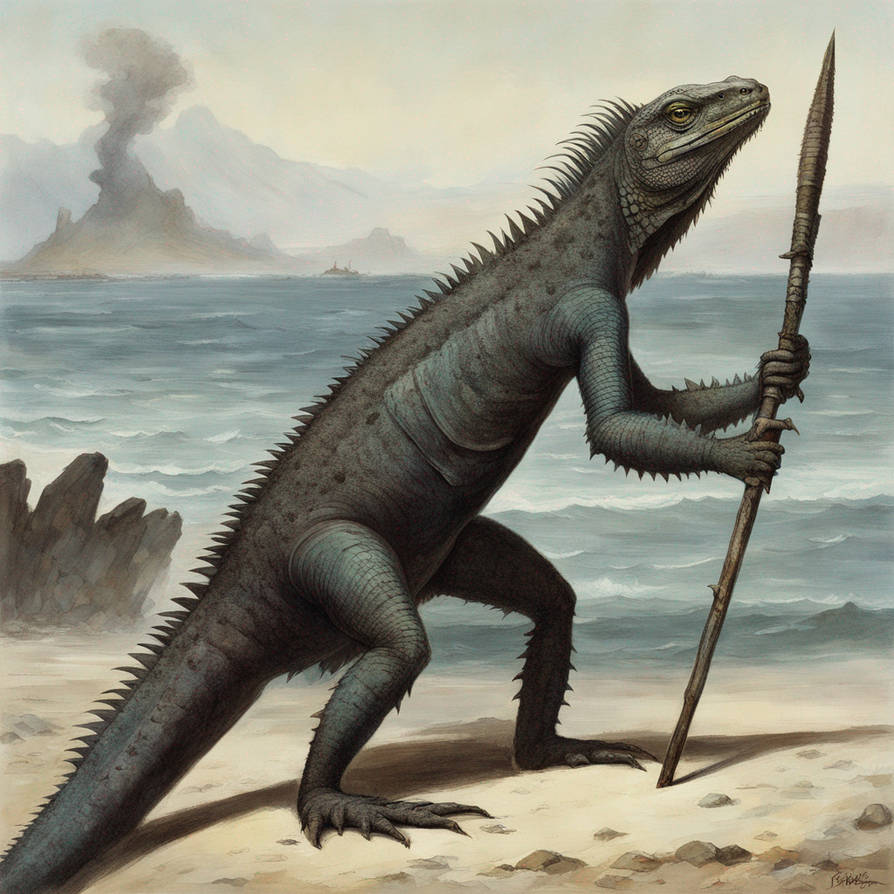
These are a subrace of lizard men with faces reminiscent of marine iguanas found on the coastlines and small islands around the Serpent Peninsula. They usually mind their own business but recently they have been encouraged to attack the humans of Quagmire (possibly by the Cult of Chaos, or maybe the Serpent folk). 

In terms of combat they are exactly the same as normal lizard men, and they differ mainly in their appearance, habitats and culture. Marine lizard men can hold their breaths for up to an hour before needing to resurface, and they are excellent swimmers at ease in both salt and fresh water. Although called lizard men, a more apt name would be lizard-folk as the females are almost indistinguishable from the males and can fight along side the males just as well. 

Marine lizard men are omnivorous, capable of eating a wide range of foods including terrestrial vegetables, seaweed, fish, molluscs and mammalian flesh. The last one is proving to be particularly popular as the city of Quagmire sinks and provides plenty of floundering, drowning morsels. The lizard men are not particularly malicious - they just don't have any compassion or empathy for humans and have no problem treating them as food. 

Marine Lizard Man Leader: AC 5, Move 60ft/swim 120ft, HD 4+2 (20hp average), THAC0 15, Att 1 weapon for 1d6+2, Save F4, Ml 12, Align Neutral, XP 125
These leaders are often found in charge of bands of lizard men between 10 and 50 strong and may lead raiding parties. If the PCs encounter a raft manned by lizard men near Quagmire there may be a leader as the captain of the raft, particularly if there are more than 10 lizard men on the raft. 

Marine Lizard Man Warchief: AC 4, Move 60ft/swim 120ft, HD 8+4 (40hp average), THAC0 12, Att 1 weapon/1 tail for 1d6+3/1d4 + knock over, Save F8, Ml 12, Align Neutral, XP 650
Warchiefs are larger and meaner, standing perhaps 8ft tall. They can use their tails as a sweeping attack against their opponents legs - anyone hit by the warchief's tail takes 1d4 slam damage and must save vs paralysation or be knocked to the ground and must spend a round regaining their feet. Warchiefs are typically in charge of a tribe of over 50 lizard-folk with 2d4 marine lizard man leaders as lieutenants and bodyguards. In the X6 module there are 2 lizard man camps with 3d6x10 lizard men -  a warchief is in charge of each of these. They have survived for several decades and are wily and experienced enough not to get into unnecessary fights, typically only getting involved in critically important battles or when personally attacked. 


Friday, 1 November 2024

Castellan Valley: The Neighbourhood of Castellan Keep

In an earlier post I gave my views on the classic module B2: The Keep on the Borderlands. The module has a map of the nearby land shown here. 


This map shows the Keep and the nearby Caves of Chaos set in woods with river running through a cleared area. However, in Gaz1: The Grand Duchy of Karameikos the writers at TSR placed it up in the northeast of Karameikos in the mountains, where the Black Peaks range meets the Altan Tepes mountains. This is shown in the map I adapted for Tarrag Duun. I know here the Caves of Chaos are marked as being in the neighboring hex (not correct), but at the time I wanted the Caves to have their own mark on the map. 


Does this directly contradict the map in the module? Not completely but it requires a certain explanation, namely that each hex does not necessarily show all the terrains within it, only the dominant terrain type. So the hex that Castellan Keep is in is predominantly mountains but not necessarily only mountains. Thus in my previous post I postulated the idea that Castellan Keep sits in a river valley in the mountains. The fact that there is a nearby river in the mountains (the Castellan River) on the hex map supports this. 

And now I have put together a rough map to show this valley. The small grey-white rectangle in the middle is a shrunk-down version of the original outdoors map from B2, showing how it fits into the predominantly mountainous hex. I am naming this valley Castellan Valley. 


 B2 is a sandbox module where the PCs are not compelled to do any specific tasks or missions - the adventurers can wander and explore, and this expanded map will give them more to find and do. I have taken the opportunity to add a few new locations and encounters, similar in theme to the wilderness encounters described in the original module. Some of these are tougher - the Valley of the Wolves and the Ogre Den are both beyond the capabilities of a 1st level party, while others are a bit easier and more suitable for novice adventurers such as the goblins of Grayhammer Valley and the orcs of Cracked Skull Hold. 

1) Castellan Keep. This is the Keep on the Borderlands, detailed in the module
2) The Caves of Chaos - The main dungeon of B2, detailed in the module, home to several bands of humanoids temporarily brought together by the Cult of Chaos
3) The Cave of the Unknown. This has been left blank for DMs to develop for themselves. 
4) Torrag Sheddor. This is a small dwarf stronghold of 130 members who mostly keep to themselves. There are 3 main sites
    a) Torrag Sheddor Iron Mine
    b) Torrag Sheddor main hall
    c) Torrag Sheddor Copper Mine: This mine has been abandoned recently after the miners broke into an orc Shaman's Tomb and disturbed the undead creatures therein. 
5) The Sylvan Vale. This break in the mountains is densely forested. In here are several colonies of sprites and pixies as well as a trio of dryads and a centaur, Borrolloy, with the spellcasting ability of a 6th level druid. The residents will be initially cautious, observing humans while invisible, but then if they feel bolder playing tricks on the outsiders. They are not malicious unless they see wanton killing and destruction. It is possible, if the jokes and mischief can be endured, for the sylvan folk here to be allies, providing food and information and possibly minor magic. The pixies and sprites have no love of the humanoids of the Caves of Chaos and may help adventurers defeat them. 
6) Cracked Skull Hold. This used to be an outpost of 70 dwarves working a tin mine associated with Torrag Sheddor, but 40 years ago they were violently ousted by a warband of orcs. These orcs are aware of the Caves of Chaos but are not swayed by the offers from the Cult of Chaos. The surviving dwarves retreated first to Castellan Keep and then on to Torrag Sheddor. 
7) The Ruined Watchtower. Initially built during the same time as Castellan Keep, this watchtower was overrun enough times by various monsters and humanoids that civilized folks no longer claim it.  These days it is home to an evil sorcerer who has ties to the Cult of Chaos in the Caves of Chaos and the chaotic raiders described in the wilderness outside the keep. He has both human and hobgoblin underlings as guards and servants. 
8) Haagnel's Junction. This is a hamlet of 120 humans and 30 dwarves that provides some food and services to Castellan Keep. In return the residents will retreat eastwards to the keep if Haagnel's Junction is under serious attack. The centre of the hamlet has a pallisade containing a watchtower, the inn, the general store and the squire of the manor, though there are farms on the outside as well. The road north leads deeper into the mountains along the Tarrag River, eventually reaching the abandoned dwarf stronghold of Tarrag Duun. There are several sheep and goat farms in Haagnel's Junction and a number of vegetable patches near the river bank. The village sits next to a wooden bridge over the Castellan river which is vital for carts and wagons trying to reach Castellan Keep. 
9) Valley of the Wolves. This is the home territory of a population of wolves. There are 4 packs here, with 4d6 adult members and 2d4 pups each. The packs may roam the surrounding mountains for food but always return to their dens here. In the centre of this valley there is a lone lodge of a fur trapper Korlon,who will tell those he meets he has an understanding with the wolves and they leave him alone. He occasionally visits Castellan Keep to sell the pelts he gathers and buy provisions. What he will not reveal (until he has the element of surprise) is that he is a werewolf. Korlon is torn about his lycanthropy and part of him really does not want to hurt innocent people, hence he has isolated himself in this valley. But if people seek him out, then they kind of bring it on themselves, don't they? Asking to stay the night in his lodge is a really bad idea. 
10) Grayhammer Valley. This used to be a dwarf village associated with Tarrag Duun with various dwarf dwellings dug into the mountainside around this valley. However, since the fall of that mighty dwarven stronghold to goblins. Grayhammer Valley has become an outpost of goblins and hobgoblins, scattered in numerous small lairs among the dwarven ruins.  
11) The Brigands' Peak.  This mountain has an encampment of human brigands (chaotic bandits) who will sometimes send patrols or raiding parties down south into Karameikos to attack vulnerable farms. They stick to the west side of the Castellan River so as to avoid Drellid's Tower.  The soldiers at Castellan Keep have been asked to deal with these brigands by various authorities in Karameikos but they do not have enough soldiers to spare for an assault on the brigands while defending against humanoids of the Caves of Chaos. 
12) Drellid's Tower. This large stone watchtower is garrisoned by a platoon of 20 soldiers of the Karameikos Army, and they stay in communication with Castellan Keep where their commanding officer, the Captain of the Guard, is based. The tower watches over the river and road and acts as an outpost for the military force at the Keep. The commander here is Lieutenant Tallena (human female, 4th level fighter, align Lawful). Although they are not particularly welcoming, the soldiers will allow travellers to stay the night in Drellid's Tower in emergencies, though they are encouraged to move on as soon as possible. No bedding is provided for guests but at least they are surrounded by stone walls and can share the fire in the hearth. The soldiers here try to keep a good relationship with the villagers of Haagnel's Junction who may provide them with food and tidbits of information such as monster sightings. 
13) The Ogre Den. This is a natural cave in the side of a mountain that has become home to a band of fifteen ogres and an ogre leader. They are joined (at least for the moment) by a minor red ogre. There is some tension within the den as the leader wants to stay independent but the red ogre believes they should ally with the cult of chaos that now holds sway over the Caves of Chaos.