Showing posts with label Ylaruam. Show all posts

Saturday, 16 May 2026

The Selenica Pass

In a previous post I discussed how I would go about gaming an overland journey from Karameikos to Ylaruam. The route I suggested involved going through the mountain pass between Selenica and Ylaruam, which is a vital trade road but with very little detail given in the Gazetteers. So here are my ideas about the Selenica Pass. 

Formation of the Selenica Pass

The Selenica Pass is unusually straight and consistent, providing a fast overland route through the Altan Tepes mountains from Selenica in Darokin to Parsa in Ylaruam. Initially this was a massive crack that opened up in the crust of Mystara when Blackmoor was destroyed in the Great Rain of Fire. Yet even this does not fully explain the straightness - some clerics have speculated that immortal intervention may have guided the initial chasm opening up. Further earthquakes, both during the Great Rain of Fire and also  when the polar holes were opened meant that rubble from convulsing mountains of the Altan Tepes filled in most of the chasm, leaving a shallow scar across the mountain range.

Since then mortals have worked to make the pass more navigable, particularly dwarves living in the mountains using their engineering and stonecrafting skills and also Nithians, using a combination of slave labour and powerful sorcery. The remnants of Nithian civilisation can occasionally be seen along the pass while the dwarves still maintain a small presence (see Torrag Gullonor below). 

Current Use of the Pass 

For trade between nations in the Known World, the Selenica Pass is vital, being the only clear route through the Altan Tepes mountains. Caravans from Darokin, Ylaruam, Alfheim, Karameikos, the Five Shires, Rockhome and further afield all take the Selenica Pass. The only realistic alternative is by sea, sailing around the Thyatian peninsula between the Sea of Dawn and the Sea of Dread. Some merchants in fact prefer the maritime route, considering the overland route to be slower and more dangerous in terms of monsters and bandits. Nonetheless, for land-locked regions who wish to trade there is little alternative. There is the Thyatian route from Fort Nikos to Ctesiphon but even this is a lot rockier and steeper, not always suitable for wagons and for Darokin and Alfheim it is too far away anyway. 

Ylaruam and Darokin, particularly the government of Selenica, realise how important the pass is and have come to an understanding. Most of the length falls under Darokin’s borders and jurisdiction , so it is Darokin army patrols setting out from either Selenica or Fort Hobart that keep the pass relatively safe. Once caravans leave the mountains to the east and enter the foothills they are in Ylaruam and Ylari patrols from Parsa will be encountered.  Karameikos has no official role as the pass is not within Karameikian territory but both the Grand Duke and traveling traders of Karameikos recognise the importance the route is to the Grand Duchy's prosperity. 

Caravans and other civilised travellers can be encountered along the road and most of the time there is no more exchange than polite acknowledgement. Those who travel this route regularly understand that little interaction is needed. Those in distress by the side of the road are sometimes treated with caution, even suspicion as bandits have sometimes used such situations as bait to get other caravans and travellers to stop and lower their guard, though most requests for help are genuine enough.  

Locations of Note

Parsa is the capital of Makistan, the west-most of the Emirates. Parsa has 2,000 residents but its population is often higher (around 3000) due to the traders and caravans regularly stopping off before heading into the mountain pass. Parsa also does its own trade, both in wool and horses as well as caravan supplies. 

Selenica is the eastmost city of Darokin and an important trade centre, with a population of 39,000, detailed in Gaz11 and discussed in this post

Orstinel: A fortified village with a substantial inn and manor house halfway between Selenica and Parsa in the mountain pass, popular as stopping point for caravans and other travellers. There are 120 long-term residents but the population is often double that when caravans are staying the night. There is also a chapel and shrine to a lawful minor immortal, Saint Thoria, manned by 4 dwarf clerics. 

Torrag Gullonor: A dwarven stronghold set into the mountainside overlooking the pass. There are 320 dwarves here. They are quite cautious about letting non-dwarves in but will often do business with merchants in either Selenica or Orstinel. Torrag Gullonor has both coal and iron ore seams nearby and does its own smelting, exporting iron ingots and buying food and drink. There are some older dwarf residents who remember fleeing Tarrag Duun when they were young. 

Doomskull Shrine: Just off the trail is a goblin shrine with a massive goblin skull carved into the mountainside. The nearby goblin tribes are occasional caravan raiders but will launch all-out war if adventurers commit sacrilege in their shrine. 

Nehirill’s Tower is a wizard’s tower, still occupied by the Glantrian exile, Nehirill (15th level mage, human female, chaotic). She is unpredictable and some say quite mad, but she tends to leave other folks alone. She has three human apprentice mages who also act as servants, as well as various golems, living statues and conjured elementals who serve as guards, fending off the monsters that roam the mountains as well as foolish uninvited visitors. Nehirill is rarely seen but her apprentices often visit Orstinel to buy food and other supplies. 

Possible Encounters

Ambush with ogres supported by hobgoblins led by a red ogre. Hobgoblin archers are behind walls while ogres have set up a road block with boulders and tree trunks, 

A passing merchant and his caravan are convinced they are being preyed on by something - guards keep disappearing. They are right - a doppelganger is killing then impersonating guards. One of the guards offers to join the PCs party as he thinks it is safer. He is of course the doppelganger. 

A damsel in distress is being pursued by an undead monster. The undead is a revenant and the damsel is not so innocent, having slain her tutor in magical arts and stolen his spellbook. The master has returned for vengeance with combined powers of a revenant and an 8th level magic user. 

Two dragons dwell near the Selenica Pass. 

Naxavorious is small male red dragon, nearly always hostile and predatory though his hunting has no pattern and is hard to predict. He is liable to attack caravans first and fly off with loot rather than making demands.

Sestarinia Skyscale is a large female blue dragon. She is served by a band of stone giants who sometimes set up a toll point along the pass. The fees are reasonable and if travellers pay and don't fight the giants Sestarina let them through without problems. She is sometimes seen watching over her stone giant minions from a vantage point high above the pass. Darokin authorities are reluctant to challenge her because they reckon she keeps the Frost Giants to the south in check. 


Random Encounters in the Pass

1d8+1d12Encounter
2DM's Choice
3Griffon
4Ogre
5Cave Bear
6Mountain Lion
7Wolf Pack
8Dwarf Patrol
9Goblin Bandits
10Merchant Caravan
11Human Soldier Patrol
12Herd Animals (d6: 1-3 wild goats, 4-5 Ibexes, 6 Yak)
13Human Bandits
14Adventuring Party
15Wild Boar
16Giant Hawk
17Wyvern
18Frost Giant
19Stone Giant
20Dragon (d6: 1-3= Red, 4-6= Blue)

This table is loosely based on the ones at the back of the AD&D Monster Manual II. Clearly DM discretion is advised and if a party of PCs is not ready to handle some of these encounters then the DM can choose a different encounter or say that there was no encounter. Similarly there are various possible encounters that could not fit on this table (hobgoblins, hippogriffs, trolls) that the DM can introduce as they wish.  

Saturday, 9 May 2026

Traders of Jaboor

source

Jaboor is a trading town on the east coast of the Emirates of Ylaruam and as such many of its more important and colourful characters are merchants of various types. 

Nabil Paranthi 

Ftr5/Mer2, human male, age 65, align Neutral

Str 12, Int 16, Wis 14, Dex 9, Con 11, Cha 14

Nabil is a native of Jaboor and also patriarch of House Paranthi. As such he finds himself at the forefront of dealing with the faction of over-zealous town guards known as Al-Fassaad. He is fed up with oppressive religion and will refuse to trade in the holy city of Abbashan and is not afraid to use his money and own influence to curb the growth of Al-Fassaad. He personally prefers trade with both Thyatis and Alphatian merchants on the Isle of Dawn. He specialises in food, including fruit, vegetables and grain. He has dabbled in trading in wines and beers but he knows that this could get him into even more trouble than currently. He does a thriving trade in coffee, but even with that some religious conservatives think that this dark brown brew is a mind-altering substance and could be addictive. Nabil Paranthi has refused to compromise here and intends continue to trade in coffee. 


Ressinik Shallowkeel 

Ftr5, human male age 45, align Neutral 

Str 15, Int 12, Wis 10,  Dex 13, Con 13, Cha 14

Ressinik is an Ostlander and has been sailing the Sea of Dawn since childhood. He shifted away from viking raiding to mercantile trade in his 20s and has become quite a businessman, though he keeps his battleaxe nearby at all times. He takes his ship (The Triton’s Triumph) all over the sea of Dawn including the Northern Reaches, Ylaruam (especially Jaboor), the Isle of Dawn and the eastern coast of Thyatis. He has recently stopped trading in Landfall after the invasion of the Heldannic Knights but is now considering trade expeditions to Oceansend. He often recruits new crew who want to move away from a life of crime and find a more peaceful way to make money. He tends to trade in weapons and armour but is versatile and open to other trading opportunities. 


Naanfaelin 

Elf6, elf male, age 340, align Lawful

Str 11, Int 15, Wis 12, Dex 13, Con 11, Cha 12 

Naanfaelin is a recent convert to the Eternal Truth and feels that Jaboor is where he belongs. He comes from the Minrothad Isles and is a Sea Elf, and grew up sailing the northern Sea of Dread from Thyatis City to Jaipur in Sind. He has had a go at piracy and knows the dark side of Ierendi, and even has some contacts in the dangerous port city of Vlaad. However, about a year ago he had a realisation that he was not happy about who he was becoming and decided a radical change of direction, and the Eternal Truth offered a way that Naanfaelin knew was right for him. 


Tarentius Altacor 

Ftr7/Mer3, human male, age 40, align Chaotic

Str 13, Int 14, Wis 12, Dex 15, Con 10, Cha 14

Tarentius is a Thyatian merchant who plies the eastern coast of Brun from his home town of Retebius to Oceansend. He has a polite and friendly exterior but he is ruthless and amoral, doing whatever it takes to make money and protect his business. As with many Thyatians he is capable of duplicity and fraud though he only does outrageous and illegal moves if he is certain he won’t see the target again - for regular suppliers and buyers he needs to maintain a certain trustworthiness. He has dabbled in slave trading (particularly around Ostland and Thyatis) but he deals in a broad range of merchandise including weapons, rare animal parts, fencing pirated loot and illicit drugs including Zzonga fruit from Alphatia. Despite his alignment he is dismissive of the Cult of Chaos (he is far more secular and focused on the here and now) and also once someone proves a worthy crew member on his ship, The Soaring Albatross, he is quite loyal and protective of them. This goes both ways and his established crew respect and fear him. 


Fezzika Daltanpur 

F4/Mer2, human female, age 55, align Lawful

Str 10, Int 12, Wis 13, Dex 12, Con 12, Cha 13

Fezzika is an inland trader and native Ylari who regularly visits Abbashan. Fed up with Al-Fassaad and would prefer to deal with other towns. Fezzika is considering establishing caravan routes across the desert to the south to trade with Hedjazi, Kuznetz and Ctesiphon, bypassing the holy city altogether. However, she also recognises that farmers around the Abbashan oasis produce good food and she is reluctant to abandon this supply of merchandise.  Trading with such farmers outside the city walls would be risky and considered tax evasion by the city rulers but Fezzika is still toying with the idea. 


Dantalla the Swift 

MU13, human female, age 53, align Neutral

Str 8, Dex 10, Con 13, Int 17, Wis 12, Cha 14

Dantalla is a former adventurer of Darokin who in the course of her explorations has acquired a magic flying carpet of unusual size. Dantalla’s carpet is 15ft x 15ft and can carry up to 1000lb of passengers and cargo. Thus she has put it to use ferrying people and small, high-value goods around the Emirates. She typically trades in incense, naptha, silks, gemstones, perfumes and rare books, and passengers willing to pay 100gp per travelling day. She is quite capable of casting powerful spells, and these days it is to fend off aerial monsters. She has become quite familiar with the Emirates of Ylaruam, having lived and worked here for 12 years. Although she does sometimes travel abroad she tends to stay within the Emirates. Being a foreigner, a female and magic-using sorceress she has encountered suspicion and prejudice - however, these days she has a number of trusted contacts in different towns and cities who are happy to do business with her, and she completely avoids the Holy City of Abbashan and anyone else who is more trouble than they are worth. 


Dornihaali Aalsta

MU4, human female, age 30, align Neutral

Str 12, Int 16, Wis 12, Dex 14, Con 8, Cha 14

Dornihaali is a native of Jaboor but half-Alphatian. Her father is an Alphatian mage who lives in Dunadale on the Isle of Dawn while her mother is a cosmopolitan Ylari in Jaboor. She has recently been hassled by members of Al-Fassaad, partly because of her parentage and partly because of her magic-use. As such she has recently become friends with Nabil Paranthi thanks to their mutual problem of Al-Fassaad.  She has also been approached by an Alphatian mage looking for people to gather information about Jaboor, its trade, politics and military and anything involving Thyatian activity. After asking her father about this mage, it turns out he was involved in Alphatia's Imperial spy network, and so Dornihaali agreed to help out the Alphatians. At the moment this is merely a matter of keeping an eye out in Jaboor and she is not ready to take serious risks - Dornihaali considers herself a merchant first and foremost, with intelligence gathering being more of an occasional favour for her father. She also trades between Jaboor and the Isle of Dawn, usually bringing fine timber into Jaboor and taking fruits and spices back to West Portage on her ship The White Porpoise. 


Galbi Ironhoof

Centaur Male, age 35, align Neutral

Str 16, Int 12, Wis 10, Dex 9, Con 14, Cha 13

Galbi is probably the most unusual looking trader in Jaboor bazaar, but he is respected and trusted by other established traders. He comes from a band of centaurs that roams the desert of Ylaruam near the coast and he still visits his home tribe. He has also become a regular trader with the nomads of the desert (both human tribes and other races) and has a knack for finding them in the vast desert. He is very wary of ships and as such he only trades inland. 


Saturday, 14 March 2026

A Journey from Karameikos to Ylaruam

Cartography by Mark Howard (source)


Revisiting the Rules for Overland Travel

It is possible to hand-wave journeys from one nation to another, and DMs are entitled to do so. One session the PCs are finishing their adventures around Castellan Keep and the Caves of Chaos, and the next session they have arrived at Cinsa-Men-Noo.  However, in many epic quests in legend, film and literature the journey is the bulk of the adventure. The Hobbit, The Fellowship of the Ring, the Odyssey, King Solomon’s Mines, Apocalypse Now and others have travel to a destination as most of the story. These are good for world-building and verisimilitude - making the campaign world seem more real, with geography, inhabitants and events going on around the PCs.  

Traditionally the idea is that Basic adventures (levels 1-3) happen around the dungeon, while Expert adventures (levels 4-13) involve venturing out into the wilderness. The X-series of modules (X1: The Isle of Dread etc) often have large sections of wilderness with dungeons often taking a secondary role. And so wilderness travel is principally addressed in the Expert rulebook. 

If the PCs stick to roads, I don’t bother with chances of getting lost and journey time is improved, as well as the reduced likelihood of hostile encounters.  If they decide to go off the beaten path , then things become more difficult and risky, and the rules for checking if the PCs get lost will apply. 

This particular journey from Karameikos to Ylaruam is more of an example than a concrete event that must happen. It is my way of considering how such expeditions might take place and how the DM can approach them. 

Motive & Hooks

The meta-reason for getting PCs from Karameikos is because I have envisioned Karameikos hosting low-level, Basic adventures - once the PCs reach 4th level or more they can venture further afield, either south into the Sea of Dread (which inevitably involves ship journeys) or staying on land they can travel to Darokin or Ylaruam. If the DM is happy with a true sandbox campaign, the PCs can venture anywhere they want, if they have the means and the motivation, but as a DM I find it better to prepare adventures in geographical clusters (e.g. northern Ylaruam or north coast of Norwold’s Great Bay) and to guide PCs towards that area if not towards a specific adventure. But of course trying to explain this to players might break the mood - why would their PCs, brave adventures in search of fame and fortune, want to travel to a far-off land like the Emirates of Ylaruam?  

  • Treasure: Gnarl Vorggonson from far-off Ostland talks to the PCs in a tavern about the Emirates of Ylaruam. There are great pyramidal tombs filled with the burial treasures of the ancients. Whatever the risks of whatever guards it, the rewards are certainly worth while. The following morning Gnarl is found dead with a Ylari dagger in his back. The Holy Killers of the Eternal Secret have struck again. 
  • Employment: A new notice is pinned on a wall of the inn at Castellan Keep: “ Caravan Guards wanted for journey northwards. Some combat experience preferable, payment is reasonable. See Beldorphix the Dwarf Merchant at the Griffon Shield Inn in Penhaligon”. 
  • Magic Items: Zashell of the Magician’s Guild in Specularum has come across old papyrus scrolls inscribed with spells not seen in centuries. After investigating their provenance, she is sure there are more such scrolls in the ancient ruins of northern Ylaruam and she is willing to pay well for them if brought to her intact.   
  • Academic Study: Ganahellion, an elf associated with Specularum College of Sages, wants to investigate the stories of ancient civilizations that once dominated northern Ylaruam. But he needs bodyguards as he has heard the land can be quite dangerous. 
  • Entrepreneurial Trade: The garrison at Duke’s Road Keep has run out of oil for both lighting and for pouring on besiegers (after a recent and brutal battle). Anyone who brings five large barrels from Tel Al Kebir will be well paid. 
  • Religion and Philosophy: Sister Alpadina, a junior cleric in the Order of the Griffon, has been asked by her superiors in Kelvin to see if there are suitable allies against the forces of Chaos in other lands. The Order has heard of the Eternal Truth and its followers but don’t know much about it. They know even less about the mysterious dervishes that inhabit the deserts of Ylaruam but Sister Alpadina wants to investigate, though she cannot do it alone. 
  • Pursuit of Justice: The chaotic priest who has infiltrated Castellan Keep has fled after adventurers find evidence implicating him on his colleague in the Caves of Chaos. Will he take a riskier route into the wilderness or will he flee by safer though more circuitous roads and trails? PCs who pursue him may need to investigate and ask questions at the various settlements he might have passed through. 

Route and Distances

Here the hex maps I have used in these blog posts become really useful. The one at the top of this post was chosen because it shows the entirety of the journey as I expect it, with Karameikos in the southwest quarter and the Emirates of Ylaruam in the northeast quarter, with Cinsa-Men-Noo near the northern edge of the map. At 8 miles per hex it is simply a matter of counting the number of hexes between points and multiplying by 8 to get the distance in miles. It could be argued that the town, castle or village featured in a hex actually only takes up a small proportion of what is inside a hex (an 8 mile hex is actually 55 square miles in area) and thus distance may not be an exact multiple of 8, but I don't feel the need to be that accurate. 

My suggestion for this would be:

  • Penhaligon to Duke's Road Keep: 7 hexes or 56 miles by road
  • Duke's Road Keep to Reedle: 4 hexes or 32 miles by road
  • Reedle to Selenica: 5 hexes or 40 miles by road
  • Selenica to Parsa: 15 hexes or 120 miles by road (Update: I have written about the Selenica Pass here)
  • Parsa to Sulba: 8 hexes or 64 miles by trail
  • Sulba to Ylaruam City: 7 hexes or 56 miles by trail
  • Ylaruam City to Cinsa-Men-Noo: 9 hexes or 72 miles by road
This gives a grand total of 55 hexes or 440 miles if the PCs stick to the main roads and trails. Whether or not the PCs stop at the various locations for rest and resupply is up to them. Generally speaking a travellers' inn, even a poor quality one, is better and safer than camping out on the side of the trail. These locations could well have their own adventures, side treks and NPC schemes going on as the PCs pass through. 

Speed of Travel

This one is explained in the Expert Rulebook and is the group's slowest traveler's movement per turn divided by five as miles per day. This is then further modified by what terrain they are travelling through although trails and roads cancel out any hinderance from terrain. I understand that this results in a daily distance that is only rarely divisible by 8, so it won't be a convenient matter of treating hexes as simple discrete stepping stones - we will be dealing in fractions of hexes (although probably not fractions of miles). 

If the slowest member of the party is travelling at 60ft/turn in a dungeon then they are travelling at 12 miles per day in the wilderness, assuming they are on relatively open and easy terrain, including trails. In fact if on roads the speed is increased by 3/2, so that character can travel at 18 miles per day on road. Such a character could therefore theoretically complete the route given above in  28 days (320 miles by road / 18 miles per day on roads = 17.8) + (120 miles by trail / 12 miles per day = 10 days).  Even a party riding mules will travel twice as fast as that (mules have a base speed of 120ft/turn) and could ideally complete the journey in 14 days. 

Random Encounters

I'm okay with random encounters as long as DM discretion applies both with regard to challenging the party and also whether it makes sense within the campaign world. Also remember that encounters need not be violent - either side may wish to parlay or avoid the other altogether. For some civilised encounters they are simply passing each other on their respective ways. Page X57 in the Cook rules gives guidelines for how often for each type of terrain random encounters are met. The number of checks per day is not entirely clear but I would suggest 2 - one during the day (presumably while travelling) and again at night (while camped) but I understand if the DM would rather keep it to just once per day. 

If the DM has enough time and motivation then custom random encounter tables are a great way to keep PCs on their toes - otherwise the encounter tables in the Expert Rulebook should be fine, especially with a bit of DM discretion. 

Weather

Weather is not actually addressed in the Expert rulebook but DMs can still make rulings about it. Harsh weather including hailstorms, downpours, blizzards and sandstorms can all hamper a party's movement and possibly get them lost if they insist on pushing on along a poorly marked trail. If already off-road, it is very difficult to navigate when the sun and stars are obscured by storm clouds. Actually damaging  weather such as lightning storms, tornadoes and the like should be rare and perhaps not random (i.e. only occuring when the DM needs the PCs to take shelter).  

The seasons will be important as well: winter travel in subarctic climes (such as Norwold) is not to be taken lightly. Similarly in hot deserts (such as Ylaruam and the Great Waste) the summer months can be unbearable.  

Provisions

Assuming the PCs have no magical way of creating food and drink, they will have to bring their own. Travelling along a river at least provides plenty of water and in temperate climes water should not be too scarce but in deserts such as Ylaruam it is a precious commodity. Since the B/X rules do not have classes dedicated to the wilderness, foraging is difficult and by no means reliable (although if using expanded rules, druids and elven rangers could be useful in this regard). Food and water for mounts may be necessary as well, especially in deserts and barren lands. The Rules Cyclopedia does offer guidelines on foraging in p89. 

Interestingly neither Moldvay Basic nor Cook Expert rules give the encumbrance for normal or iron rations. It's all lumped together with other miscellaneous equipment as 80cn/8lb. However, the Rules Cyclopedia is much more specific - a pack of one week's normal rations is 200cn and a week's iron rations are 70cn. A full waterskin (a quart) is 30cn and is probably going to last a day of travelling, two days if strictly rationed. 

As far as B/X rules are concerned there are no specific consequences for hunger, thirst or exhaustion. I would suggest for every 2 days without food or half day without water each PC suffers -1 to Str and Con (temporary - lost point are restored at 2 points per day once the character can eat and drink). If either score drops below 3 they are incapacitated (cannot move or fight and are barely conscious), and if either score drops to 0 they die. Clearly this is not scientifically accurate - most humans cannot survive more than 3 days without water to drink, even less in hot deserts - but I think it is sufficient for my purposes. If you prefer to work out your own rules for hunger and thirst, go for it. There is a brief section on p32 of Gaz2 Emirates of Ylaruam about heat exhaustion, but this is not really the same as dehydration. 

Friday, 5 December 2025

The Selenica Co-operative


source

The Selenica Co-operative is a network of merchants who have agreed to work together to stay in business and protect themselves and their goods. As the name suggests, the group is centred on Selenica in eastern Darokin and as such is on a crossroads between various nations including Karameikos, the Five Shires, Ylaruam and Rockhome. The merchants are all travelling traders, moving goods and money around between cities and countries, and generally do not maintain static shops, though they often trade with those that do. 

The four main functions of the cooperative are

  1. Mutual defence. Members of the co-operative will often band together into large and well-guarded caravans when travelling to the same destination, or at least travelling the same road for a distance. Given how dangerous some of the mountain passes and hills can be, this is a sensible precaution. Bandits and monsters are less likely to raid a large caravan than a sole trader. 
  2. Trade and financial information. There is a general understanding in the co-operative that news about trade and economics is important for finding the best deals and avoiding difficulties. As such members of the cooperative will tell each other about the ebb and flow of commodities, the activities of rivals who might compete with the cooperative, and laws and taxes in the places the cooperative might do business.
  3. Avoiding competing with each other. Merchants don't like cutting prices simply because somebody else is selling similar wares cheaper. Although there is some disagreement and arguing within the co-operative, it is considered a safe place to sort out potential rivalry and help merchants find alternative markets. 
  4. Loans at reasonable rates of interest. Admitedly what counts as reasonable can be subjective, but as long as both lender and borrower are in agreement, this has kept various merchants solvent and in business when they might otherwise have been ruined by the ups and downs of life as a travelling merchant.
Darokin is a land famous for its merchants including the great merchant houses that employ dozens or even hundreds of workers, and a head of the house overseeing all of its business, with junior merchants often acting under instruction. The Selenica Co-operative is far less hierarchical, and all members are at least in principle equals (though richer members are more equal than others). Each merchant in the co-operative is considered an independent trader looking after their own business and making their own deals. Most members are from Darokin but in the fifty years since it started in Selenica, more merchants from other places have joined, including:
  • Ylaruam. This includes Parsa and Ylaruam City. The co-operative avoids Abbashan as they have had bad experiences with the theocracy there. In Cinsa-Men-Noo there is Maerell Dhambor, who is not a member but has had friendly dealings with the co-operative. 
  • Karameikos, including Specularum, Kelvin and Penhaligon. Specularum is also a trading port for members who wish to trade further across the sea. In Penhaligon there are two members - Beltorphix and Maddrasso.  
  • Rockhome. Though there are great opportunities to trade between Darokin and Rockhome, currently the only safe route through the mountains is into Ylaruam’s Parsa and then north through the Ust-Urt valley and through Karrak Castle. Nonetheless, merchants of the co-operative consider this long way round to still be worthwhile and in Greenston there is Meribidus Silverbrow   
  • Athenos in the south of Darokin is the nation’s main port, and as such many merchants will either sell to foreign merchants here or else hire ships to trade overseas. 
  • Corunglain in the north of Darokin is both a large city of customers and also the jumping off point for merchant caravans braving the dangerous routes to Glantri and Ethengar. There are several members of the co-operative based here. The mutual defense clause of membership is frequently invoked and the co-operative makes sure that caravans heading north into the Broken Lands are as well protected as they can afford to be. 
  • Ierendi City. Note that the members are quite cautious about trading here - the city itself may be safe but the surrounding seas are patrolled by pirates from Vlaad. No sane member of the co-operative will trade actually in one of Ierendi’s pirate ports. 
  • Thyatis City and Kerendas. The Empire of Thyatis is a great opportunity for trade, and the co-operative has several merchants based there. Goods will often be loaded onto a ship at Specularum and make the short trip past Minrothad. 
  • No direct trade with Minrothad City occurs, primarily because of the Minrothad Guilds’ policies and insistence on maintaining a near-monopoly in their homeland. But sometimes Minrothad merchants will trade with members of the co-operative either in Kerendas or Specularum. 

The Selenica Co-operative is quite open-minded about its membership. A certain level of trustworthiness is required, so no theft from or assaulting other members is tolerated. Fraud and getting into trouble with law enforcement is likewise frowned on, and slandering other merchants (especially those within the co-operative) is discouraged. These basic rules mean that most of the cooperative are Lawful or Neutral in alignment - Chaotic types tend not to fit into the co-operative’s ethos. However, a range of races and nationalities are represented, and female merchants are welcome as well. This is primarily a matter of professionalism - the ability to do business and make money is the most respected attribute. 

Although not hierarchical, the co-operative does have leadership of sorts in the form of the Board of Directors, who are the 9 most senior or wealthy merchants in the co-operative who are asked to set the rules, welcome or expel members and deal with disputes between members. Although there is a certain amount of political manoeuvring both by those on the board and those seeking to ascend to the board, it does generally work fairly well, partly because of the ever present competition of the big merchant houses.  Those on the board who are particularly selfish, incompetent or greedy will find themselves outvoted on decisions and possibly voted off the board if the other eight directors would rather have someone different. Nonetheless, the board has run into trouble when one or more directors have been magically influenced (usually involving Charm or Suggestion spells) and there was one period when a rival major merchant houses was using a mage to scry on the board of directors meetings. 


Saturday, 28 June 2025

Constructs of the Shielded Fortress

Introduction

These are 4 new creatures for the B/X edition of D&D. Although they have been created with the Shielded Fortress of Hjaal in mind, they can be used elsewhere. I feel they are best suited for ruins of lost empires, still guarding the remains of their creators. I have assumed that the process for creating these constructs has been lost to time, but it is possible that the formulae may be discovered (perhaps in the same ruins that hold these constructs), and a talented and resourceful mage (or perhaps cleric) could create new creatures.

 Jade Serpent

Armour Class2
Hit Dice8* (36hp)
Movement120ft
THAC012
Attacks1 bite / 1 tail
Damage2d4 + poison/1d10 + crush
No. Appearing1
Morale12
Save AsF8
TreasureSee below
AlignmentNeutral
Intelligence3 (Semi)
Size & TypeLarge Construct
XP Value1200

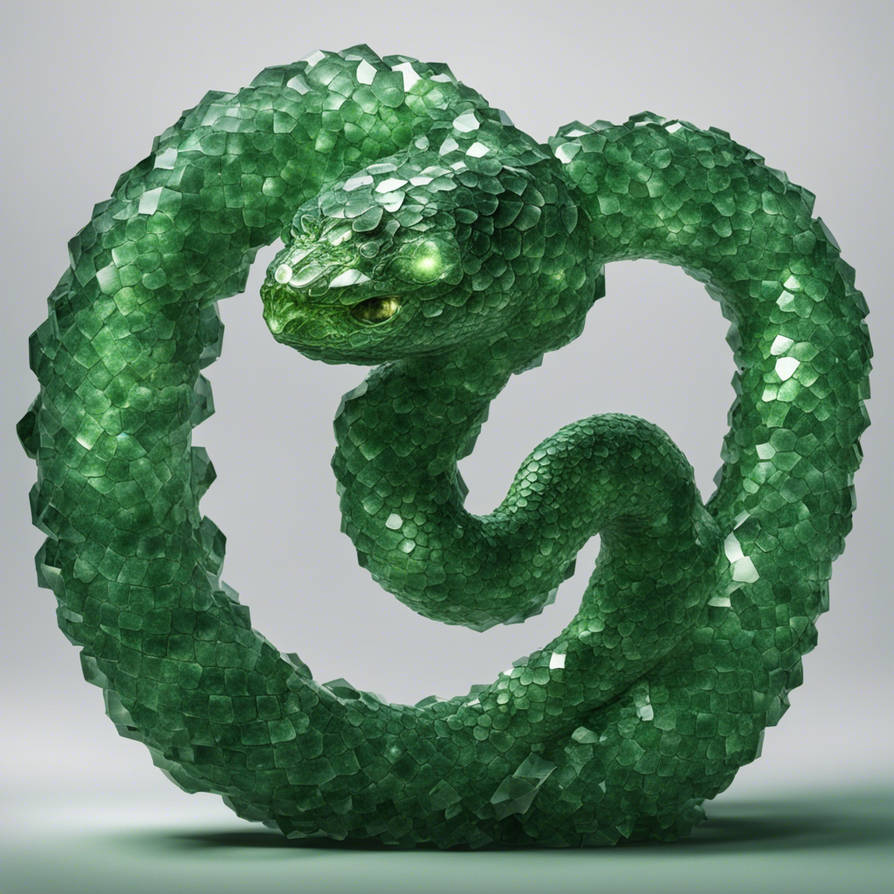
The method of creating these green crystalline guardians are long forgotten along with so much of Mogreth sorcery though a few functioning specimens can still be found among the ruins of Mogreth culture. They appear as jade statues of huge snakes and of rough finish approximately 30ft long. Jade serpents can sense hidden and invisible creatures due to heightened sensitivity to vibrations, and sound. Jade serpents can attack with both their fangs and lashing tails. If a creature is bitten by a jade serpent, they must make a saving throw vs poison or die in 2d4 turns. In addition, any creature of Large size or smaller hit by the jade serpent's tail must make a save vs Paralysis or be grappled by the serpent's tail. If grappled the creature will automatically take another 1d10 crushing damage per round, cannot move away from the jade serpent and any bite attacks by the jade serpent will be at +4 to hit against the grappled target. Jade serpents are invulnerable to normal weapons - magic weapons (+1 or better) or spells are needed to damage it. As a construct the jade serpent is immune to poisons, disease, energy drain, Sleep, Charm and other mind-affecting spells. If the jade serpent is destroyed it is shattered but 2d10 pieces of jade each worth 1d6 x50gp can be found. 

Turquoise Living Statue

Armour Class3
Hit Dice4+4* (22hp)
Movement150ft
THAC015
Attacks1 headbutt
Damage1d6+1
No. Appearing1d4
Morale12
Save AsF4
Treasure TypeSee Below
AlignmentNeutral
Intelligence3 (Semi-)
Size & TypeMedium Construct
XP Value200


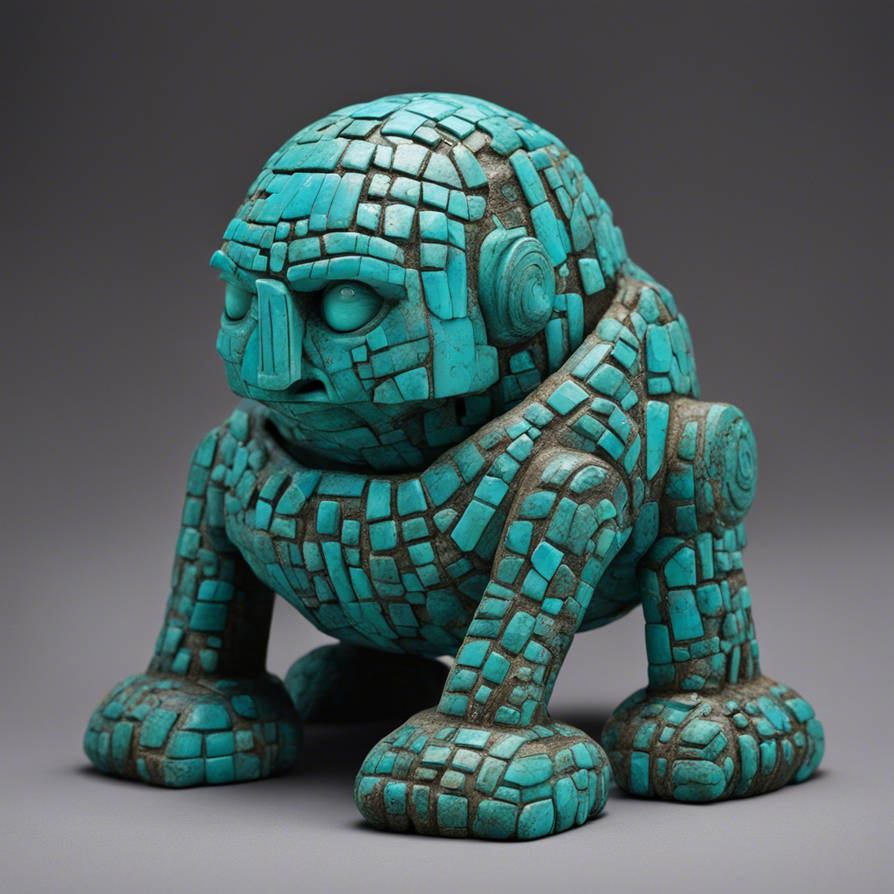
The Turquoise Living Statue is a strange construct of bygone ages. It resembles a quadrupedal statue made of chunks of turquoise and held together by grey cement with a large round head. It can gallop along faster than a human and it can charge any opponent if it has 20ft or more of straight running distance at the start of its round. Charging gives the turquoise living statue +2 to hit and double damage (2d6+2 bludgeoning). Furthermore anyone hit by the charge must also make a save vs paralysis or be knocked 10ft away and prone. The turquoise living statue once per day can emit an aura of lethargy instead of attacking with its headbutt: Anyone within 30ft must save vs spells or be affected by a Slow spell for 2d4 turns. It will sometimes use this after charging into a group of opponents. As constructs, Turquoise living statues are immune to Sleep, Charm and other mind-affecting magic, disease & poison. Should a turquoise living statue be destroyed, it will collapse into bluish-green dust but amongst the dust there may be 2d10 pieces of turquoise worth 1d6x10gp each. 


Bone Rattler

Armour Class6
Hit Dice6+4* (31hp)
Movement150ft
THAC014
Attacks2 bites or 1 rattle
Damage2d6/2d6 or special
No. Appearing1
Morale12
Save AsF6
Treasure TypeNone
AlignmentNeutral
Intelligence1 (animal)
Size & TypeMedium Construct
XP Value750

These creatures look like undead snakes but are in fact constructs formed from the bones of giant rattlesnakes. Bone rattlers are immune to non-magical weapons (+1 or better weapons or spells needed to hit). They usually attack with their fangs and retain the frightening speed of living rattlesnakes, striking twice per round. Fortunately their venom glands are no longer present (any flesh is removed in the construction process) and any residual venom has dried up in their fangs. However, they have still retained the rattle on the end of their tails and instead of biting a bone rattler may rattle its tail. Any creature within 30ft that can hear must save vs spells or be gripped by a magical fear and will attempt to flee the bone rattler for 1d6 turns (moving at maximum speed away from the encounter, preferably back the way they came). If a creature successfully saves, they are temporarily immune to the rattle effect for the rest of the day. As constructs, bone rattlers are immune to Sleep, Charm and other mind-affecting magic, disease & poison. They cannot be turned by clerics. 


Beryl Golem

Armour Class2
Hit Dice10* (45hp)
Movement90ft
THAC010
Attacks2 fists
Damage3d6/3d6
No. Appearing1
Morale12
Save AsF10
Treasure TypeSee Below
AlignmentNeutral
Intelligence10 (Average)
Size & TypeLarge Construct
XP Value1600

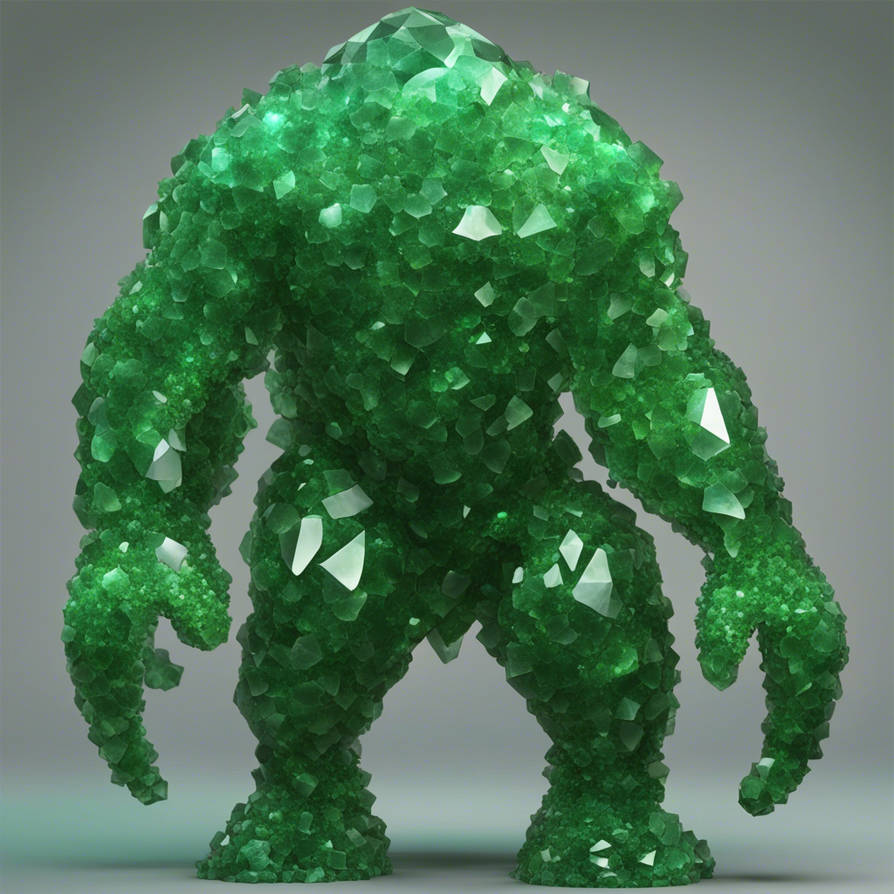
Beryl golems are powerful creatures created by ancient and forgotten magic rituals. They appear as vaguely humanoid statues of bright green crystal standing about 9ft tall but without any apparent facial features or even clearly defined head. As with other golems they are immune to non-magical weapons and can only be hit by weapons of +1 or better enchantment or by magic spells. They attack with their massive jagged fists inflicting 3d6 bludgeoning damage with each strike.  They have the ability to Dimension Door 3 times per day to a distance of 240ft from their current location. As constructs, beryl golems are immune to Sleep, Charm and other mind-affecting magic, disease & poison.  If a beryl golem is defeated, it shatters into green dust though a search will reveal 2d10 pieces of beryl worth 1d6x100gp each. Unlike many of the constructs here, beryl golems are surprisingly intelligent at least in terms of tactics and strategy. They are given standing orders (such as "Guard this location and attack any non-serpent-folk who enter here") and will obey them but have a certain discretion about how they go about their duties.   

Sunday, 27 April 2025

New Undead Monsters

Slavering-tongue ghoul

Slavering-Tongue Ghoul

Armour Class

6

Hit Dice

4+4*

Avg. Hit Points

22

Movement

120ft

THAC0

15

Attacks

2 claws + 1 tongue

Damage

1d6/1d6/2d4

No Appearing

1d6

Morale

12

Save As

F4

Alignment

Chaotic

Intelligence

10 (Average)

Size & Type

Medium Undead

XP Value

200


These undead creatures resemble regular ghouls, but for their obviously enlarged tentacle-like tongues that drool with horrific slime. In combat they attack with their two claws and their tongues. Their claws do normal slashing damage but if their tongues hit a creature of ogre size (large) or smaller their target must save vs paralysis or the tongue will wrap around them and grip them. Any hit by the tongue does 2d4 acid damage and if the tongue has gripped their opponent then no further roll to hit is needed - the tongue both holds the target close to the ghoul and automatically inflicts 2d4 acid damage per round. Claw attacks against the gripped target are at +2 to hit. 
Slavering-tongue ghouls are only hit by magic, fire and silvered or magic weapons. They are immune to acid, normal weapons, cold, poison and disease. As they are undead they are also immune to Sleep and Charm spells. Anyone slain by a slavering-tongue ghoul will become one in 2d6 nights after death. Slavering-tongue ghouls can be turned by clerics as if wraiths. 
These horrible creatures are usually found in Norwold, near or in Arvorian ruins, so the few sages that know of them speculate that they have been created by Arvorian chaos magic or perhaps one of the Scions of the Outer Dark.  

Ancient Heretic

 art by Inkary source

Ancient Heretic

Armour Class

5

Hit Dice

8*

Avg. Hit Points

36

Movement

90ft

THAC0

12

Attacks

2 fists

Damage

2d6/2d6

No Appearing

1

Morale

12

Save As

C8

Alignment

Chaotic

Intelligence

14 (Exceptional)

Size & Type

Medium Undead

XP Value

1200


Ancient Heretics appear as mummified high priests of Nithia and may be mistaken for normal mummies. These were once priests of the Nithian gods who turned from their patrons towards Chaos. This betrayal brought the curse of Undeath onto them. They hate anyone who worships conventional immortals and despise followers of Law. 

In combat an ancient heretic will attack with its fists, each of which will inflict 1d6 bludgeoning and 1d6 necrotic (negative energy) damage. They are immune to non-magical weapons, requiring +1 or better enchantments to hit. As they are undead they are immune to disease, poison, Sleep and Charm spells and the like. 

Once per day an ancient heretic may use Animate Dead to create animated skeletons or zombies from corpses, which they can then command. An ancient heretic may thus command up to 16HD of animated undead at a time. Although more intelligent undead such as wights, wraiths and mummies are not compelled to obey an ancient heretic, they may still ally themselves to this monster. In combat an ancient heretic will try to make full use of its minions and allies. 

Any cleric, druid, shaman or other divine magic spellcaster within 60ft of an Ancient Heretic must make a Wisdom check in order to cast any spells for each spell attempted. Failure means that the ancient heretic’s aura of Apostasy has temporarily disrupted the cleric’s connection with their deity. Ancient Heretics are immune to turning by clerics and any attempt to do so requires the cleric to save vs spells or be stunned by the Aura of Apostasy for 1d4 rounds as doubt and despair suddenly rush into the cleric’s soul. 


Spectral Ronin 

Spectral Ronin

Armour Class

2

Hit Dice

6*

Avg. Hit Points

27

Movement

90ft

THAC0

13

Attacks

1 bastard sword

Damage

2d6+2

No. Appearing

1d8

Morale

10

Save As

F6

Alignment

Chaotic

Intelligence

10 (Average)

Size & Type

Medium Undead

XP Value

500


Spectral Ronin are undead found in the Pearl Islands. They are formed from the hateful spirits of disgraced samurai, unable to find peace after death. Many of them died in a state of cowardice, trying to flee the field of battle to save their lives and failing to even do that. 

A spectral Ronin can scream once per day. Any living creature within 120ft who hears the scream must save vs spells or be affected as if by a Fear spell, attempting to flee for 2d4 turns as they are seized by the same terror and panic as the ronin was in its last living moments. After its scream the spectral ronin will rush into melee wielding its ghostly katana that can inflict wounds just as a solid sword would. 

Spectral Ronin can be turned by clerics (and Sohei) as if they were mummies. They are immune to normal weapons but can be hit by magic weapons of +1 or better enchantment. As they are undead they are immune to disease, poison and sleep and charm spells. 

Unlike most undead, spectral ronin do occasionally need to check morale in combat. If they fail they will flee for 2d6 rounds before regaining their composure and returning to combat, ashamed that their cowardice in life is still there in undeath and fighting with even greater ferocity (+2 to hit and damage due to rage). 


Mogreth Lizard-Zombie
source

Mogreth Lizard-Zombie
Armour Class6
Hit Dice3+1
Avg. Hit Points15
Movement60ft/Swim 60ft
THAC016
Attacks2 claws/1 bite
Damage1d3/1d3/1d6

No. Appearing

2d10

Morale12
Save AsF3
AlignmentChaotic
Intelligence0 (Non-)
Size & TypeMedium Undead
XP Value50

First mentioned in Gaz2 The Emirates of Ylaruam, these undead reptiles are the remains of the inhabitants of the pre-human Mogreth civilization that occupied what is now Ylaruam long before even the Nithian empire ruled the area. They were the footsoldiers and general population of the ruling serpent folk, and were often entombed with their masters. The humans who inhabit Ylaruam generally do not know of the Mogreth civilization but occasionally encounter these zombies when digging down into Mogreth burial chambers. These have been found in both the town of Kirkuk as described in the Gazetteer, and also in Cinsa-Men-Noo. Both of these towns have been built over the top of Mogreth sites that contain these lizard-zombies. 

As well as using their claws and teeth in close combat, about half of any encountered will also be carrying 1d6 javelins that they can throw (range 20ft/40ft/80ft, dam 1d6+1). Mogreth lizard-zombies can be turned as if they were ghouls. As undead they are immune to poison, disease and Sleep and Charm spells. 


Vermin-Vomiter

Vermin-Vomiter

Armour Class

5

Hit Dice

8*

Avg. Hit Points

36

Movement

90ft

THAC0

12

Attacks

2 fists

Damage

1d6+2/1d6+2

No. Appearing

1

Morale

12

Save As

F8

Alignment

Chaotic

Intelligence

3 (Semi-)

Size & Type

Large Undead

XP Value

650 + 5 per skeletal rat


Vermin-Vomiters are created from reanimated ogres and giant rats. They appear as zombie ogres though often with bloated, distended torsos that seem to writhe. They are barely aware of anything except their urge to kill and destroy living things but have slightly more intelligence than most zombies. When encountered there is a 50% chance they will already have 2d4 skeletal rats skittering around their feet. 

In combat the vermin-vomiter will lash out with its fists that will smash any foes within reach. Perhaps more disturbingly though is that once per round a skeletal rat will emerge from the vermin-vomiter’s mouth and attack its foes. If a Vermin-vomiter is slain, then its final retribution is its belly bursting open and 2d6 skeletal rats rushing out to attack anyone in the vicinity. Vermin-vomiters can be turned by clerics as if they were mummies. However, any skeletal rats in their vicinity are targeted by the cleric’s turning attempt before the vermin-vomiter. As undead, vermin-vomiters are immune to sleep, charm, poison and disease.  Unlike many greater undead, vermin-vomiters can be harmed by non-magic weapons, though this does hasten their unleashing the rats within.