Showing posts with label Great Waste. Show all posts

Sunday, 7 June 2026

Pre-Cataclysmic Cultures of the Great Waste

There are ruins in the Great Waste of Sind. They are not prolific, but the sages of Sayr Ulan, the main city of Sind, believe that these ruins predate the Great Rain of Fire that devastated the  ancient civilizations of Blackmoor and Arvoria, causing the collapse of the first and forcing the survivors of the second underground. The Great Rain of Fire caused massive dramatic climactic upheavals as Mystara was tilted on its axis. What was the north pole became southeastern Brun and the pole shifted to where it is now, where a continent-sized hole in the crust leads to the Hollow World. 

Before the Great Rain of Fire the area that would become the Great Waste was the Kallinth Forest, a great woodland, mostly conifers to the east but shifting to deciduous woods such as oak and elm towards the west. As well as plentiful wildlife the Kallinth forest host several different tribes of humans as well as sylvan creatures such as dryads, centaurs and pixies. Some of the tribes stayed nomadic, wandering the forest but others, most notably the Kallinthians (naming themselves after their forest home), the Hyskians and the Darvonians settled into early cultures with cattle and horse farming in cleared areas. 

The Kallinthians

The semi-nomadic Kallinthians espoused moderation and common sense in their approach to life. Of the three, the Kallinthians were the closest to nature, and also were friendly towards tribes of elves and centaurs in the forest. They  dwelt in the eastern part of the forest, around what is now Sind. 

The Hyskians

These were the most volatile and ruthless of the three tribes, and their clerics would worship the primal forces of Chaos. They also had great mages and were pioneers in their explorations of magic, some of which would be considered dark sorcery. It is believed that their most powerful sorcerers opened up portals to the Planes of Chaos, one of which is still found in a ruined temple in the Great Waste (see B4: Master of the Desert Nomads, the section on the Buried Temple). Some of these mages would use corrupted forms of magic to extend their lifespans, and inadvertently turned themselves into the first nagpas, vulture-like creatures with magical powers, though the Hyskians are not the only culture to have spawned these vile sorcerous monsters.    

The Darvonians

The Darvonians were great craftsmen, pioneers of bronze and copper as well as pottery and architecture. Some suggest they learnt this from the dwarves or gnomes, though their own legends speak of being gifted this knowledge by the scorpion god Ixitak (possibly the avatar of an immortal). They also used cuniform writing on clay tablets and became a structured society with laws. 

Their most devoted clerics were sometimes transformed by Ixitak into Scorpion-men, monstrous looking centauroid beings with the lower bodies of giant scorpions and the upper body, arms and heads of humans. Despite their scary appearances, these scorpion-men remained benevolent and lawful at least until the Great Rain of Fire. 


The Great Rain of Fire

The first effect to be noticed in the Kallinth Forest when the Blackmoor device exploded was the massive earthquakes as shock waves rippled out from the epicentre of the explosion and travelled across the planet of Mystara. Many were killed as buildings collapsed, crushing people in and around them. Others fell into the crevasses that suddenly opened up across the lands. Further to the east a chunk of Brun was torn from the south coast; The parts that did not sink beneath the waves would become the Ierendi Islands. To the east the previously modest Black Mountains had been pushed up into taller, more jagged and volcanically active peaks.   

Then came the actual rain of fire, the fallout of the explosion. Flaming hot debris fell from the sky, catapulted from Blackmoor. Conflagrations fell amidst the devastated towns and farmland, setting buildings, crops and people on fire. The people were in abject terror, convinced it was the end of the world and they were all going to die. For some of them this was true. 

This all happened within a space of three days as the ground convulsed and the sky pelted the land with fire. Afterwards there was an eerie calm. The survivors had no idea what had happened. Were the immortals angry with them? They noticed that the stars in the sky had changed position - even the heavens had been shaken. There were various attempts to rebuild shattered towns and livelihoods . 

Then the climate shifted. The change in Mystara’s axis meant that temperatures became warmer, the rains stopped falling on the forest and after a year or two the process of desertification began. The smaller plants died first, then the trees, then grazing animals and after three years the human survivors of the Great Rain of Fire realised that the disaster had not concluded yet. 

The Migrations and Aftermaths

As the land dried up and became a desert waste, the Kallinthians, who were already used to migration, set off east into what is now Atruaghin and Darokin. Their connection to nature and balance may have been shaken by the cataclysm but still remained. Their flexibility and adaptability allowed many of them to survive though no longer in their homeland. Their culture disappated but many of their lineages blended in with the human tribes that would become the Atruaghin clans. 

The Hyskians did what they had to do to survive and moved west through the Black Mountains which were now far more formidable. Not all the Hyskians survived that journey west, but those that did found themselves in the great basin that would eventually become Hule. Their belief in Chaos has remained, and Hule these days is still a chaotic hagiocracy. There was a split, as some Hyskians decided to stay and endure the changing climate. Many of them became the ancestors of the human desert nomads that now roam the great wastes.

The Darvonians suffered the most. They had become so reliant on a stable, predictable society that when the Great Rain of Fire struck, they had no way of coping with the complete upheaval of the world around them. Some of their clerics and even the blessed scorpion-men lost their faith and renounced their patron Ixitak. They instead turned to Chaos. Some of them joined the Hyskians in Hule, while others were offered a new transformation to help them survive in the desert. A mysterious being (actually a Chaos Prince) called Serathis transformed those who swore loyalty to him into Manscorpions, vicious and corrupted versions of the noble scorpion-men of Ixitak. A lucky few found the newly formed Asanda river and settled along its banks. Although not the true founders of Sind, they would merge with the Urduks, a tribe migrating from the east that would also settle in the fertile Asanda valley who would be instrumental in the settling and growth of Sind. 

source


Author’s Note 

I was considering moving B4: The Lost City to this region but I think at the moment it is well established to be in the Emirates of Ylaruam, as indicated in the Mentzer Expert set. The culture of the Cynidiceans seems closer to Mesopotamia or maybe ancient Turkey than ancient Egypt (which is the inspiration for the Nithians of northern Ylaruam). Nonetheless I believe it is simpler to go along with canon on this one. There is also the level difference - B4 is for levels 1-3 while the adventures set in the Great Waste are for levels 6 to 10, both official ones and my own humble attempts. In terms of the flow of the campaign, B4 seems more suited to Ylaruam. 

The principal published adventure set in the Great Waste is of course X4: Master of the Desert Nomads. The sequel, X5: The Temple of Death is really set in the land of Hule to the west of the Great Waste. There are two main ruins in X4: the Buried Temple and the Abbey of Evil. The Abbey of Evil feels too new to be linked to the ancient cultures discussed here. My suggestion is that it was originally founded by Sindhi Mystics and built about 100 years ago, but they were infiltrated and then killed by the Bhuts about 10 years ago. 

The  Buried Temple dates back to those pre-cataclysmic centuries and is actually my main inspiration for this blog post. My two dungeon posts set in the Great Waste, The Pillared Halls of Serathis and The Tower of the Nagpas have both drawn from B4, especially the section on the Buried Temple. This post is my attempt at explaining and giving historical context to the Buried Temple as well as my own two dungeons of the Great Waste. I hope it proves satisfactory.


Tuesday, 26 May 2026

Logos Location #16: Tower of the Nagpas


Cartography by Dyson Logos, source

Thanks to Dyson Logos' generosity, he has made a large number of his high quality maps available for use. I have decided (with his approval) to incorporate these into locations within Mystara.
This adventure is intended for characters of levels 7-9, and it uses my version of nagpas rather than the official one. This adventure involves multiple spellcasting creatures and as such it could be very dangerous for PC parties who are geared towards melee. 

Background to the Tower of the Nagpas

On the northern edge of the Great Waste of Sind, near the western end of the Khurish Massif, there are ruins of a once-great culture. The sages of Sayr Ulan (the capital of the Kingdom of Sind) have long been interested in their predecessors and about a month ago a wandering merchant brought to these sages a very old scroll found in the ruins which has generated much excitement in the academic community. One particularly adventurous sage, Mehnaz, set off north to the ruins but has not been seen since. The PCs are approached by two groups of sages: The first group would like to find their errant colleague and bring him back, alive if possible. The second is simply interested in retrieving more scrolls for research. 

Adventurers setting off can easily follow the trail to an outpost called Gunga Keep in the desert, which was the last known stop of Mehnaz before he headed north. The Sindhi soldiers know of an old abandoned tower north of Gunga Keep and suggest the PCs investigate that. 

Key to the map

1) Outbuilding: 2 minotaur skeletons stand guard. They were previously guards of the nagpa who died in combat and have been reanimated. There is a flight of stairs heading down into the ground (to room 9). This outbuilding is covered with a flimsy wooded roof on top of its stone walls, 
Minotaur skeleton: AC 6, HD 6, Move 120ft, THAC0 14, Att 1 gore or 1 bite for 1d6, Save F3, Ml 12, Align Chaotic, XP 275. Undead: As undead minotaur skeletons are immune to poison, disease, Sleep and Charm.  

2) 1 lesser nagpa is posted here, keeping an eye on the minotaur skeletons. There is also a spiral flight of stairs that go up to area 5 and also down to area 8
Lesser Nagpa Antoris: 
Memorised spells: Dispel Magic, Web, Read Magic
Treasure: 40pp
 
3) 1 minotaur is resting here, ready to act as muscle if the lesser nagpa in room 2 is in trouble. 

4) Empty

5) Empty apart from rubble and broken furniture. There are some books on the ground - most are too badly chewed up by vermin but there are two that are intact: one is an elvish history of the civilizatons that used to dwell in the area before it became the Great Waste, worth 1000gp to history scholars. The other is written in a form of Hulean, an account of a mage finding out his colleagues and rivals are making dark pacts with powers of Chaos and becoming Nagpas, worth 500gp. 
 
6) Tower summit. Here is a lesser nagpa and its pet, a gargoyle. They are supposed to be watching the surrounding land for approaching threats but neither is paying attention, being stuck in an argument about the gargoyle’s poor behaviour. 

Lesser Nagpa Breekill: 
Memorised spells: Clairvoyance, Levitate, Sleep
Treasure: 22pp + 1 beryl gem worth 300gp

Gargoyle: AC 5, HD 4, 14 hp, Move 90ft/fly 150ft, THAC0 16, Att 1 bite/1 horn/2 claws for 1d6/1d4/1d3/1d3, Save F8, Ml 11, Align Chaotic, 
Gargoyles are immune to normal weapons and require spells or magic weapons to hit. 

7) 1 Nagpa has its quarters here. 
Nagpa Chanaktor:
Memorised spells: Wall of Ice, Dispel Magic, Web, Sleep 
Treasure: 20pp + potion of extra healing (restores 3d6+3 hp)

8) Stairs leading up to area 2 and down to area 14

9) 3 minotaurs are dismembering the carcass of a desert antelope. They will attack strangers on sight. There are also several other butchered animal carcasses hanging from hooks on the ceiling.  

10) No creatures although there are numerous sleeping couches here, used by the nagpas. 

11) Corridor. Halfway along there is a branch north  that has caved in behind a door. The door still opens and on the floor immediately beyond is a scroll. Anybody looking at the writing on the scroll  activates the Explosive Rune, causing 6d4+6 fire damage to all within 10ft range. A save vs spells reduces this to half damage. The explosion may also attract the attention of nagpas in room 12.

12) The Study. Here are 2 lesser nagpas reading books. They will attack strangers on sight. Also on the east wall there are 2 shelves, one with books, one with scrolls. The scrolls are of interest to scholars though not as much as the ones in room 18. These ones are worth 100gp each and there are 20 of them. On the bookshelf there are 3 spell books that are shared by the nagpas for their memorised spells. 
Book 1: 
    1st level: Magic Missile
    2nd level: Levitate
    3rd level: Dispel Magic, Explosive Rune (borrowed from AD&D)
    4th level: Dimension Door, Wall of Ice 
Book 2: 
    1st level: Read Magic
    2nd level: Caustic Bolt, Detect Invisible
    4th level: Polymorph Self
Book 3: 
    1st level: Sleep
    2nd level: Web
    3rd level: Protection from Normal Missiles
Note that the DM can add new spells here if wanted. 

Lesser Nagpa Dorrishon: 
Memorised spells: Dispel Magic, Levitate, Sleep 
Treasure: 36pp

Lesser Nagpa Eigorn:
Memorised Spells: Magic Missile, Caustic Bolt, Protection from Normal Missiles
Treasure: 20pp + Potion of Flying

13) Stairs down. This is the lair of a minotaur boss who acts as if the leader of the minotaurs here, though he realises that even he answers to the nagpas. He wears an oversized chain mail shirt and wields a halberd, There is also a flight of stairs heading down to area 15.  In his chest he holds the minotaur tribe's treasure: 12,500sp, 4300gp and 260pp as well as a Crossbow +2 and a Dagger +2 +4 when used to Backstab/Sneak Attack
Minotaur Boss: AC 4, HD 9, hp 45, THAC0 11, Att 1 polearm for 1d10+3, Save F9, Ml 11, Align Chaotic, XP 900
Art by Bill Willingham
from B2: Keep on the Borderlands


14) The cells. This passageway has stairs going up to area 8 as well as 4 small chambers, each with a locked door. 
a) Empty apart from rubble from partially collapsed ceiling. 
b) Menhaz the Scholar (human male, MU4, AC 9, hp 5, Move 90ft, att none, save MU4, Ml 5, Align Neutral), a prisoner of the nagpas who is not very heroic but will cooperate with any rescuers. 
c) Boxes with supplies of ink, vellum, quills, blank books and alchemical glassware. No creatures.  These stores are worth about 150gp but weigh 50lb. 
d) Minotaur imprisoned for trying to attack a nagpa. Due to be used as test subject in the nagpas’ experiments. He is raging and will attack any creature (including other minotaurs) that release him. 
 

15) 1 Nagpa +1 minotaur. This particular nagpa has the keys to unlock to cell doors in room 14
Nagpa Forzzen: 
Memorised spells: Wall of Ice, Dispel Magic, Web, Sleep 
Treasure: wrought Silver medallion worth 500gp

16) The menagerie. Held in 4 forcefields are creatures the nagpas and minotaurs have captured for study and possible dissection: 
Red forcefield: 1 Otyugh
Yellow forcefield: 1 Displacer Beast
Cyan forcefield: 1 Rhagoddessa. 
Purple forcefield: 1 Centaur chief
There are also 4 gems embedded on pedestals around the room - each controls the forcefield of the same colour - pressing it down into the pedestal lowers that particular forcefield, pressing it again and the gem pops back up like the button on the end of a ballpoint pen, and the forcefield is turned back on.  They are Amber (yellow) on northwest, Amethyst (purple) on northeast, Aquamarine (cyan) on southeast, and garnet (red) on southwest. If prized from their pedestals each gem is worth 500gp. This will deactivate that forcefield and unleash that monster. The Rhagodessa and Displacer beast are both feral and will desperately try to get out of the dungeon, attacking anything in their way. The otyugh is less aggressive but still wants to get out. The centaur chief (called Wehhill) is wary of humans and demihumans but may recognise they are potential allies against the nagpa and minotaurs who have been attacking his centaur tribe. 
There is a nagpa here who will try to unleash the monsters if threatened. 
Nagpa Galazi:
Memorised spells: Polymorph Self, Dispel Magic, Web, Sleep
Treasure: 34pp + amber gem worth 100gp

Otyugh:AC 3, HD 7, hp 33, Move 60ft, THAC0 13, Att 1 bite/2 tentacles for 1d4+1 + disease/1d8/1d8, Save F7, Ml 10, Align Neutral, XP 450. Disease: anyone bitten by the otyugh must save vs poison or be infected by a rotting disease that causes 1d4hp damage per day as well as -2 to the sufferer’s saving throws until cured by a cleric 
Displacer Beast: AC 4, HD 6*, hp 30, Move 150ft, THAC0 14, Att 2 tentacles for 2d4/2d4, Save F6, Ml 11, Align Chaotic, XP 500. Displacement gives -2 bonus to AC (raising it up to AC 2) and +2 to all saving throws. 
Rhagoddessa: AC 5, HD 4+2, hp 20, Move 150ft, THAC0 15, Att 1 leg/1 bite for special/2d8, Save F2, Ml 9, Align Neutral, XP 125, Hit with leg means target is grappled and can automatically be bitten for 2d8 damage each round thereafter until released
Centaur chief: AC 7, HD 6, hp 24, Move 180ft, THAC0 14, Att 2 hooves for 1d6/1d6, Save F6, Ml 8, Align Neutral, XP 275

17) Alchemy labs. Here is a nagpa in deep research assisted by 2 gargoyles. It will react badly to anyone interrupting its study and instruct its stony lab assistants to attack.
Note that this lab is full of shelves and tables with bottles, flasks and brewing pots of strange chemicals and volatile compounds.  Roll 1d6 for any liquids investigated:
1. Acid 1d6 damage per round of contact
2. Volatile oil. Can be used as lantern oil or thrown as burning oil
3. Poison, as per poison potion
4. Noxious but not fatal. Save vs poison or suffer -2 to hit and to saves and to ability score checks for 2d4 turns. Vomiting is optional. 
5. Water
6. Potion - roll on random potion table in treasure section of the rules 
Nagpa Hessex: 
Memorised Spells: Magic Missile, Detect Invisible, Fly, Dimension Door
Treasure: 40pp + Potion of Extra Healing (restores 3d6+3hp)
Gargoyle: AC 5, HD 4, 14 hp, 16 hp, Move 90ft/fly 150ft, THAC0 16, Att 1 bite/1 horn/2 claws for 1d6/1d4/1d3/1d3, Save F8, Ml 11, Align Chaotic, 125xp
Gargoyles are immune to normal weapons and require spells or magic weapons to hit. 
 
18) Greater Nagpa’s quarters. As well as the leader of the nagpas, this room also contains a shelf at the east end which holds the scrolls of the ancients. Although not magical they are very valuable to scholars and sages (30 scrolls worth 500gp each). In addition the greater nagpa has a conventional treasure chest which is unlocked but has an Explosive Rune on the inside of the lid (causing 6d4+6 fire damage to all within 10ft range. A save vs spells reduces this to half damage). There is a lever on the side of the lid that covers up the rune so the chest can be opened safely. Inside is 8800pp + 4 rubies worth 1000gp each and a large blue diamond worth 6000gp
Greater Nagpa Izzthork: AC 1, HD 12**, hp 48, Move 120ft, THAC0 8, Att 1 bite for 1d8 or special, Save MU12, Ml 8, Align Chaotic, XP 2700 
Create Flames (3/day), causing a burnable object (such as clothes or knapsack) to burst into flames, causing 2d6 damage per round of contact with a creature,
Darkness (3/day), 
Phantasmal Force (3/day)
Paralysis (1/day): all lawful creatures within 10' of the nagpa must save vs Spells or be paralysed for 1d4 rounds
Corruption (3/day) - this will cause a single non-living item within 60' to decay into uselessness. Magic items are allowed a saving throw vs spells as the character using them
Memorised Spells: Wall of Force, Dimension Door, Fireball, Web, Sleep

Art by Keith Parkinson
from X4: Master of the Desert Nomads


Common Monster Stats

Lesser Nagpa: AC 5, HD 6**, 24hp, Move 120ft, THAC0 12, Att 1 bite for 1d6 or special, Save MU6, Ml 7, Align Chaotic, XP 725. Spec abil: 
Create Flames (3/day), causing a burnable object (such as clothes or knapsack) to burst into flames, causing 2d6 damage per round of contact with a creature, 
Darkness (3/day), as per 1st level cleric spell, 5ft radius around point or creature
Phantasmal Force (3/day), as per 2nd level MU spell 
Memorised spells: 1 x 1st level MU spell, 1 x 2nd level MU spell, 1 x 3rd level MU spell

Minotaur: AC 6, HD 6, hp 28, Move 120ft, THAC0 14, Att 1 battle axe for 1d8+2, Save F6, Ml 12, Align Chaotic, XP 275

Nagpa: AC 3, HD 9**, hp 40, THAC0 11, Att 1 bite for 1d8 or special, Save MU9, Ml 8, Align Chaotic, XP 2300 Spec abil:
Create Flames (3/day), causing a burnable object (such as clothes or knapsack) to burst into flames, causing 2d6 damage per round of contact with a creature, 
Darkness (3/day), as per 1st level cleric spell, 5ft radius around point or creature
Phantasmal Force (3/day), as per 2nd level MU spell 
Paralysis (1/day): all lawful creatures within 10' of the nagpa must save vs Spells or be paralyzed for 1d4 rounds
Memorised Spells:  1 x 1st level MU spell, 1 x 2nd level MU spell, 1 x 3rd level MU spell, 1 x 4th level MU spell 


Saturday, 9 August 2025

Logos Location #14: The Pillared Halls of Serathis


Cartography by Dyson Logos (source), 1 square: 10ft
Thanks to Dyson Logos' generosity, he has made a large number of his high quality maps available for use. I have decided (with his approval) to incorporate these into locations within Mystara. This is a dungeon adventure using the B/X D&D rules for a party of characters of levels 6-8 set in the Great Waste of Sind

Background of the Pillared Halls of Serathis

The Pillared Halls of Serathis was originally a seat of power for the proto-Hulean tribes that roamed the land before the Great Rain of Fire of Blackmoor transformed the land into a parched desert. When the land dried, the plants withered and the animals fled for greener pastures, most of the proto-Huleans traveled west over the mountains into what is now Hule. But some stayed, mainly because their cellars beneath the surface structures had their own water sources, thus removing at least one problem. These formed into two main groups, one led by mages, one led by clerics. But both groups of spellcasters became greedy, ambitious and conceited, and there were struggles for dominance, and even a few skirmishes. Then the clerics performed a fearsome ritual to summon a Prince of Chaos called Serathis, a lieutenant of their patron deity, and bind them to their service, with the intent to set Serathis against the upstart mages. This did indeed summon the Prince of Chaos, but he was neither controlled nor compliant, and instead transformed all of the inhabitants of the Pillared Halls into various monsters. They have roamed the halls ever since. 

Possible hooks for exploring the Pillared Halls of Serathis

  • The PCs are desperate for water having crossed the parched wastes for weeks, and divination indicates that fresh water can be found down in this dungeon (see rooms 7, 12 & 23)
  • The Scrolls of Zarrash the Dark are believed to contain powerful mage spells, as well as the instructions and incantations for constructing Jade Serpents. A wizard in Glantri has determined that this location holds the scrolls. (See room 9)
  • A caravan the PCs were part of was attacked by monstrous raiders. Some caravan members were captured and dragged away by the creatures and the tracks lead would-be rescuers to here. (See room 19)
  • A dwarf warrior disappeared in this area carrying a dwarven heirloom, an axe called Goblin-slicer. (See room 20) 

On the Surface

source

As the PCs travel the Great Waste they can see the ruins of some ancient settlement. Time, wind and sand have reduced most of these down to no more than a man's height, with only a few arches and pillars still standing. Although the DM is welcome to place encounters here (either wilderness or dungeon-related), I have not done so. In the middle of these surface ruins there is what appears to be a well, a circular hole in the ground 15ft diameter with a low (2ft tall) wall around its perimeter. This drops down 30ft to an underground chamber. At the bottom is a pile of sand (blown in from the desert) so anyone dropping down takes 2d6 rather than usual 3d6 falling damage. Nonetheless, most PCs will want to travel down a little more gently, and preferably with some way of getting back up (such as a rope tied to something secure on the surface). Once on the sandy pile, they are in room #1....

General architecture of the dungeon

The Pillared Halls of Serathis are relatively spacious compared to some dungeons, with the halls with actual pillars being 20ft high. Furthermore there are plenty of carved relief decorations on the wall showing scenes of pre-Hulean culture (which has a similar aesthetic to Earth’s Assyrian and Babylonian wall carvings). The dungeon is generally unlit as all the resident creatures have infravision. 

The Key to the Dungeon Map

  1. The Dusty Shaft - main way in and out. The circle in the middle is the pile of sand and dust blown in from the shaft directly above. As described above, dropping down from the top of the shaft will cause 2d6 falling damage. 
  2. The Jackalwere lair. This was an abandoned chapel, now occupied by 3 jackalweres (borrowed from AD&D) who will appear to be human travellers and claim to be human merchants stuck down here. When the PCs are close enough They have ladders in a corner to ascend & descend the shaft in room 1. They have looted treasure from various victims stored in a single large earthenware pot that contains 3500sp, 1500gp, 110pp and a small sapphire gem worth 500gp as well as a scroll of 4 magic user spells: Dispel Magic, Fireball, Phantasmal Force and Knock. 
    Jackalwere: AC 4, Mv 120ft, HD 4 (hp 16, 18, 19), THAC0 16, Att 1 bite for 2d4, Spec abil: gaze, weapon immunity, Save F4, Ml 8, Align C, Int 12, XP 125, Gaze against unsuspecting (i.e. non-hostile) creatures causes sleep (save vs spells or fall asleep for 4d4 turns. Weapon Immunity: Silver or Magic weapons needed to hit, immune to normal weapons.  
  3. Empty
  4. Altar at the far end is trapped with an Explosive Rune. Anyone who reads or touches the rune on the altar takes 6d4+6 fire damage, no save. Those within 10ft radius are also affected but may save vs dragon breath to take half damage.  But behind the trapped altar is a lever that opens up the secret door to room 22. 
  5. Empty
  6. 3 minotaurs are based here. This room has sides raised up 10ft and the minotaurs will lurk there behind the pillars, attacking when the PCs reach the steps halfway along. 
    Minotaur: AC 6, Mv 120ft, HD 6 (27 hp each), THAC0 14, Att 1bite/1 gore for 1d6/1d6, Save F6, Ml 12, Align C, XP 275
  7. This Chamber is divided by a moat 5ft deep with stone bridge. The water is drinkable. At the east side are two alcove each with iron-grey statues of ancient warriors. In the room is a lesser Nagpa called Alchellos. At its command the two statues attack as Iron Living Statues. Alchellos has a purse with 20pp and 45gp. 
    Lesser Nagpa Alchellos: AC 5, Mv 120ft, HD 6**, hp 29, THAC0 14, Att 1 beak for 1d6 or special, Save MU6, Ml 7, Int 14, XP 725, spec abil: innate abilities: Create Flames, Darkness, Phantasmal Force, prepared spells: Charm Person, Locate Object, Protection fron Normal Missiles. 
    Iron Living Statue AC 2, Mv 30', HD 4, hp 20, THAC0 16, Att 2 fists + special for 1d8/1d8, Save F4, Ml 12, Align Neutral, XP 125  Metal absorption: If a character hits the iron living statue with a non-magical metal weapon, the character must make a save vs spells or else the weapon is partially absorbed by the statue, and cannot be used again until the living statue is killed 
  8.  This is the living quarters for the lesser nagpas, and there are 2 lesser nagpas in here, Ganthor and Errikis. The 5ft deep pool of water on the west wall is connected to similar pools in rooms 7 & 9 by 2ft wide pipes. Similar 2ft wide pipes lead out of the dungeon to the north and east to some underground water source. Errikis has 40pp while Ganthor has a purse of 30gp and an ornately wrought silver bracelet worth 150gp.  
    Lesser Nagpa Errikis: AC 5, Mv 120ft, HD 6**, hp 20, THAC0 14, Att 1 beak for 1d6 or special, Save MU6, Ml 7, Int 14, XP 725, spec abil: innate abilities: Create Flames, Darkness, Phantasmal Force, prepared spells: Hold Portal, Web, Lightning Bolt (6d6 damage).
    Lesser Nagpa Ganthor AC 5, Mv 120ft, HD 6**, hp 26, THAC0 14, Att 1 beak for 1d6 or special, Save MU6, Ml 7, Int 14, XP 725, spec abil: innate abilities: Create Flames, Darkness, Phantasmal Force, prepared spells: Charm Person, Caustic Bolt. Haste
  9. 1 Greater Nagpa, Norgatho, guards a library of books containing the Scrolls of  Zarrash the Dark as well as a chest containing a treasure hoard of 6000gp, 1200pp, 4 pieces of jewelery worth 1500gp each and a huge ruby worth 5000gp, as well as a Shield +2 a Longbow +1 and an Amulet of Elemental Friendship (new item, see below).  On the west wall is a 5ft deep  
    Greater Nagpa Norgatho: AC 1, Mv 120ft, HD 12** (55hp), THAC0 10, Att 1 bite or special, Save MU12, Ml 8, Int 16, XP 2700, Spec Abil: Innate abilities: Corruption, Paralysis, Create Flames, Darkness, Phantasmal Force, Prepared spells: Magic Missile, Continual Light, Lightning Bolt (12d6 damage), Polymorph Other, Cloudkill, Invisible Stalker
  10. 1 lesser nagpa, Chorros, is negotiating with 3 minotaurs, trying to convince them to work for the Nagpas. Chorros has a purse with 30pp.
    Lesser Nagpa Chorros: AC 5, Mv 120ft, HD 6**, hp 20, THAC0 14, Att 1 beak for 1d6 or special, Save MU6, Ml 7, Int 14, XP 725, spec abil: innate abilities: Create Flames, Darkness, Phantasmal Force, prepared spells: Magic Missile, Web, Hold Person
    Minotaur: AC 6, Mv 120ft, HD 6, hp 22, 26 & 23, THAC0 14, Att 1bite/1 gore for 1d6/1d6, Save F6, Ml 12, Align C, XP 275
  11. 1 Minotaur boss, Gorewrench has made his lair here and has 2 normal minotaurs as minions. He commands the minotaurs within this dungeon and has a tentative agreement with the nagpas. He has a treasure chest with 5400gp, 22000sp and 10 platinum ingots worth 500gp/100pp each. There is also a small sack that holds 2 potions of Extra Healing and 2 Antidote Potions.  
    Minotaur: AC 6, Mv 120ft, HD 6 (hp 23, 33), THAC0 14, Att 1bite/1 gore for 1d6/1d6, Save F6, Ml 12, Align C, XP 275.
    Gorewrench the 
    Minotaur boss: AC 4, Mv 120’, HD 9, hp 37, THAC0 11, Att 1 battle axe for 1d10+3, Save F9, Ml 12, Align C, XP 900, equip: oversized battle axe
  12. There is a pool of fresh drinking water in the centre of this room. However, within the pool is an 8HD water elemental that will attack anyone that approaches, unless they wear the Amulet of Elemental Friendship (from room 9). 
    Water Elemental: AC 2, Mv 60', swim 180', HD 8, hp 30, THAC0 12, Att 1 slam for 1d8 (2d8 if opponent is in water such as the pool), Special Defenses: Immune to non-magical weapons (+1 or better weapons needed to hit), Save F8, Ml 12, Align N, XP 1200 
  13. Empty apart from evidence of magical rituals and destructive spellcasting. This is where the chaotic clerics foolishly summoned Serathis himself. 
  14. Mechanical descending ceiling trap. Once the PCs enter the room, the doors at both ends lock shut. On the south wall there is Magic Mouth spell that asks “What part of you always goes up, never goes down?” If the PCs answer “Age” then the doors at both ends open again. However, after 3 round the ceiling starts crushing PCs, causing 1d10 damage, then 2d10 on 4th round, then 3d10 on 5th round and so on. A generous DM may allow a Knock spell to open one of the doors without answering the riddle correctly. 
  15. 4 square pillars dominate this chamber. Between the pillars are 3 raised platforms about 5ft high that each has a gem (a small ruby) worth 500gp. Anyone touching or removing the gems activates a mechanism. All 4 pillars descend, and standing on the top of the pillars are 4 mummies (one on each pillar). The mummies attack of course.
    Mummy: AC 3, Mv 60ft, HD 5+1, 24hp each, THAC0 15 Att 1 slam for 1d12 + disease, Save F5, Ml 12, XP 400 disease prevents magical healing and slows down natural healing 
  16. A vicious Manscorpion resides here. Between this room and #15 is a portcullis-like wall of bars. However, on the west side is a lever that raises thisfor 1 turn allowing the manscorpion to enter room #15 and attack the PCs while they are occupied with the mummies.The manscorpion wears a gold and amethyst unholy symbol worth 400gp.
    Manscorpion: AC 1, Mv 240ft, HD 8**, 39hp, THAC0 12, Att 1 weapon/1 sting for 3d6/1d10 + poison or paralysis, Save F8, Ml 10, Int 10, Align C, XP 1750 Opponents stung by stinger must make a save vs poison or die. Those that make their save are paralysed for 1d8-1 (0-7) rounds. 
  17. Apparently this room holds a female adventurer called Marra held captive by the manscorpion. However, "she" is actually a Mujina in disguise and will betray the PCs at a critical moment. Note that the mujina has no love of the manscorpions as it was caught stealing from them so it really is a prisoner. It has picked up two oversized clubs it dual-wields.
    Mujina: AC 4, Mv 120ft, HD 8*, hp 34, THAC0 12, Att 2 weapons for 1d6/1d6, Spec Abil: Faceless Scare, Save F8, Ml 10, Int 12, Align C, XP 1200. Faceless Scare: creatures that can see the mujina must save vs wands or attempt to flee for 1d3 rounds.  
  18. These two alcoves used to hold treasure but are now empty. 
  19. 1 Manscorpion watches over 3 hapless humans, seized from a caravan raid and now tied up and expecting a grisly doom. The three are: Bijan (F2 human male, caravan guard), Shervin (NM, human male, camel handler) and Atoosa (F2, human female, merchant), all of whom are unarmed. The manscorpion wears a gold and amethyst unholy symbol worth 400gp
    Manscorpion
    : AC 1, Mv 240ft, HD 8**, 32hp, THAC0 12, Att 1 weapon/1 sting for 3d6/1d10 + poison or paralysis, Save F8, Ml 10, Int 10, Align C, XP 1750
  20. The Manscorpion cleric called Orrsos rules the other manscorpions in this dungeon, and guards a treasure hoard all piled into a carved stone sarcophagus, containing 22,000sp, 9600gp, 2600pp, a Wand of Fear (10 charges), an Antidote Potion (see below) and a magical battleaxe called Goblin-slicer (see below). Orrsos himself wears a gold and ruby unholy symbol worth 1000gp
    Orrsos the Manscorpion Cleric: AC 1, Mv 240ft, HD 10**, 48 hp, THAC0 10, Att 1 weapon/1 sting for 3d6/1d10 + poison or paralysis, spec abil: clerical spells. Save C10, Ml 12, Int 12, Align C, XP 2700 spells as 10th level cleric, including Insect Plague, Animate Dead, Dispel Magic, Bestow Curse, Cause Disease, Speak with Dead
  21. 1 Manscorpion: AC 1, Mv 240ft, HD 8**, 33hp, THAC0 12, Att 1 weapon/1 sting for 3d6/1d10 + poison or paralysis, Save F8, Ml 10, Int 10, Align C, XP 1750 treasure: unholy symbol worth 400gp
  22. Secret chamber with a treasure chest guarded by a Jade Serpent, The manscorpions are aware of this secret room but leave it alone as they cannot control the Jade Serpent. Inside the chest is 12,000sp, 3500gp, 4 gems worth 1000gp each (2 sapphires, 2 diamonds) and a ceremonial jeweled dagger worth 2000gp  
    Jade Serpent: AC 2, Mv 120ft, HD 8*, 40hp, THAC0 12, Att 1 bite/1 tail for  2d4 + poison/1d10 + crush, Spec Abil: Immune to non-magical weapons, tail hit enables continual crush + grapple, Save as F8, Ml 12, Align N, XP 1200. 
  23. 4 giant scorpions guarding a source of fresh water. They will not attack the manscorpions who treat these as pets. 
    Giant Scorpion: AC2, Mv 150ft, HD 4*, hp 18 each, THAC0 16, Att 2 pincers/1 sting for 1d10/1d10/1d4 + poison (save or die), Save F2, Ml 11, Align N, XP 125  

New magic items

Amulet of Elemental Friendship: Anyone wearing this amulet will not be attacked by elementals unless the elemental is specifically instructed to do so by its summoner. Even then the elemental must make a Save vs Spells to overcome the amulet. Similarly if the amulet wearer or one of the wearer’s allies attacks the elemental, the elemental is allowed a saving throw vs spells each round of being attacked. If successful the elemental can ignore the amulet and defend itself.  
Goblin-slicer: This battleaxe is clearly of dwarven design, with dwarven runes etched into the blade. In the hands of anyone else this weapon functions as a Battleaxe +1. But if wielded by a dwarf, Goblin-slicer becomes a battleaxe +2. It also gives its dwarf owner an extra attack each round when fighting goblins and orcs and will glow a soft green when goblins or orcs are within 120ft. 
Antidote Potion: This potion lasts for 1 hour during which the imbiber is immune to all poisons. Furthermore if the potion is poured into the mouth of someone who has already died of poison within 1 turn, the potion will bring them back to life. 


Friday, 11 July 2025

The Great Waste of Sind: A Quick Overview

What is officially said

 My two main sources for the Great Waste of Sind are X4: Master of the Desert Nomads and Champions of Mystara: Explorer’s Manual. X6: Quagmire includes a bit of the Great Waste but does not really deal with it. . 

Sind in the real world is a province of India that borders on Pakistan and includes part of the Thar Desert (not to be confused with the Orcs of Thar). This may have inspired Mystaran Sind. I am also looking at Arabian desert and Gobi Desert for ideas and inspiration.

X4 is set in the Great Waste and is less of a guide to the area and more of an encounter-based adventure where the encounters are not tied to particular hexes but happen at the DM’s discretion. Nonetheless features and encounters are indicative of the rest of the Great Waste. It also has a small section set in the Salt Swamp which includes a very tricky encounter with an evil spirit called The Malakaz. 

Inhabitants of the Great Waste and Nearby

New monsters: 

  • Leucrotta (borrowed from AD&D), 
  • Lamara from Creature Catalogue or else replace with Lamia from AD&D.
  • Desert Hobgoblins: New subrace with greyish-black skin and black hair. They are nomadic and often partake in banditry and raiding settlements. The Master of Hule and his chaotic forces have tenuous agreements with the various desert hobgoblin tribes but these are often broken. They sometimes have hyenas as hunting animals and guards, and their strongest leaders will ride hyaenodons (dire hyenas) into battle. 
  • Jackalweres (borrowed from AD&D)
  • Desert Worms (subrace of purple worms)

Established B/X D&D monsters:  

  • Bhuts (X4 & Creature Catalogue), 
  • Nagpas (X4 & Creature Catalogue) 
  • Manscorpions (Rules Cyclopedia)
  • Mujina (X5 & Rules Cyclopedia) 
  • Blue Dragons (Basic Rules)
  • Sis’thik (desert lizardmen from Creature Catalogue) 
  • Desert Leviathans (borrowed from Dune and statted in Creature Catalogue). 
  • Elves & gnolls are found under the surface of the Plain of Fire (the northern part of the desert). Graakhalia has 7 pages in Champions of Mystara and is home to the Gruugrakh gnolls & Sheyallia Elves. I prefer the idea of rather than a truly mixed society, they are two separate cultures that have come to an uneasy truce.  Most of the gnolls have become neutral with a druidic slant, but a few remain dangerously chaotic. The underground realm beneath the Great Waste (including Graakalia and also less civilised cavern networks) could really be a post in itself. 
  • There are also gnoll tribes, some of which wander the Great Waste itself but other gnolls stay on the more hospitable borders including the Barren Plain and Konumtali Savannah, venturing into the harsher waste when a suitable target (such as a passing caravan) presents itself. They are far more closer to normal gnolls than the Gruugrakh gnolls of Graakhalia and are nearly always chaotic. They, like desert hobgoblins, sometimes strike deals with the Master of Hule and his minions. 

There is also a salt marsh, savannah, hills, oases and a river running through Sind. All of these will have their own ecologies and inhabitants. 

The Great Waste in General

Natural living things are fairly sparse - the vast majority of the Great Waste is rocky desert with outcrops, canyons and occasional hills. There are some hardy desert plants but even these are not in abundance but are found in slightly cooler shady places where sunlight is moderate not scorching, such as cliff overhangs and between boulders.  

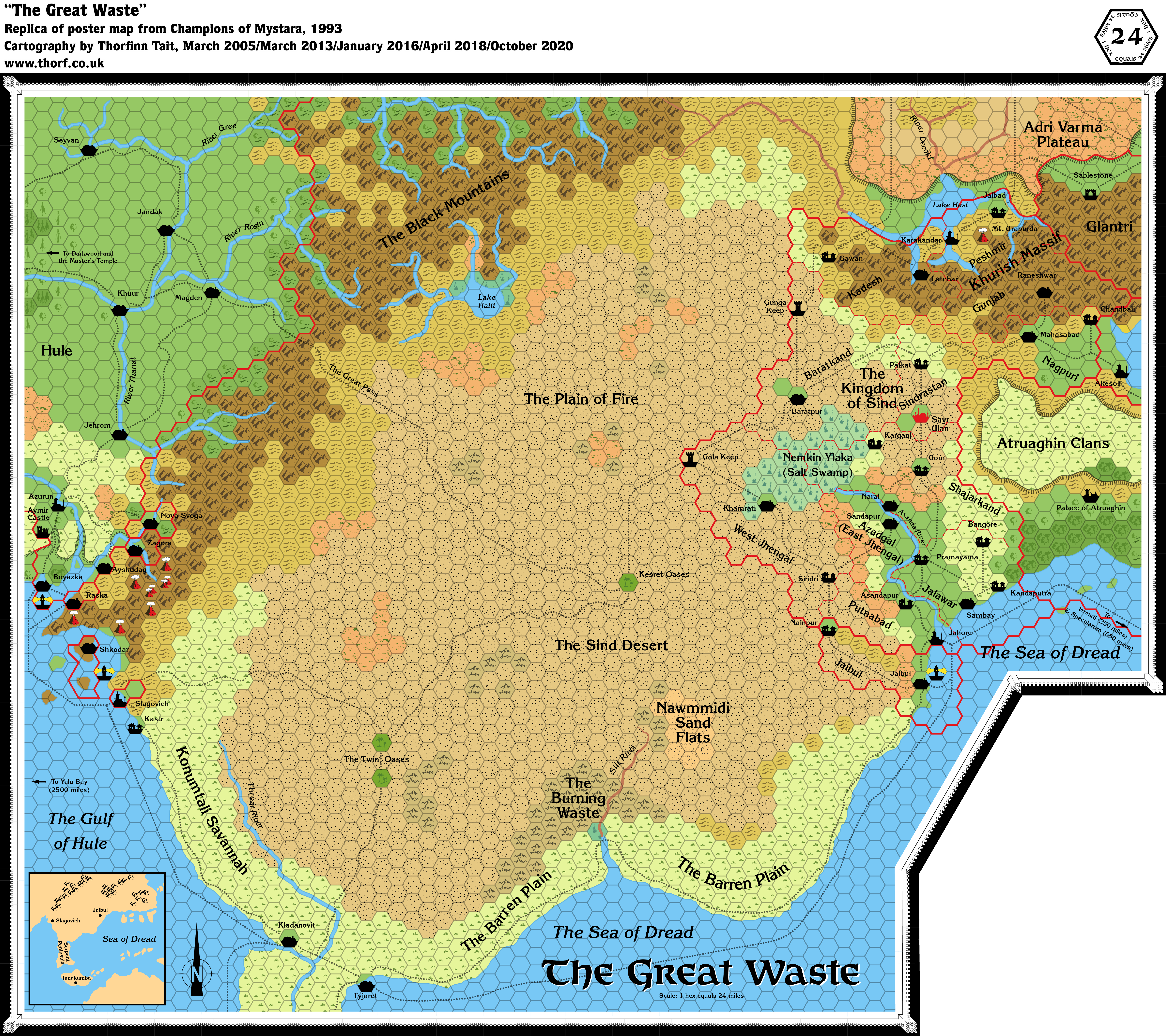
Oases are few and far between. The Twin Oases in the southwest and Kesret Oases in the middle are the two marked on the map. 

It is tempting to try to shoehorn excuses for lots of encounters into here but maybe this is not sensible. Perhaps this is better left mostly empty. Few monsters, settlements and other encounters. This really is quite barren. The environment becomes the real challenge: Dehydration, sunburn and disorientation become the predominant threats to adventurers, not wandering monsters. 

Although such geographic areas are not given level ranges for characters in the same way that modules are, I would consider it too dangerous for low-level PCs - it is not just the monstrous encounters that mean X4 is recommended for PCs of mid level (6th-9th). Having access to the 4th level cleric spell Create Water is a game-changer and could make the caster popular with NPCs. 

Besides, Graakhalia is part of, or at least connects to, the Shadowdeep, Mystara's underdark, so there are plenty of caves to explore there. And there may be a few desert ruins - proto-Hulean outposts and settlements abandoned as the desertification of the land intensified. These ruins are much sought after by various creatures, few of them pleasant. Bhuts, Nagpas, undead such as wights & mummies and monstrous forces of Hule can all be found in these ruins. The Evil Abbey and the Buried Temple from X4 are typical ruins. 

It’s a big area. 39 hexes x 24 miles/hex = 936 miles across in the middle. There is a caravan track across, and this will have more encounters. X4 explores this, with the option of PCs joining a caravan for part of the journey. Assuming land travel at 24 miles per day, this means crossing the desert will take 39 days. The caravan trail does pass through the two oases mentioned, but even so that’s over a week without natural water between oases. Clerics who can create water will be appreciated.  Failing that, camels (who need less frequent water) are preferable to horses for this journey.  

This is between Hule and Sind, so there will be patrols and merchants from both realms. During X4 & X5 there will also be armies marching across. What about Glantri and Darokin? There could well be travellers from these and other nations further east if they have reason to travel to Hule. The Serpent Peninsula is large enough that to sail around its southern tip would take as much time as to travel the Great Waste on camel.

Cartography by Thorfinn Tait, source

https://mystara.thorfmaps.com/wp-content/uploads/2016/01/champions-great-waste-24.png

All in all I think this could be a great place for mid and high level adventures and I may come back to it and its bordering regions in future posts.