Thursday, 28 July 2022

New Undead Creatures

 Bloated Zombie

Image by JamesDentonsource

NameBloated Zombie
Armor Class7
Hit Dice (Avg hp)2 (9hp)
Movement60’
No Attacks2 claws
THAC019
Damage1d4/1d4 
No Enc1d4
Save asF2
Morale12
AlignmentChaotic
Treasurenil
Size/TypeMedium Undead
Intelligence0 (non-)
XP value30
Bloated zombies are similar to normal zombies except for their bloated, distended tissues under their greenish skin, especially around the abdomen. While still animated they fight much like normal zombies, losing intiative and attacking last with their rotten hands. When they are slain, however, they explode in a disgusting and messy way, spraying anyone in a 10' radius (including anyone in melee range) with gangrenous acidic fluids. This causes 1d6 acid damage to each creature in range.

Bloated zombies are not immune to each others' acidic fluids, so one exploding may cause another nearby bloated zombie to explode – possibly setting off a vile chain reaction. As they are mindless and have no sense of self-preservation they will not avoid this.
Like other zombies, bloated zombies are undead, and thus immune to charm, sleep and other mind-affecting spells, as well as poison and disease. They can be turned as if they were ghouls.

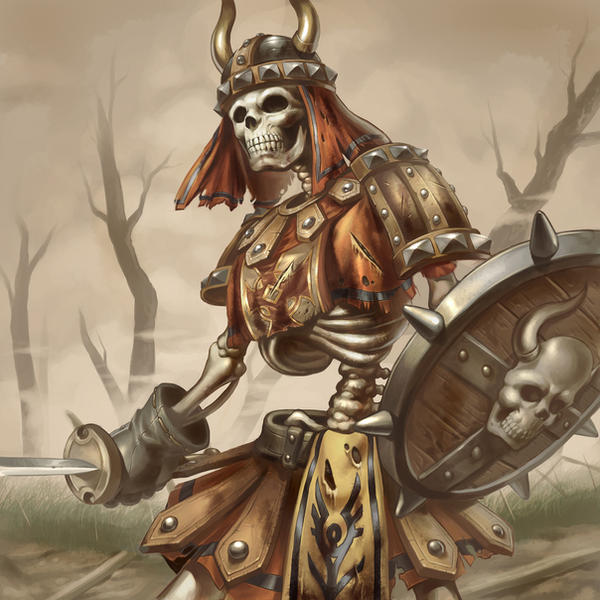
Bone Warrior

image by reaper78source 
NameBone Warrior
Armor Class5
Hit Dice (Avg hp)3 (14hp)
Movement120’
No Attacks1 weapon
THAC017
Damage1d8+1 
No Enc1d6
Save asF3
Morale12
AlignmentChaotic
Treasurenil
Size/TypeMedium Undead
Intelligence3-4 (semi-)
XP value35

Bone warriors are the animated remains of experienced fighters, and some skill seems to have somehow lingered in the bones. Bone warriors are superior in combat to normal skeletons. It is unknown exactly how clerics of Chaos manage to create these variants, but even casual observation shows that they move in a more steady and purposeful way than other animated undead. Bone warriors wear armour and some sort of weapon, usually a sword. They are often found in small squads, assigned specific duties too important to be left to normal skeletons. Their modicum of intellect is used in combat for tactics that normal skeletons would not think of. Bone warriors are undead and thus immune to charm, sleep and other mind-affecting spells, as well as poison and disease. They can be turned as wights by clerics.

Skeletal Rat

source
NameSkeletal Rat
Armor Class7
Hit Dice (Avg hp)1/2 (2hp)
Movement90’
No Attacks1 bite
THAC020
Damage1d3 
No Enc2d10
Save asNM
Morale12
AlignmentChaotic
Treasurenil
Size/TypeSmall Undead
Intelligence0 (non)
XP value5

Skeletal rats are the animated remains of giant rats, and are about the size of small dogs. Although one on its own is little threat to a party of adventurers they are nearly always found in packs up to 20 strong, and as such they may overwhelm with sheer numbers. They are created using dead giant rats and a cleric with Animate Dead spells and as such are usually found in chaotic temples or cursed crypts. They have a tendency to attack and kill any living thing, even living giant rats. 

Like other skeletons, skeletal rats are undead, and thus immune to charm, sleep and other mind-affecting spells as well as poison and disease. 


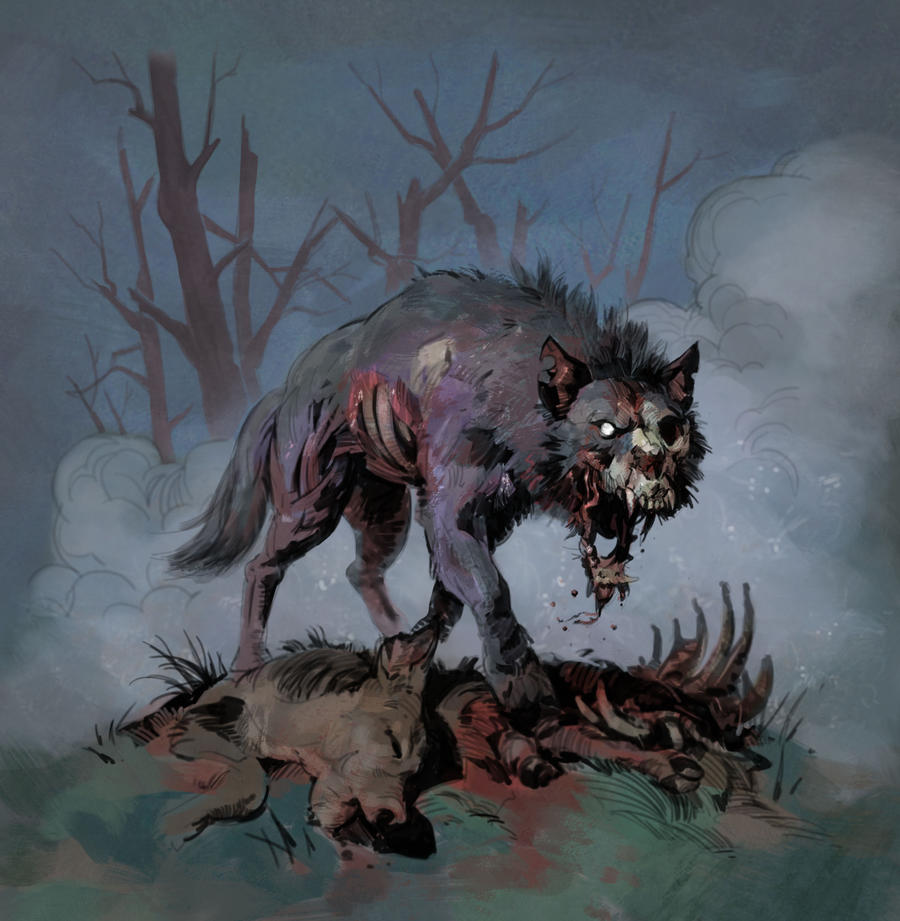
Zombie Wolf

Image by EedenArtwork, source
Namezombie wolf
Armor Class6
Hit Dice (Avg hp)3+2
Movement120’
No Attacks1 bite
THAC017
Damage1d6+1 
No Enc1d6
Save asF3
Morale12
AlignmentChaotic
Treasurenil
Size/TypeMedium Undead
Intelligence0 (non-)
XP value50

Zombie wolves are the animated remains of wolves, coyotes and large domestic dogs, created by chaotic and despicable spellcasters using Animate Dead spells. Although they attack slower than living wolves (like other zombies they attack last in each round), they can still lope around as fast as a human can run, and therefore are used when humanoid zombies are too slow. Zombie wolves are of course undead and thus immune to charm, sleep and other mind-affecting spells, as well as poison and disease. They can be turned by clerics as if they were ghouls.


Friday, 8 July 2022

The Lost Treasure of Captain Grigorivic

 Captain Grigorivic was one of the great pirates of the Sea of Dread a hundred years ago. From AC 891 to AC 920 he was the scourge of the seas, raiding Karameikos, Thyatis, Minrothrad and the Five Shires in his ship the Bloodied Rose. He and his crew accumulated a king's ransom in treasure - some say worth half a million gold pieces. 

In 919 he buried a large amount on an island off the Serpent Peninsula - not just some simple pit, but a carefully constructed vault built into a repurposed native temple. There were certain puzzles and traps set with specific solutions by his most trusted crewmen. Once they had set all the traps, Grigorivic killed them to keep them silent. He was the only one who knew how to circumvent the traps. 


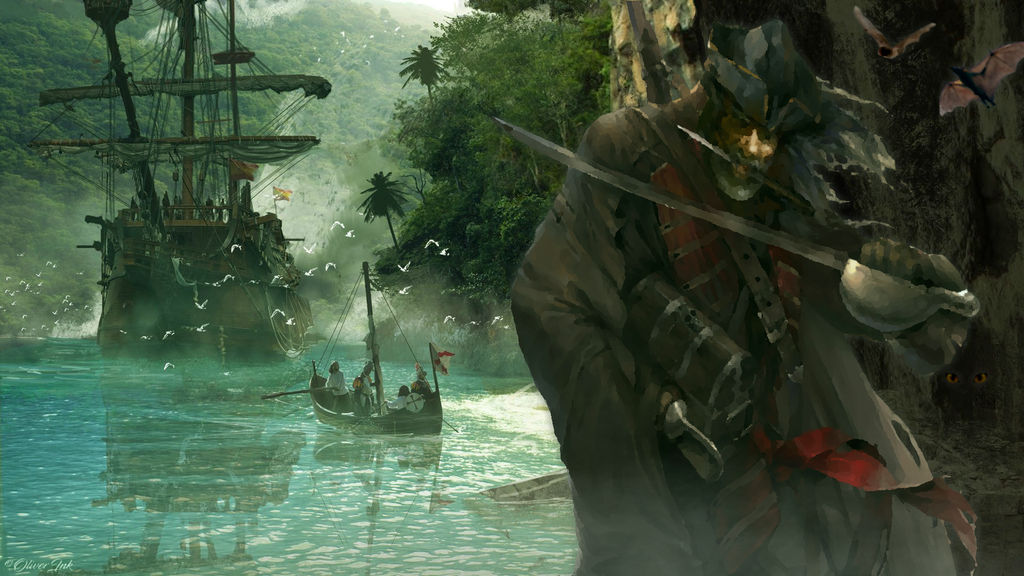
Flint's Treasure, Jul 13, 2018 by OliverInk

He and the rest of his crew sailed away, with Grigorivic creating his own map to find the same island and native temple. Grigorivic continued his reign of piracy on the high seas in the Bloodied Rose for another year until AC 930 when his luck ran out. While trying to reach the port of Vlaad the Bloodied Rose ran into the reefs northeast of Fletcher Island and was wrecked. Captain Grigorivic went down with the ship along with with his map to the island and the native temple. 

The wreck of the Bloodied Rose is dangerous to anyone venturing inside. First of all it is under 50 feet of seawater, with only the top of the mast sticking above the waves at low tide. Anyone going down to the wreck had either be able to breathe underwater or be really good at holding their breath. Captain Grigorivic is still in charge, this time as a wight, commanding a quite literal skeleton crew with the bo'sun' and first mate as ghouls. The local wildlife is not too friendly either, with bull and mako sharks patrolling the area. However, should adventurers find their way into the captain's cabin they will find his chest which contains a decent amount of treasure in itself (acquired in the year after burying his main hoard). More importantly they will find the map that leads to the island. 

The wreck of the Bloodied Rose has been discovered by local fishermen who in turn alerted Darionus Astor, a merchant of Darokin based in Athenos who specialises in salvaging from wrecks. His team, based on the ship The Valiant Porpoise, used their Helmets of Water Breathing to dive down. They managed to confirm the identity of the ship but were then attacked by the undead crew. One diver was killed, another was injured and had to be pulled back to the Valiant Porpoise by the other two surviving divers while being chased by sharks who sensed blood in the water. 

After retreating back to Athenos for resupply and academic research, Darionus has decided the Bloodied Rose is worth another attempt, this time with adventurers who can fend off any monstrous threats. Darionus is willing to split the treasure but as a classic Darokinian he will try to negotiate the best deal, although he will refuse to help the adventurers if his cut is less than 30%. Given the treasure map could lead to much greater riches, the PCs could accept this split. 

Friday, 1 July 2022

The Town of Barathmir


based on original by sixinchnails, source

This is a small town on the north coast of the Great Bay of Norwold, situated between the dominions of Panteria and Latela.  Interestingly it is not ruled as a dominion by some powerful warlord or former adventurer with pretensions of nobility. It is mostly self-governing though with obvious fealty to the King in Alpha

Barathmir has a population of 660, mostly human but with some hin (halflings) and elves. There are also sometimes visitors including local tribal elves and lupins. 


The town economy relies on a combination of fishing, forestry and hunting for meat, fur and leather but is always looking out for new resources to exploit. As the map above shows, the town has a substantial wooden palisade studded with watchtowers, and a decent port complete with harbour wall. 
Significant buildings numbered on the map are:
  1. The Mayor's Residence. 
  2. The Chapel of Law
  3. Farnath's Forge (local blacksmith)
  4. The Town Well (principle source of fresh water)
  5. The Iron Halberd Inn
  6. The Gatehouses
  7. The Bay Watchtower
  8. The Merchant-Traders' Guild
  9. The Warehouse
History: Barathmir was founded about 60 years ago as a trading outpost and has slowly developed since then. It suffered near-catastrophe several times in its history, including the dread winter of 955AC when half the population died of starvation or cold but the residents could not flee because the bay had frozen. The giant attack of 979AC saw  a band of 7 hill giants rampage through the town, killing the then governor and anyone who opposed them, destroying the local barracks and seizing dozens of sheep and cows. Ulquolor the Usurper was a mage exiled from Glantri for various crimes who arrived in 981AC (the townsfolk were still rebuilding from the giant attack) and took over the town as his own private fief for several weeks. Several fishermen escaped across the bay to Alpha and returned with an elderly couple who turned out to be Alphatian mages on a retirement cruise around the Alphatian Empire. One Feeblemind spell later and order was restored.

Diplomacy & Relations: The leaders of Barathmir try to maintain a good relationship with Alpha and will regularly pay taxes but otherwise they try to stay neutral in matters of Thyatis vs Alphatia. 
Trade with the local elves ensures some goodwill and communication. Although the elves are unlikely to risk themselves if Barathmir is under attack, they will at least try to warn the town. In return the townsfolk try to be restrained and respectful around lumber and forestry.  
Similarly there is a local tribe of Malamute lupins who are usually friendly but do warn the townsfolk about overhunting.  
The town is aware that it is between Panteria and Latela, both of which are described in Vaults of Pandius. With Panteria firmly loyal to Alpha and Latela being an outpost of Thyatian subversion and greed, the leaders of Barathmir fear the town may be the focus of a subtle but dangerous power struggle between agents of the great empires. 

Defences: As a rugged frontier town, Barathmir has a militia system where every man between 18 and 40 is expected to train with weapons every week. This has produced a pool of 120 1st level fighters, no standard equipment but usually spear, shortbow and maybe leather armour. In addition, the mayor has a professional bodyguard of 20 swordsmen (human F3). Finally there are various NPCs with levels in adventuring classes, including clerics in the Chapel of Law and a maybe a wizard visiting from Alphatia. 

Notable residents include:
  • Mayor Osquith (human male MU3, neutral, Str 8, Int 14, Wis 7, Dex 12, Con 10, Cha 10) is not a very effective ruler - he seems perpetually out of his depth with almost any significant decision. He relies heavily on those around him. He is the third son of a mage and minor aristocrat in Alpha who basically asked the king to give the job to his rather useless son. 
  • Captain Gunningham (human female, F5, lawful, Str 14, Int 12, Wis 11, Dex 10, Con 14, Cha 13) is in charge of defence and policing. Although technically subordinate to the mayor, she really has free reign. Fortunately she takes her responsibility seriously and wants to protect the town and keep it safe. 
  • Mellissa Wazzak (human female, MU4, chaotic, Str 7, Int 16, Wis 13, Dex 10, Con 10, Cha 13) is one of the principle merchants in town and organises a lot of the trade with other settlements along the bay, including Alpha. She is self-serving and greedy. She is also a part-time agent for the rulers in Latela, but only when they pay her enough.  
  • Sandrina the Surfwatcher (human female, C3, neutral, Str 10, Int 12, Wis 16, Dex 8, Con 13, Cha 10) is a cleric of a neutral Exalted patron of the seas and sailors. She has taken up residence in the Bay Watchtower and has built up a small congregation among the fishermen and caravel sailors.
  • Sorsoni the Mysterious (elf male, elf spellsword 5, neutral, Str 8, Int 16, Wis 12, Dex 10, Con 9,  Cha 14) is considered the most knowledgeable of the townsfolk. In matters of lore, magic, legend and monsters he is almost a sage.  
  • Father Rythorn (human male, C4, lawful, Str 10, Int 11, Wis 15, Dex 7, Con 16, Cha 11) is the chief cleric in the Chapel of Law. He sees his two main duties as firstly protecting and helping the community of Barathmir, and secondly detecting and investigating the forces of Chaos that may lurk in the region. 
  • Ribbari Buttonjacket (halfling male, H3, neutral, Str 9, Int 10, Wis 12, Dex 13, Con 14, Cha 15) is the landlord of the Iron Halberd Inn, the only place in town that offers accommodation to strangers. Ribbari is generally easy-going and friendly, but he does expect payment and can get very angry if he thinks customers are taking his hospitality for free. 

Friday, 24 June 2022

Rough ideas about a Norwold Campaign

Regular readers will have noticed that I have started to pay attention to Norwold, setting of various Companion level modules such as CM1: Test of the Warlords and CM2: Death's Ride. My idea is that Norwold need not be just for high-level characters but could accommodate PCs and adventures right from 1st level. 

So what sort of adventures am I thinking of? Part of me really likes the epic campaign arcs first introduced in the AD&D GDQ series starting with fighting hill giants in G1: Steading of the Hill Giant Chief, progressing through the larger giants (G2 & G3), going underground in D1-3 and eventually confronting the demon queen Lolth herself in Q1: Queeen of the Demonweb Pits. 

The Dragonlance series also had a go at this, with the original DL1-14 series taking the PCs all over the Dragonlance continent of Ansalon in an epic war against the evil Dragonarmies. However, this did highlight a problem with these long storylines - railroading. You know you are railroaded when characters are not even allowed to die if the almighty storyline requires them to live. 

art by Caldwell, Parkinson & Easley, source

Paizo took up the baton in the 2000's with their adventure paths - although written for their own Pathfinder game, they were compatible with D&D 3.x. And they produced a lot of them - according to the Paizo website, 24 Adventure Paths, each with 6 parts that could be considered adventures. That's 144 adventures. 

5E has had a go at the epic campaign story, with pairs of hardback adventure books, such as Hoard of the Dragon Queen + Rise of Tiamat. However, I do get the feeling that the PCs' level gains are artificially accelerated to keep up with the increased threats in the story. My personal feeling is that PCs should gain levels through regularly earned experience points, not because the story says so. And I do recognise that gaining levels in B/X is slower than in more recent editions, plus less equal among the PCs of the party because of different progressions for each class. 

The big question of these epic story lines is "Will the players and PCs stay interested or will they want to do something else after a while?" I cannot answer that, but I will assume that they stay interested. I suspect it will require a better adventure-writer than myself to keep players interested in a single story line over 20 levels and months (possibly years) of game-play.  

So can it be done in Norwold? Should it be done or is it a bad idea? I think it can be done, though I won't try to produce anything of either the size or quality of the previously mentioned published campaigns. This is an amateur blog after all. 

The main bad guys will be the Arvorians, in a way not that different from the drow of the GDQ series. Intelligent and manipulative, I expect they will start off only behind the scenes, encouraging attacks against civilized towns in Norwold by chaotic humanoids and human chaos cultists. Their end goal is to open up the dimensional prisons and unleash their alien masters (the Scions of the Outer Dark)  onto Mystara. Therefore the PCs may well end up trying to save the world - That's pretty epic.

Things to be considered as part of this campaign (The exact order may change but this is my rough outline):

  • The PCs arriving in the Great Bay of Norwold, possibly Alpha the capital. 
  • Initial, seemingly mundane adventures that hint at the bigger picture
  • Investigating clues to the Arvorians' existence
  • Finding the Arvorians' hands behind various attacks against civilized settlements and projects
  • Exploring the ruins of the Arvorian cities and the dungeons beneath them
  • Encountering the Arvorians in combat
  • Finding out about their quest to undo ancient magics
  • Learning about the Arvorians' chaotic and alien masters
  • Realising that the Arvorians are trying to set their masters (Scions of the Outer Darkness) free
  • Preventing this from happening and thus saving the world
source

Another thing I am considering is Eldritch Crystals. These are fragments of magical monoliths shattered when the Blackmoorians attacked the Arvorians and scattered when Blackmoor was destroyed in the Great Rain of Fire. They are still full of magical power and could be used to fuel mighty rituals that could either open the dimensional prisons that hold the Scions, or else permanently shut them. Eldritch crystals appear as green, blue or cyan glowing gems, usually of rough and uncut form. Although they look nice as ornamental stones in broaches or other jewelry, any mage casting Detect Magic will realize they are no ordinary mineral, though the exact nature of their magic is not clear. They are sought after by Arvorians, particularly those who are eager to free their alien masters.  However, human mages and elves would love to get their hands on them, as eldritch crystals can be used to power certain magic items. 

Something else I should bear in mind is that not every adventure or session needs to be an integral part of this story about the Arvorians. There can be side-treks, subplots and other agendas. I believe this is one of the reasons the 5E adventure hardbacks force the PCs to level up quicker than they would do so simply with awarded XP - the books, hefty though they might be, simply cannot contain the side-treks and episodic adventures that would allow normal leveling by XP. The political intrigues of the various new dominions in Norwold, particularly those sponsored by either Thyatis or Alphatia could be a steady source of adventures. Similarly there may be non-human forces quite separate from the Arvorians who may make their presence felt - the dragons of the Icereach range of mountains may have formed a loose coalition and pressed the humanoid tribes into service. Trade, commerce and acquiring new resources is an important part of rulership, and the PCs may be asked to assist in developing these in the new baronies and duchies of Norwold. Rather than a tightly controlled railroad, this could be a sandbox campaign but with a suggested path heading towards the cities of the Arvorians. 

See also the following posts that could tie into this campaign


Thursday, 26 May 2022

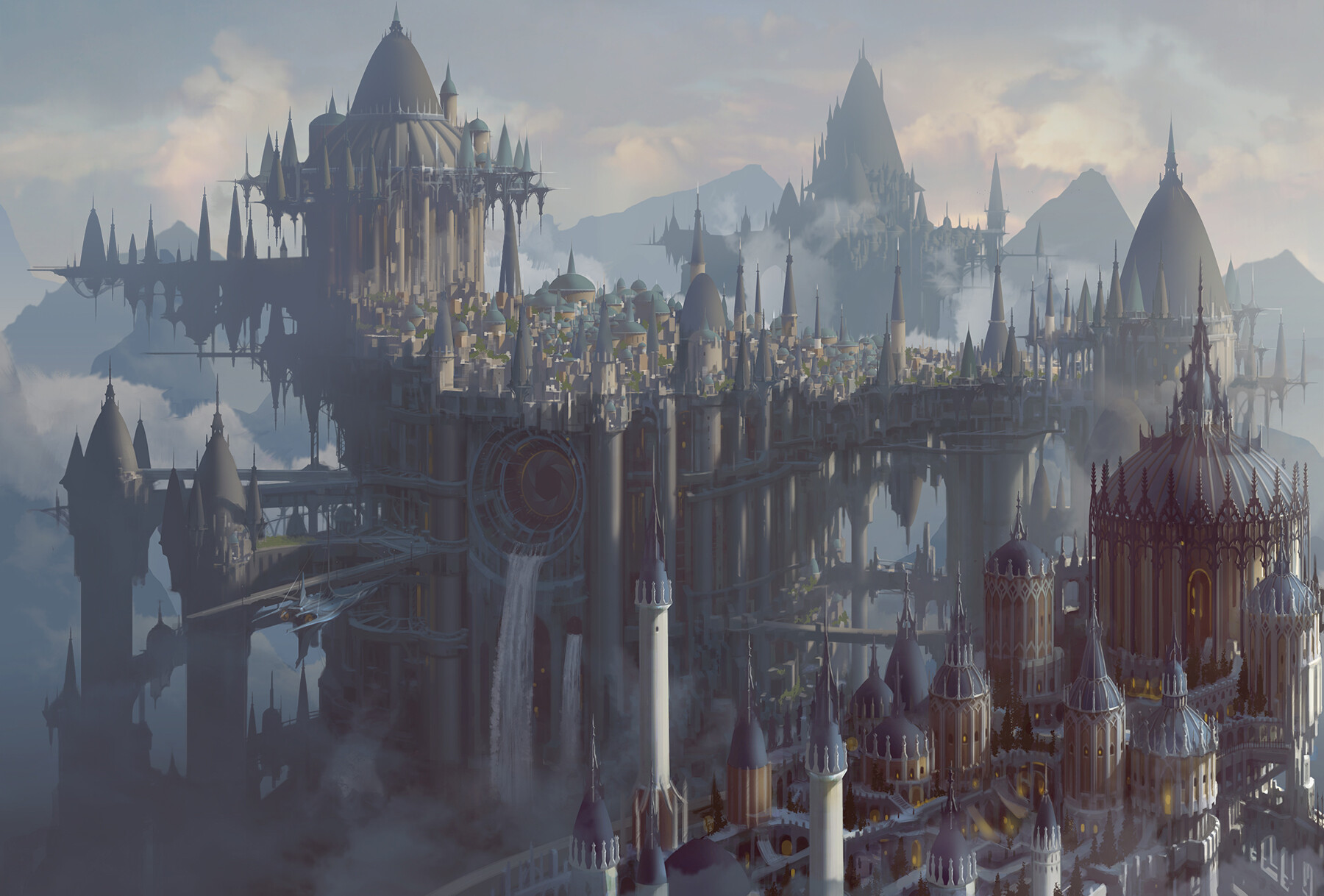
The Floating City of Aalthir


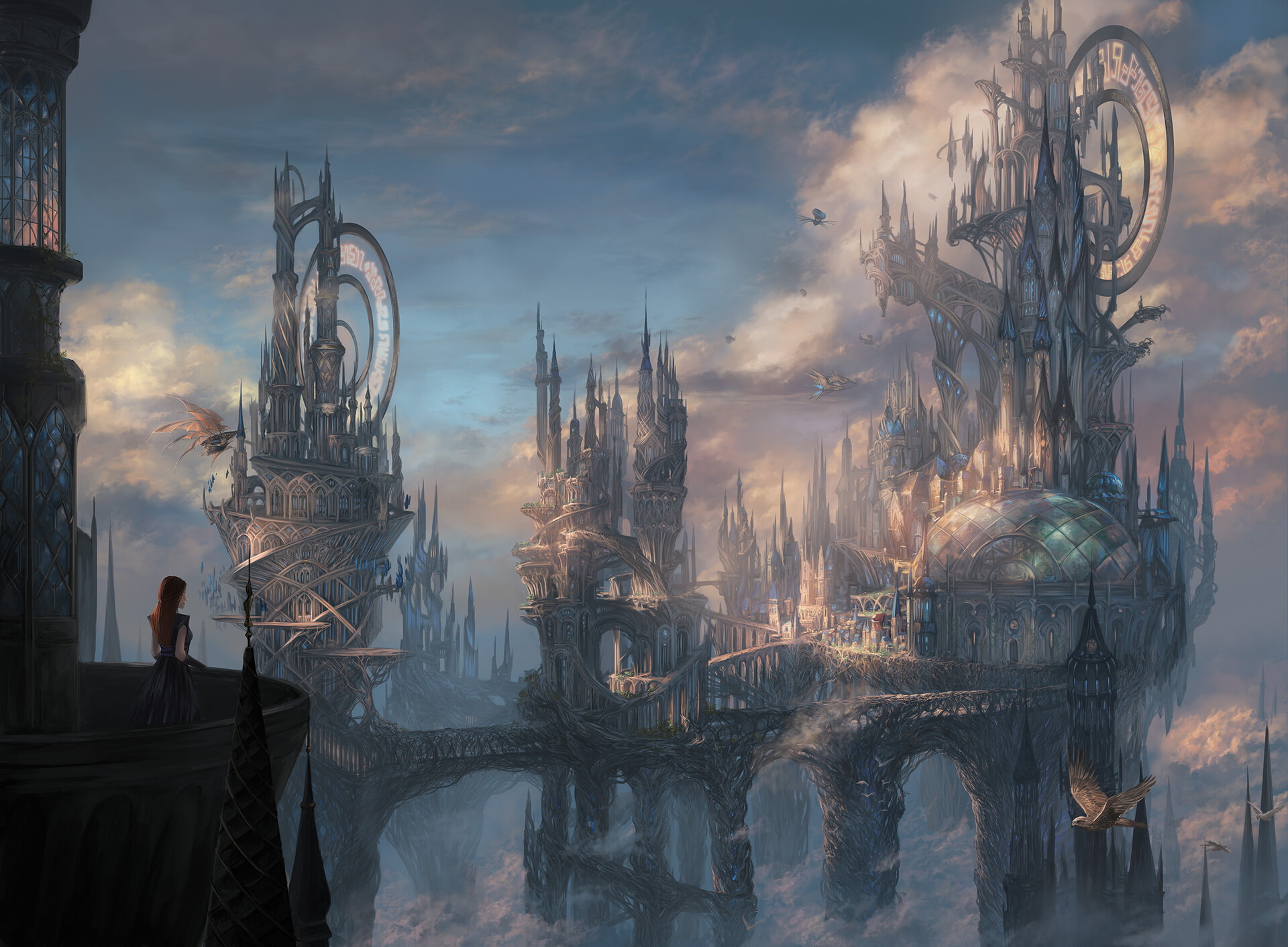
Art by min seub Jung - source
Using similar magical techniques that created Floating Ar from northern Alphatia, Aalthir is the extraordinary result of a circle of 12 Alphatian archmages (36th level magic users) who combined their expertise and magical powers to create a floating metropolis over 300 years ago about 6 square miles in area and nearly half a mile from bottom of the rocky base to the highest pinnacle. Politically Aalthir is run by a council of 12 high-level magic users, the successors to the creators. Those who can claim a link of either blood or apprenticeship to the original archmages are considered particularly noble and well-regarded. The ruling council offer lip service to the Empress of Alphatia and try not to cross her but most of the time they act as an independent city state

Unlike Floating Ar, Aalthir is not limited to roaming a single kingdom of Alphatia but can float all over the surface of Mystara, and is currently over northern Davania. The city can be moved by a powerful wizard seated on the Throne of Aalthir in the Lords' Palace in the centre of the city - this is nearly always one of the council members with the approval of the ruling council. While on this magical throne the mage can move the city at about 6 miles an hour, usually for a 4 hour session, after which the mage becomes mentally exhausted and needs to rest. Although this is not fast compared to even a Fly spell, the entire city weighing thousands of tons moves. If multiple wizards are willing to take turns on the Throne of Aalthir, the city can move 144 miles per day (two 72-mile hexes)

Current population is 23,000, of whom about 2,000 are magic users of various levels of power. As with other Alphatian cities Aalthir is dominated both legally, culturally and militarily by mages. There are also other human classes and a few demihumans, and also a small group of 10 pegataurs. Feeding this population would be difficult were it not for the Hall of Portals, which is a cathedral-sized building with a huge central hall filled with dozens of archways that frame magical portals that lead back to various places in Alphatia. This enables the all-important food supply as well as other forms of trade and commerce. This is supplemented by a fleet of 23 Alphatian air-ships anchored on the side of the city. These can swoop down to wherever the city is floating over and trade with locals or, if in wilderness, gather resources straight from the land.  There is also a city stable with 23 hippogriffs and 30 pegasi. No regular horses are found on Aalthir - the chances of them panicking and falling off the edge with their riders is too great. and The inhabitants all speak Alphatian common and their culture and attitude is mostly Alphatian, but with a cosmopolitan multicultural touch. Due to the travels of the city it is inevitable that the inhabitants have more frequent contact with other nations and cultures than most Alphatians on solid land. 

Art by Alayna Lemmer-Danner, source

In terms of dealing with other nations, the city is peaceful but quite arrogant. The city effectively comes and goes as it pleases without regards to national boundaries, and with the large numbers of resident wizards the city is confident of winning any fight - especially if on the defensive. Attacking any city is a difficult military operation but attacking one floating nearly a mile above the ground is nearly impossible for most nations - only Thyatis and Glantri offer a serious threat and so these nations are avoided by the city. Also wilderness dominated by dragons (such as the Wyrmsteeth Range in Norwold) is given a wide berth. 

As with so many cities, there are a wide variety of groups and powerful characters. Merchants trade, clerics preach, thieves steal and guardsmen patrol. The big difference is that that this is all happening a mile or so above the ground. 

The city merchants are good at trading a wide variety of items from all over the world - certain parts of the city are dedicated warehouse districts. While hovering over a region, merchants from Aalthir will take the opportunity to travel down on the skyships and buy local goods straight from the producers. Rare woods, fine wines, gems, minerals, well-crafted weapons or furniture, fabrics, works of art and other tradable things are all bought at relatively low prices, then sold at a markup when Aalthir moves on to another region The merchants of both Minrothad and Darokin are quite jealous, and some have requested to move to Aalthir permanently. This is not always granted - the city bureaucrats have a complex procedure involving a lot of form-filling and paperwork, but this can be overruled by any of the 12 archmages of the ruling council. 

See also 


Friday, 20 May 2022

The Arvorians of Norwold


Image by JackWangLei, source 

Arvorians are an ancient humanoid race that were around from before the age of Blackmoor. They are nearly always chaotic in alignment and worship dark powers from beyond the known ranks of the "normal" Immortals.  

As Non Player Characters

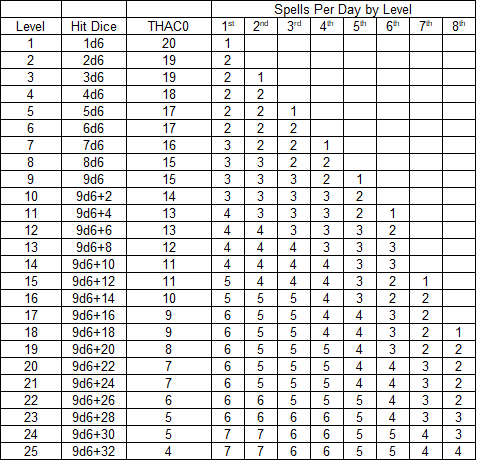
There are 2 classes of Arvorians, the Eldritch Crusaders and the Arcane Knights. Both can use any armour, shield and weapon as a fighter, but while the Crusaders cast spells from the clerical list, the Arcane Knights cast spells from the Magic User list. Thus the Arcane Knights are similar to elves in their combat abilities (fighter/magic users in AD&D terms) while the Eldritch Crusaders are closer to AD&D fighter/clerics. The table below applies to both Arvorian classes although for the Crusaders the column for 8th level spells should be ignored (cleric spells only go up to 7th level). As they are intended as NPCs, no XP requirements are given (though the XP progression for elves would be suitable for the first 10 levels). 


All Arvorians have infravision to 60'. They can all Read Magic at will as if it were a natural language and Detect Magic once per turn.
Unlike other editions of D&D, B/X does not have racial adjustments to ability scores. But if they are used, Arvorians would get +2 to Intelligence but -2 to Constitution. They are an extremely clever and magically talented race, but they are decadent and their bodies are not as robust as those of younger races. 

Eldritch Crusaders can use any magic item that either fighters or clerics  can use, while Arcane Knights can use any magic item that a fighter or a magic user can use. 

Appearance

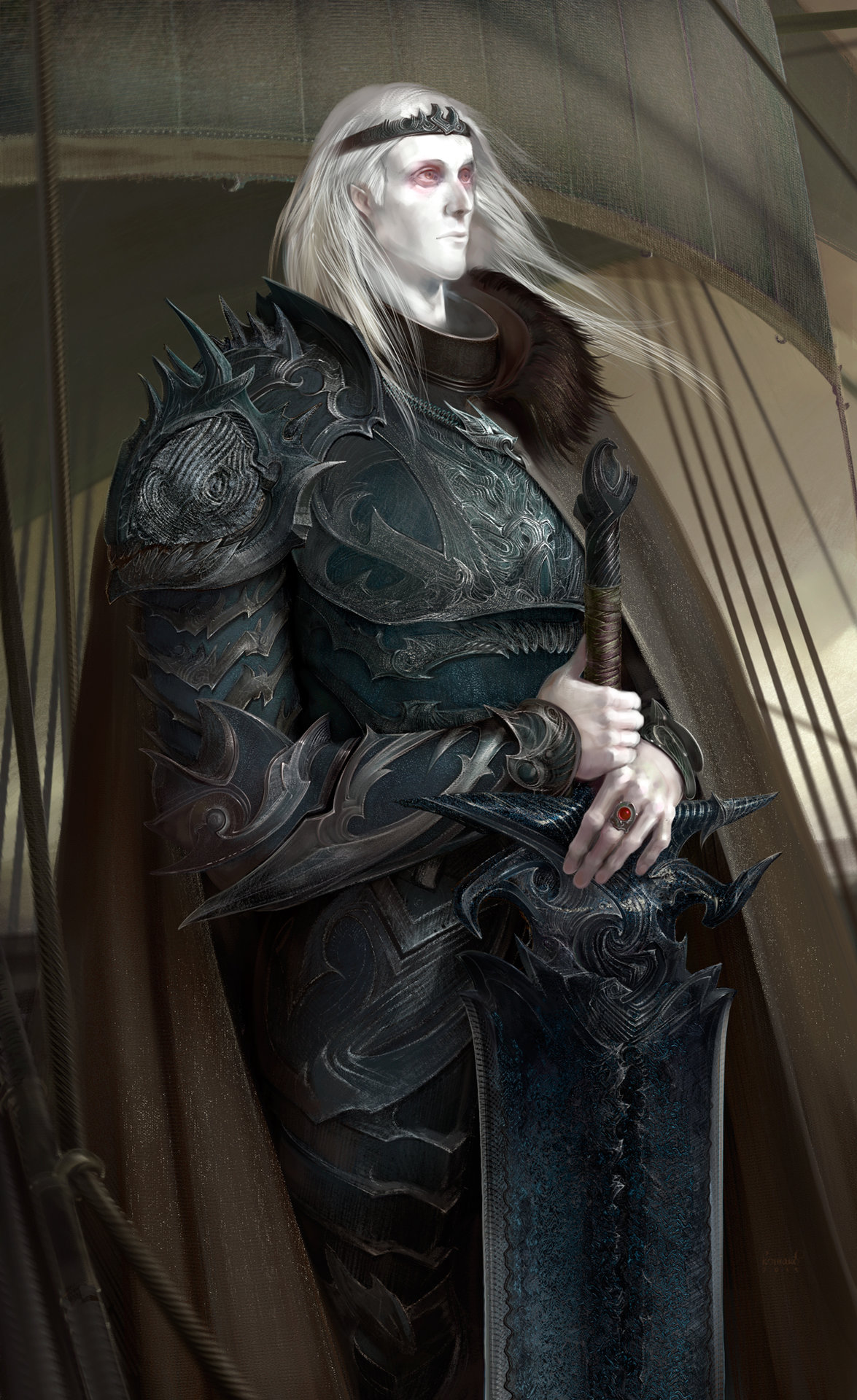
Arvorians are slim like elves and pale, often to the point of albinism. They have very pale, often white skin and pale blonde or white hair, and pink or blue eyes. They have almost no facial or body hair. They appear ageless, and can live for up to 500 years. They are often very vain, and want to look good, even when bringing chaos and destruction. Arvorians are from a decadent civilization and always dress well. Even their armour looks elegant. 

Image by shuo liu, source

Culture and History

 Arvorians worship entities from beyond normal time and space that are quite different from the known Immortals of Mystara known as the Great Old Ones. The Great Old Ones are inscrutable, with inhuman, incomprehensible motives - some Arvorians have theorised that while some Immortals drawn on the Sphere of Entropy, the Great Old Ones are born of it. But they sent certain servants to Mystara to act as intermediaries to deal with these curious, upstart mortal arvorians. These servants were known as Scions of the Outer Dark, and although they were as alien as their Great Old One masters these scions could communicate with and grant assistance to their Arvorian followers. These Scions of the Outer Dark often took physical form as avatars - some appeared as Arvorians, hiding their true natures, while other scions were far less discrete and their appearance is the stuff of nightmares even for those who have faced liches and beholders. It is said that the avatar of E'hillit could drive a mortal to insanity at a glance, and although it could have taken a less shocking form, it did not care to. 

Arvorians have been around for millennia and were contemporaries of Blackmoor when it was at the height of its technological power and splendour. But the attitudes of the two civilizations were very different and there was an intense rivalry that bordered on hatred. This was partly because of their different sources of power - the Blackmoorians used a combination of magic and technology, while the Arvorians worshipped and were assisted by things of ineffable darkness and horror. 

A century before the cataclysm a strike force of powerful wizards, clerics and fighters from Blackmoor equipped with the greatest technological weapons magically travelled to Arvoria and in a series of battles they imprisoned the Scions of the Outer Darkness in dimensions beyond normal time and space. The Arvorians were filled with outrage but were powerless to retaliate. 

When the Great Rain of Fire struck Blackmoor in 3000BC, Arvoria was severely damaged but not entirely destroyed. The axis of Mystara shifted and Arvoria, which had previously enjoyed a temperate climate, suddenly found the weather getting much colder. What was the nation of Arvoria is now the Norwold region of Brun. The Arvorians blamed the Blackmoorians for this global disaster. Since the Blackmoorians themselves were destroyed, the Arvorians turned to surviving humans and demihumans for vengeance. 

These days the Arvorians live in underground cities and dungeons beneath the surface of Norwold. They are a long-lived, patient race and they know how to pass strategies and long-term plans from one generation to the next. Their overall plan is to open up the dimensional prisons that hold their alien masters and allow the Scions of the Outer Dark to roam free on Mystara. The Scions may be imprisoned but they can still communicate in dreams and can still grant clerical spells to Arvorian Eldritch Crusaders. The Arvorians are convinced that when they have freed the Scions of the Outer Dark they will forge a new Arvorian Empire through blood and magic that will push aside all the other mortal races, including the hated humans. Then they will have their long-awaited vengeance and become the ultimate civilization on Mystara. Whether the Scions of the Outer Dark intend to stick to this plan is another matter. 

There are also some Arvorians who have ascended to immortality, usually sponsored by a Great Old One based on a Scion's recommendation. Such Arvorian immortals are nearly always Chaotic (and hence Chaos Princes) and draw on the Sphere of Entropy. These offer a more relatable and understandable patron than the Scions of the Outer Dark who were never mortal and are often utterly alien in thought, deed and appearance. 

Arvorians are contemptuous of other races. Nonetheless they can still find uses for them, particularly chaotic humanoids such as orcs, goblins and gnolls. As such these tribal humanoids are often found as the bottom caste of Arvorian society, acting as footsoldiers, servants and menial labour. Chaotic humans have their uses as well, and the Arvorians will often encourage the Cult of Chaos as a useful pool of servants and allies, though they view the cultists as far beneath them and utterly expendable, barely better than the orcs and gnolls.

Image by Alexandr Komarov, source


Thursday, 12 May 2022

Dwarf Strongholds

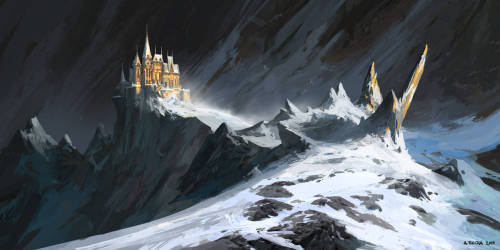
Image by andreasrocha, source

Scattered throughout the dwarven kingdom of Rockhome and also found in nearby lands such as Ylaruam, Karameikos and Darokin, dwarves have set up fortified homes in mountainous regions across the Known World. Many of these are small enough not to be marked by cartographers - their populations typically stay below 1000 which is the demarcation point between a village and a town. 

Structure and Architecture 

How much is above or below ground? This varies, as does the architectural style. Most dwarf strongholds will have some of both - a visible part above ground which may be like a human fortified town or village, or perhaps a fortress with towers, curtain walls and a keep. The entrance to the underground part is sometimes large enough that carts pulled by mules and donkeys can get through with trade goods and supplies. Other times it may be narrow enough for a single dwarf to block it - useful if under attack. These entrances are often trapped or at least offer tactical advantages for the defenders such as murder holes, firing ports from side chambers and perhaps a pit with a drawbridge. How much of the stronghold is underground will vary, but most dwarf strongholds are around 1/4 above ground, 3/4 below. There are of course some where the surface structure is minimal - perhaps a fortified gate set into the mountainside.  In terms of building style some dwarf strongholds will be simple, while others, typically of the wealthier families, will have fine carvings, imported stone and bronze and brass fittings, looking quite baroque. Some may feel small and claustrophobic, while others will have great vaulted ceilings supported by pillars like medieval cathedrals. 

Politics

Most strongholds are owned and inhabited by a single dwarf family. The leader of this extended family is a dwarf of considerable renown and often of great fighting prowess - stronghold chiefs are expected to be the military leaders and champions of their families. Such chiefs are usually referred to as Dotars, particularly if their strongholds have fewer than 1000 dwarves. If the stronghold holds 1000 or more  inhabitants, the chief is entitled to sit in the Senate of Rockhome in Dengar as a Senator (Krey). If a chief becomes old and infirm he may well step down and hand over to his heir - abdication is considered far more honorable than trying to lead when ineffective. Sometimes a Dotar will make the political and judicial decisions but leave military matters to the captain of the stronghold's forces, who is then referred to as the Evedar. As is the nature of dwarves, rightful authority is respected and although there may be disagreements about how things are done, coups and hostile takeovers are very rare, and only happen when something has gone very wrong indeed.  

In terms of relations with the King in Dengar, most strongholds within Rockhome are loyal. Even those that are mostly independent offer nominal fealty. Open rebellion is very rare, and usually invites exclusion and economic sanctions rather than direct military action. There are dwarf strongholds beyond Rockhome's official borders, including in Karameikos (particularly the Altan Tepes but also the Black Peaks), Ylaruam and Darokin. These strongholds often feel torn, or at least keeping a delicate balance, between political allegiance to the realm they are actually in, and cultural and spiritual belonging to their dwarven homeland of Rockhome.  If these other nations went to war against Rockhome these expatriate strongholds would have to decide who to support - and many would support Rockhome. 

In terms of the seven great clans, a dwarf stronghold will usually identify itself with one of these (Buhrodar, Everast, Hurwarf, Skarrad, Syrklist, Torkrest or Wyrwarf), typically based on the lineage from which the resident family is from. There are a few strongholds that refuse to declare their clan allegiance and instead consider themselves clan-neutral. 

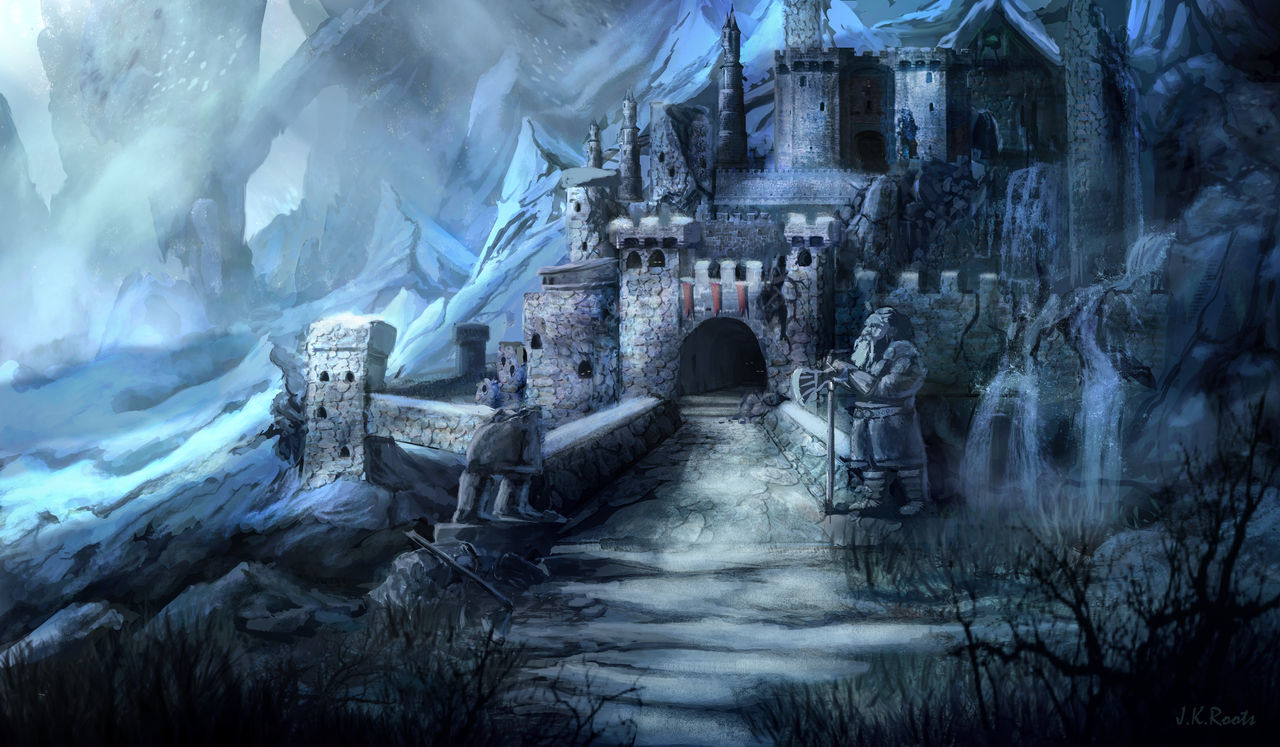
Image by JKRootssource

Defences

Dwarf Strongholds typically have a standing force of about 1/10th of their population, so a stronghold with 800 dwarves will have a force of 80 professional dwarf soldiers (2nd level dwarf warriors). However, in the event of an attack about 1/3rd of the population can pick up weapons and join in the defence of their home (1st level dwarf warriors). Any stronghold worth its name will be in a constant state of preparedness for a possible attack, usually by hated goblins or orcs, with guards at their posts, ammunition and supplies stockpiled and all inhabitants knowing what to do if the alarm should be raised. Dwarves are the undisputed masters of defending strongholds.

Dwarves rarely launch military expeditions beyond their strongholds - being caught in the open can prove disastrous as the dwarves of Tarrag Duun found out to their cost. However, when the kingdom of Rockhome is threatened by a major invasion, a stronghold chief will often send a contingent to join the national army - typically this is half of their professional soldiers plus any plucky young dwarves wanting to join on an adventure and earn some glory. So the stronghold with 800 dwarves may send 40 professional soldiers and perhaps 20 eager volunteers to join the King's army.  Loyalty to the king is a factor here, as are any immediate threats to the stronghold that may mean a chief keeps his forces at home. 

Trade and Industry 

Mining and metalwork is the heart of dwarven industry, and many strongholds start off as mines that then expand to become towns and fortresses as well. However, even the toughest of dwarves cannot eat metal, so every stronghold needs to have a supply of food. This can be grown in the valleys below the stronghold, or imported from further afield. There are some that have taken agriculture underground and turned it into fungiculture - mushrooms and toadstools grown in dark damp caverns become their staple food. Although not always tasty, such fungiculture will make a stronghold quite self-sufficient. Beyond food, strongholds will generally need to trade with other communities, both dwarven and other races, for supplies and materials they cannot create themselves. Popular materials include leather, cloth, wood and metals (even if the stronghold is also a mine, it usually mines only one metal such as iron, and will need to trade for other metals such as gold, copper or lead). Pack animals, livestock, wines and spirits, weapons and tools are all useful. Of course, this trade requires reliable travel to and from the stronghold, and dwarves will vigorously patrol their necessary trade routes, protecting them from bandits and monsters, as well as clearing landslides and mending bridges across chasms.  

Culture and Religion

Most strongholds will have a few dwarf clerics, typically 1 in 200 dwarves. Even the smaller strongholds with less than 100 members may have a dwarf cleric visiting or on loan from a larger community. There are a few strongholds that are not interested in clerics or religion at all - such "secular" strongholds will need to find other ways of healing and curing the sick. Others (particularly those loyal to clan Buhrodar) may swing the other way and have more than their fair share of clerics (perhaps 1 for every 50 dwarves) who may prove unduly influential on the chief and his advisors and lieutenants.

Strongholds are typically self-sufficient in terms of entertainment, and each one will have some talented dwarves who can play instruments, sing ballads or tell epic tales of ancient dwarven heroes. The visual arts are usually based around sculpture rather than drawing or painting, and dwarf homes with disposable income may have a bust of a revered family member sitting on a pedestal. Travelling bands of dwarf entertainers may visit, putting on shows of theatre, harmonic singing and occasionally juggling and acrobatics for a few days before moving on to the next audience. 

The dates of importance mentioned in the Gazetteer are generally observed by each stronghold, though different strongholds and families will put different emphasis on different dates and perhaps observe them in slightly different ways. 

Role in Adventures

  • The stronghold may be under attack. Although this is usually orcs and goblins, it could be something more unusual such as giants, a dragon or giant vermin. 
  • The stronghold may have turned hostile, either against the rest of Rockhome or against someone else who is not normally an enemy. The adventurers are asked to assist with negotiations and perhaps investigate why the change in attitude.
  • The stronghold is a safe base for adventurers to investigate a nearby dungeon. Although the dwarves will expect fair payment for food, lodgings and healing, a successful adventurer will have plenty of loot to pay with. 
  • There is something wrong inside the stronghold that needs investigating. A murder, a theft, evidence of a Cult of Chaos. Perhaps this is the work of evil dwarves (though rare they do exist) or perhaps something else has infiltrated the stronghold (doppelgangers can easily imitate dwarves). Werebeasts are nearly always human but there might be variants that affect dwarves (were-badgers?) 
  • Nobody has heard from the stronghold for several weeks and surrounding communities are worried. The adventurers are asked to investigate. 
  • The stronghold has been abandoned for some time after some disaster (military attack? plague?) but now dwarves want to reclaim the stronghold, and they have asked the adventurers to assist in clearing out any monsters. 
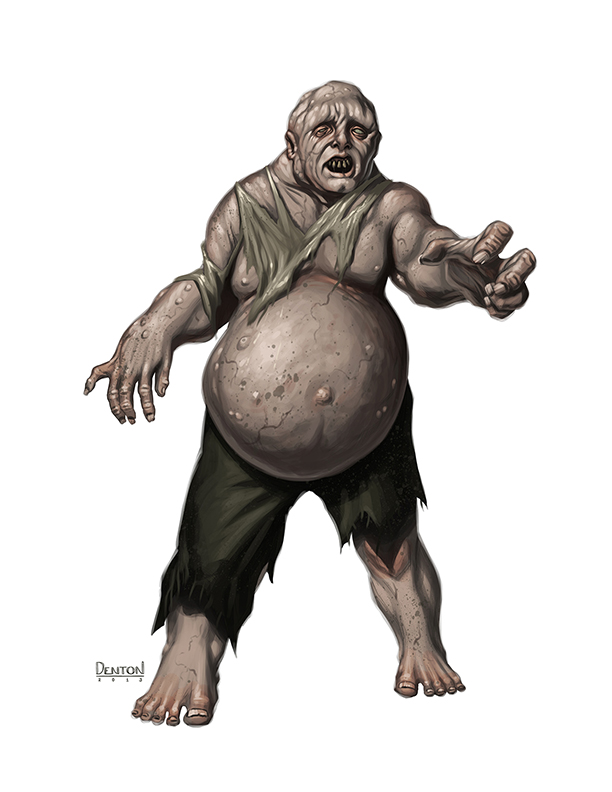

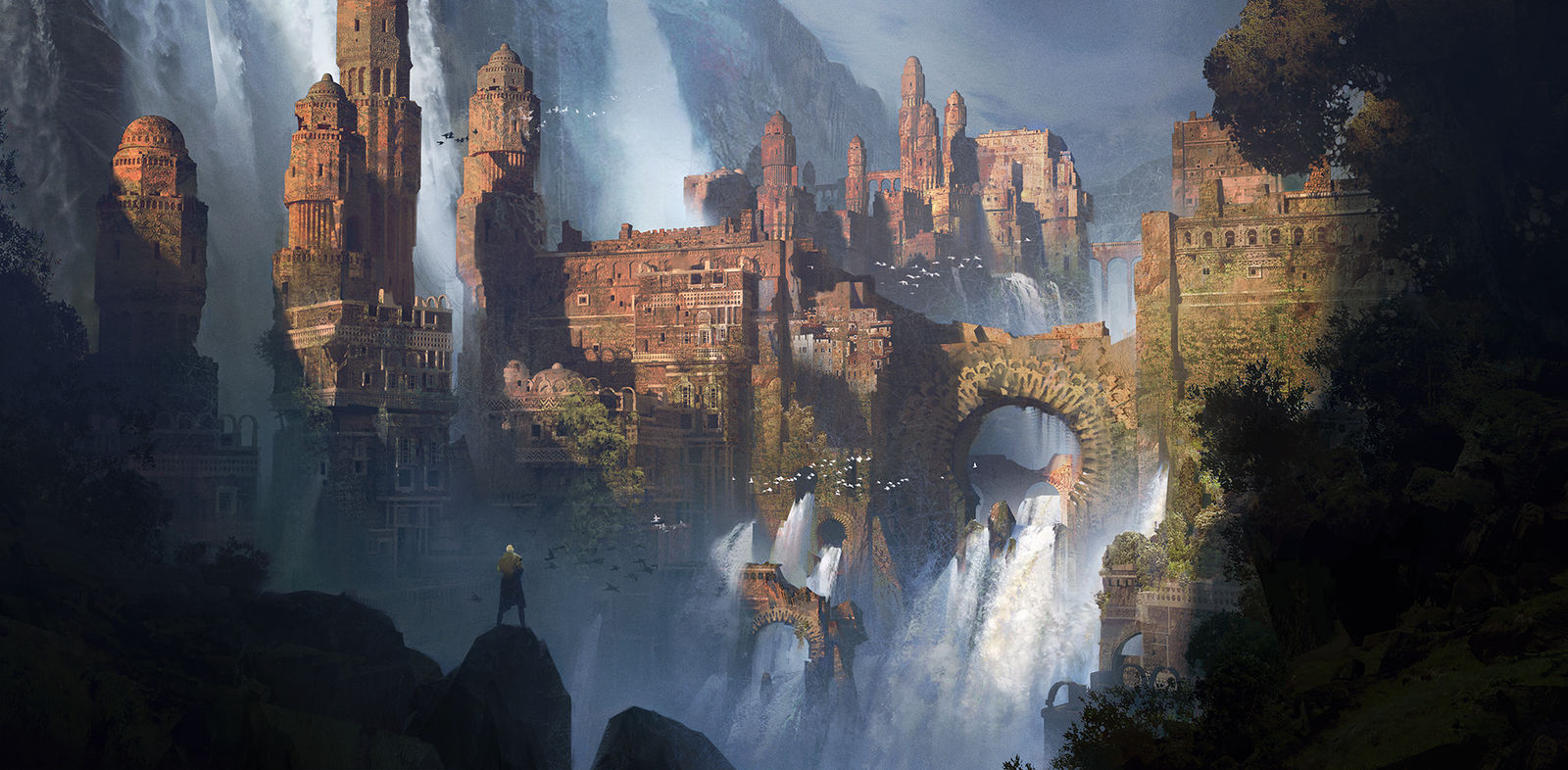
Image by IvanLaliashvilisource


Saturday, 7 May 2022

My Overview of Rockhome

Illustration by Clyde Caldwell, source

The Kingdom of the dwarves is right in the middle of the Known World and shares borders with many other nations, including Darokin, Ylaruam, the Northern Reaches (Soderfjord Jarldoms and Vestland) and the Ethengar Khanate. Yet strangely enough not many adventures are set in it. A few possible reasons spring to mind:

Dwarves, the predominant race, only have 1 character class according to the core rules. Both Gaz6: The Dwarves of Rockhome and I have added the Dwarf Cleric class, which are similar to each other. Which one you choose is up to you as a group. But even so, 2 classes does not offer quite as many NPCs and possibilites as the basic 4 for humans (fighter, cleric, thief and magic-user). So dwarves could seem all a bit samey. And the absence, or at least rarity, of arcane magic  reduces possibilities in that area. 

Rockhome is fairly stable politically. There are no rivals to the throne, no major rebellions and no imminent invasions. 

There is no mentions of ancient civilizations within its borders. There is no equivalent of Nithia or the Lizardmen of Mogreth that Ylaruam has, or the Traldar of Karameikos. 

But there are good reasons why the dwarves of Rockhome could be hosts to lots of adventures:

Lots of external enemies. The obvious ones are the humanoids - the orcs, goblins, trolls, ogres and the like, some of whom have established footholds within the borders of Rockhome. Although Rockhome does not share a direct border with the Broken Lands, they are not so far away and humanoids can move through the Orclands of north-eastern Darokin with impunity. But there are other enemies. Glantri may not consider itself a true enemy, more like ruthless investigators, but the dwarves of Rockhome view them as threats to be dealt with. The Ethengar Khanate raids the dwarves because, well, that's just what they do. The Elves of Alfheim are perpetual rivals with the dwarves, and goading each other seems to be a common hobby, almost a sport. 

The many connections to other civilized nations means opportunities for trade, diplomacy and espionage, including some that are quite far away, such as Thyatis, Alphatia, Karameikos and Ierendi. All of them would like to benefit from Rockhome's mineral wealth. 

Lots of borderlands. It is no coincidence that a lot of Rockhome's population is centred around the two lakes Stahl and Klintest. This is where the agriculture is and where trade and travel is easier. That leaves a lot of land area, predominantly mountains and near the national borders, with not much  marked on the map. And as any good DM knows, just because an official map doesn't have anything marked on it, it doesn't mean the DM can't put anything there. Humanoid tribes are the obvious choices but there are many less obvious ones, including monstrous lairs, independent human realms and perhaps dwarves who have lost contact with the rest of the kingdom. Blank areas on the map are simply empty canvases for DMs to do their own doodles and perhaps a real piece of art. 

Dwarves are excavators of epic dungeons. The name of the game is Dungeons and Dragons, and dwarves are very talented at carving out homes, strongholds, mines, workshops and so much more into the deep earth. Although the dwarves hold onto many of these underground structures (such as Lower Dengar), there are others that have been abandoned or the dwarves have been driven out. My own contribution to this is Tarrag Duun in Karameikos, but you can bet your last d20 that there are more like that dotted around the borderlands of Rockhome. Tarrag Duun itself was inspired by Tolkein's Mines of Moria and the kingdom of Erebor based within the Lonely Mountain, both created by Tolkein's dwarves. The Mines of Moria are, in a way, the Ur-dungeon, the prototype on which so many other dungeons have been based. 

Dwarves have their own magic. Although they do not have magic-users, dwarves have access to means and ways of creating their own enchanted weapons, armour and other magic items. And their clerics, although in some ways similar to human clerics, could well be given access to powers and spells their human counterparts are not aware of. Dwarves can achieve immortality and become saints, exalted or even chaos princes. And despite what the gazetteer says, Kagyar is quite capable of sponsoring heroic dwarves he considers worthy of immortality. This means there are ascended dwarf saints with their own clerics and sects that I intend to look at in a later post. 

Dwarf History is long. This ties in to the excavating dungeons and perhaps also the discovery of dwarven magic items. 2,800 years have passed since Kagyar created the first dwarves (1800 BC) and a lot of things have happened since then, even within the relatively stable land of Rockhome. Towns, fortresses and family lineages have risen and fallen. Battles have been fought, plots schemed and occasionally thwarted, works of art created and perhaps lost, other nations have been traded with, fended off and negotiated with.   

In short, there are a lot of adventures to be had in Rockhome, and I intend to write about some of them in this blog. 

Monday, 2 May 2022

My ideas about Norwold

Norwold was introduced in CM1: Test of the Warlords, the first adventure module written with the Companion Rules in mind. Being further north than the "classic" Known World, it has a cooler, subarctic climate and borders on true arctic wastelands to the north. Since one important aspect introduced in the Companion Rules was PCs building and managing dominions, there was a certain expectation (and indeed encouragement) that PCs should try to set up their own strongholds and fiefdoms in this region. This was complicated by the two great empires of Mystara, Thyatis and Alphatia, who both wanted to rule this region and its resources. PCs could ally themselves and their dominions to one of these great nations. 

Illustration by Clyde Caldwell, source

My ideas about Norwold

As my basic map, I am starting with this magnificent piece of cartography by Robin (6inchnails on Deviant Art) though I expect I will add my own stuff to it. 

Map by Robin/6inchnails: source

The wildlife in this region is dominated by iconic creatures of the Ice Ages, including woolly mammoths, woolly rhinos, sabertooth tigers, cave bears and dire wolves. Mammoth steppe and tundra make up wide stretches of the wilderness. As this is D&D, there are quite a few magical monsters as well as natural animals, including white dragons, frost giants, winter wolves and arctic variants of established monsters including the all-white arctic griffon and the dread arctic chimera (with the heads of a white dragon, musk ox and polar bear instead of the usual red dragon, lion and goat). Random wilderness encounters are found in this post.

So my ideas include this region being not just for characters of Companion level (15th-25th)  but also Basic and Expert (1st-14th). I reckon if the DM is sensible about what encounters the PCs run into, the Norwold region could be the setting for an entire campaign. There are plenty of humanoid and human tribes to keep low level characters occupied, including familiar goblins, ogres, bugbears and the less common quaggoths and taer. Neanderthals have made parts of Norwold their hunting territory. 

The competition between the Thyatians and the Alphatians brings its own adventures, particularly if the PCs take sides, even if they don't yet have their own dominions or strongholds. Direct warfare, trade disputes, diplomacy towards native allies and espionage all benefit from the skills that adventurers can bring. The Alphatians are primarily based in Alpha, on a peninsula jutting into the Great Bay of Norwold. Oceansend used to be a Thyatian possession but is now independent, with only cultural ties to Thyatis. Landfall has experienced both Thyatian and Alphatian influence but is now in the grip of the criminal gangs. 

The Heldannic Knights are another national faction that can make its presence felt in the south of Norwold. Aggressive, territorial and capable of both great nobility and terrible brutality, I envision them as similar to the Teutonic Knights of northeastern medieval Europe, launching their own crusades against what they consider the inferior pagan tribes. Although they might be cautious where the two great empires of Alphatia and Thyatis are concerned, they are certainly not cowed into submission.  

Although in the normal course of wilderness adventures the weather is usually not serious enough to count as a threat, in Norwold the weather and seasons can be deadly, particularly winter and blizzards. I have included some of these in my random encounters for Norwold. Rules for frostbite, hypothermia and similar cold-weather effects should be considered by the DM and any sensible PC. Starvation and the ability to start camp fires become serious issues. Norwold is no place for the weak or unprepared. 

Finally there are the Arvorians, a truly ancient race not that different from elves. Their civilization was  contemporary of ancient Blackmoor. But while Blackmoor dabbled with science, the Arvorians turned to darker, more malevolent powers from other planes of existence. If the Blackmoor civilization was D&D meets Star Trek, the Arvorians were D&D meets Call of Cthulhu. And despite the cataclysm that destroyed Blackmoor and changed the globe, they have not entirely died out. Deep beneath their shattered ruins scattered across the north of Norwold there are surviving Arvorians and they still follow their evil and chaotic powers of darkness. Even worse, they seek to summon and unleash their alien patrons on an unsuspecting Mystara. The Arvorians have also lured various chaotic humans including Chaos cultists into their plans, with the promise of destroying the forces of Law and Order. Just as chaotic cultists can use orcs and goblins as pawns to further their games, so to the Arvorians manipulate and encourage the human forces of Chaos to act on their behalf, and thus on behalf of powerful beings that seek to inflict damnation and destruction across the whole of Mystara. 

Sunday, 17 April 2022

The Lizardmen of Mogreth


In the village of Kirkuk there is the Well of the Faithful Prophet that supplies water to the village animals, which draws water from an underground grotto. There are many tombs of ancient lizardmen dotted around the grotto - the ones above ground have already been disturbed and those undead lizardmen have been destroyed, usually in  brutal combat with human tomb-robbers.  

What is officially said in Gaz2: Emirates of Ylaruam (p.49):

"Lizardmen Undead: Not strictly speaking NPCs, but these monsters are bad news if they start shambling out of the grotto and terrorizing villagers. The zombies are a nuisance, but the sanctuary's staff should be able to handle them. Undead lizard clerics and wizards are another matter; unless mid- or high-level magical support is available, the smartest move might be to evacuate the village, use delaying and containment tactics and wait for reinforcements.

The lizardman race itself is ancient beyond imagining - their tombs having been buried by ice sheets 4000 years ago while the Blackmoor World was in its infancy. Their descendants still survive in parts of the D&D World, though they have descended into savagery. 

When awakened from the sleep of death the lizardmen are bewildered by what they find. Their swampy homeland has disappeared and been replaced by a desert populated with horrible mammals in a mockery of lizardman form. They find they are not really alive but only sustained by ancient magics, reawakened only to preserve the sanctuary of their tomb. 

The lizardmen might respond in a number of ways to their reawakening:

  • Perhaps they are more than content to return to the slumber of the grave, once the sanctity of their tomb is re-established
  • Perhaps they struggle instinctively to destroy the alien world they discover
  • Perhaps the undead lizardman clerics and sorcerers imagine they can re-establish a race of lizardmen with their Lizardskin bed."
    Source
This is the first official description of what is now known as the Mogreth civilization. The original culture no longer exists in its old form but it is not truly extinct. The original Mogreth culture was based around the Nithian river basin (what is now Ylaruam) but had outposts further away in modern Thyatis, Northern Reaches and Rockhome. 

There were various castes of different species in my version of Mogreth culture. 
  • The Serpent Folk were the leaders
  • The Gatormen and Lizard Kings were the battle champions
  • The Lizardfolk were the commoners and the most numerous
  • The Kobolds and Humans were the peasant slaves

I am going to change the timeline a bit here. Although the quote from Gaz2 says that 

The lizardman race itself is ancient beyond imagining - their tombs having been buried by ice sheets 4000 years ago while the Blackmoor World was in its infancy. Their descendants still survive in parts of the D&D World, though they have descended into savagery. 

Since the current year is 1000AC (when the gazetteers are set), this means the ice sheets came in 3000BC, which is actually when the legendary Great Rain of Fire ended the Blackmoor civilization (not when Blackmoor started) and caused massive climactic upheavals. As far as this campaign is concerned, the Mogreth Empire rose about 9000 years ago (8000 BC) and fell into decline in 3900BC when humans from the Blackmoor civilization encouraged the enslaved humans of Mogreth to rise up against their reptilian masters. These humans would later form the Nithian empire. 

When the Blackmoor civilization destroyed itself with the Great Rain of Fire, a brief ice age that covered the land in snow and ice for a century destroyed all the Mogreth inhabitants that remained - their reptilian bodies could not cope with the cold. Those that did not die had fled south towards the Serpent Peninsula and other warmer climes. The native humans also either moved south or died, though after the ice and snow had retreated they returned to their homeland, now free of living lizardfolk overlords. Although the human Nithians eventually overthrew their Mogreth masters, the Mogreth influence lived on in two powerful evil deities of the Nithian pantheon - the brutish crocodile god Sobek and the more cunning and insidious serpent god Apep, both closely allied with the forces of Chaos, entropy and death. Worship or ignorance of these two deities generally influenced the alignment of the lizardmen - without Apep or Sobek the lizardmen would drift towards neutrality, merely content to look after themselves rather than being footsoldiers of Chaos. It was often the serpent people, gator men and lizard kings who encouraged or demanded their followers join them in worshipping chaotic deities that pulled those lizardman tribes into chaotic behaviour. 

Although Mogreth society in the Nithian river valley collapsed, there were surviving lizardfolk who battled across southern Brun until they found themselves in the jungles of the Serpent Peninsula, in between the two human cultures of Yavdlom on Thanegia Island and Ulimwengu to the north. They have established new strongholds there and have been rebuilding their strength, and are now challenging Yavdlom for control of the inland sea of Dkiki Mamazzi, attacking coastal human settlements such as Quagmire. These lizardmen of the Serpent Peninsula have some distant awareness of their history, but it has become distorted into myth and legend. 

Smaller groups of lizardfolk have also found new homes in smaller swamps and marshes such as the Malpheggi swamp in southern Darokin, but these are primitive and degenerate, with no memory or written history of their glory days nor any means of recapturing their former greatness. 

The most accurate records of what Mogreth was actually like now lie underneath the sands of Ylaruam, sometimes directly underneath the cursed ruins of ancient Nithia or under living Ylari settlements (such as Kirkuk). In north-central Ylaruam there are known to be three sets of Mogreth ruins near Deraan, known as Akha-Sstalzhat, Akil and Ithkesp respectively. There are also Mogreth ruins deep below Cinsa-Men-Noo, underneath the layer of ancient Nithian remains, and the Shaddranath Silver Mine, originally started by Mogreth but taken over by various other cultures over the centuries.