Sunday, 26 June 2011

The Traitor Legion

During the Wars between the Empires a regiment of the Toutus Imperial Army, the Astasian 3rd Infantry Regiment was subverted by a cult of Chaos that followed Slargor, Lord of Slaughter and Bloodshed. It is said that all the battle and slaughter that the soldiers and officers witnessed pushed them to the edge of sanity. During the wars they obeyed orders and fought ferociously but gained a reputation for not showing any mercy or taking any prisoners - they killed all who were not on their side and committed war crimes in attempted invasions and raids against other empires. 
When the Summoning occurred, the regiment turned renegade and attacked towns and cities of Toutus that they were supposed to be protecting.
The regiment, changed its name to the Traitor Legion once deception was no longer a priority. Many now openly display their new allegiance, wearing the eight-pointed star of chaos on their armour and flags. They are scattered across western Toutus in various strongholds and lairs. Their exact numbers are not known, but a standard Imperial Regiment was 1500, split up into 5 battalions of 300 men each. The legion has recruited many chaotic humans to its cause.
The chaplains of the regiment are all chaotic clerics of Slargor. In some ways the Traitor Legion operates as a Cult of Chaos, but one that does not try to hide itself.  The Traitor Legion prefers to confront, attack and slay rather than hide away. The chaplains are skilled at subversion - after all, they managed to subvert the entire regiment 50 years ago - and it is they who are the main recruiters.
There is a strange and vicious code of honour among the Traitor Legion -
  • No Surrender - Cowardice is the ultimate dishonour
  • No Prisoners - Compassion is tantamount to Cowardice
  • Do Not Allow Enemies to Flee if You Can Catch Them
  • Obey Orders from your officers
  • Terrifying your enemies is preferable to deceiving them
  • Loyalty to the Legion and Loyalty to Chaos are one and the same
  • Internal Disputes and Insults should first be resolved in non lethal combat then in a duel to the death if the dispute persists.
Most Legionnaires are 3rd level fighters with chain mail, shield and longsword.
Sergeants are 5th level fighters with plate mail, shield and longsword
Chaplains are 6th - 10th level clerics
Lieutenants are usually 6th level fighters
Captains are usually 7th level fighters.
The mysterious General who commands the Traitor Legion is thought to be deep in the heart of Toutus, close to the capital. 


Chaos mutations are known, particularly among officers and champions as "rewards" for serving Chaos.
Magic weapons and armour are favoured by officers and chaplains when they can be found.
Humanoids and monsters of Chaos are used as auxiliaries, but not accepted as full members.
It has been suggested that with its military structure and bloody code of honour, the Traitor Legion is in some ways a chaotic order of knights. Other orders of knights vehemently deny this and refuse to accept the comparison.


Contingents are known to exist in Aerisport, the Island of Lost Souls and an island with a small fort in the Salty Forest.

Thursday, 23 June 2011

Towns and Baronies of Teiglin - Thaldion

The Barony of Thaldion is in the heart of the Kingdom of Teiglin and is named after its main city, the capital of Teiglin. The Barony of Thaldion is under the King's direct control - it is his own personal barony, and it is probably the wealthiest in Teiglin. Only Brandir and Luthien approach it in prosperity. Part of this is the large numbers of people - 41,000 folks live in Thaldion Barony (including the 16,300 in the city of Thaldion), mostly human but with 3,600 halflings as well.
The barony is strategically in a vital position, at the kingdom's narrowest point and splitting the Teiglin land mass in two, separating Alvenir and Tredgor from the other realms. It has access to both the southwest coast and Mussel Bay, and there is plenty of merchant traffic passing through it at any time.

Greenport is a small trading port and fishing village that sees traders passing through on their way to both Thaldion and Glensor. The elves of Glensor don't have a proper sea port of their own, so Greenport is the nearest and most convenient. Greenport has 900 villagers (650 humans, 100 halflings, 150 elves), almost a town but not quite. This relatively small size makes it less threatening to the elves, some of whom are not comfortable in big cities such as Thaldion city.

Waydown is a fishing village of 540 people at the bottom of a steep series of cliffs. It would be barely worth mentioning, but the cliffs are inhabited by giant seagulls that are proving to be annoying and possibly dangerous pests, attacking pets and small livestock and then swooping off to their inaccessible cliff ledges. Anyone capable of dealing with these avian pests would be rewarded by the villagers - there is already a talk of a 10gp bounty on each gull head but the village council has not yet approved this.

Harmeck is a small town on the shore of Mussel Bay, with a population of 1670. Its numbers are swollen by the families of soldiers posted at Harmeck Keep, as well as those who provide services to soldiers (tavern keepers, entertainers, blacksmiths, ladies of the night and so forth). Aside from trading with the garrison, there is a small fishing fleet and numerous sheep and dairy farmers on the outskirts, as well as docks for cargo ships to load and offload wares.


Harmeck Fort is the headquarters of the Royal Army of Teiglin. It is a concentric castle with numerous barrack buildings and training grounds and also doubles as a prison for those suspected or guilty of serious crimes. At any one time it typically has 500-600 soldiers and officers present. Harmeck Fort is on the estuary of the Foulflow River (and is nicknamed Foulmouth Fort - a reflection on some of its coarser inhabitants as well as its geographical position) and there is a wooden pontoon bridge across the river that the soldiers maintain. This bridge allows easy access to the town of Harmeck on the other side, but could easily be burnt or cut loose if someone tried.

Tuesday, 21 June 2011

Creatures of the Seas around the Godsblood Straits

Even before the Summoning and its attendant catastrophic changes, both Teiglin and the Duchy of Urdus were maritime duchies with extensive coastlines dotted with fishing villages and ports. Now that Teiglin is an island and the Duchy of Urdus is now the Godsblood Straits, travelling by sea is more important than ever. The following creatures are found around the shores and in the shallow seas.

Giant seagull
No. Enc.     1d10
Alignment    unaligned
Movement     30'/swim 30'/fly 240'
Armor Class  7
Hit Dice     2 (9hp)
THAC0        18
Attack       1 peck or 1 vomit
Damage       1d4 or special
Save As      F1
Morale       6
Hoard Class  none
Size         Medium
Type         Animal
Intelligence animal (1)
XP value     29
Giant Seagulls are birds with 8' wingspans, white heads underwings and bellies and grey backs and upper wings that populate temperate coastlines. They are more gregarious and also more opportunistic than albatrosses. They will not attack elves, dwarves and humans, but may have a go at halflings and children when in numbers or sufficiently hungry. They will also rumage through garbage, scavenge carrion and search the high tide mark for anything remotely edible.
In combat they will usually attack with their beaks but if they are faced with a dangerous foe they want to escape from they can vomit once per day. This requires a save vs breath weapons to avoid. If struck (i.e. failed save) the target becomes nauseated as the half-digested oily fish remains seep into clothing, armour and hair. For the next 1d4 hours the target suffers -2 to all to hit rolls, saves and ability checks, and may well vomit themselves. Creatures immune to poison are immune to seagull vomit. Giant seagulls don't like their own vomit, so they won't use it on prey they intend to eat.

Placodont
No. Enc.     2d6
Alignment    unaligned
Movement     60'/swim 150'
Armor Class  4
Hit Dice     6
THAC0        15
Attack       1 bite
Damage       1d6
Save As      F3
Morale       5
Hoard Class  none
Size         Large
Type         Animal
Intelligence animal (1)
XP value     320
Placodonts are relics of an older age, and are large, stocky marine reptiles that browse on marine life that clings to rocks, including seaweed, shellfish, sea urchins and crabs that don't get out of the way. Placodonts have bony plates on their back like crocodile scutes, which give some protection against the larger predators. Their mouths are full of blunt flat teeth which cause crushing rather than cutting injuries,
Like turtles and seals, placodonts will pull themselves up onto the beach when needed, such as laying eggs and avoiding marine predators. A placodont will usually only attack if cornered or defending its nest.

Scarlet Crab
No. Enc.     2d10
Alignment    unaligned
Movement     90'/swim 60'
Armor Class  4
Hit Dice     1
THAC0        20
Attack       2 pincers
Damage       1d6/1d6
Save As      Normal Man
Morale       8
Hoard Class  none
Size         Small
Type         Animal (invertebrate)
Intelligence animal (1)
XP Value     10
Scarlet Crabs are common predators that move around in swarms. On their own they are nasty but not too serious - a sailor with a bailing pin could keep one at bay, but in groups of a dozen or more they will swarm over a human and rip him to pieces with both claws. Scarlet Crabs are amphibious in that they can survive for 1d6 hours out of water on land before needing to return to the sea to refresh their gills. Once the time is up, the scarlet crab suffers 1hp and -1 to hit per 10 min until they die. Underwater they usually crawl around on the bottom, and can only swim in short bursts - 1d6+1 rounds at a time - before sinking back to the sea bed. 
Other creatures listed in the Labyrinth Lord rules found in the seas include
Crab, Giant
Dragon, Sea
Dragon Turtle
Water Elemental, 8 HD
Fish, Giant Rockfish
Storm Giant
Hydra, Aquatic
Insect Swarm - actually Crustacean Swarm
Men, Pirate
Merfolk
Octopus, Giant
Sea Serpent
Shark, Bull
Shark, Mako
Snake, Sea
Squid, Giant

Sunday, 19 June 2011

Seaview Keep - The Above-Ground Keep

Seaview Keep is the megadungeon on the border between Teiglin and the Godsblood Straits


This is the ground floor. The portcullis on the front has been ripped down by some monstrous strength.
The keep is mostly intact - it was built to last, and it has done so.
The exact contents of each room is left up to each DM.
The vital stairway leading down into the dungeons below ground is in the north-west tower. It used to have a large trapdoor covering it, but this has been smashed up and ripped away, allowing free access down into the subterranean levels.  Each corner tower has a staircase leading up to the second floor.
The courtyard is open to the sky. 


Above the second floor there are only flat roof and battlements along the walls, plus one extra level of tower on each corner, each of which has its own roof and battlements. 
Many of the rooms have arrow slits which allow a little daylight into the rooms. 

Friday, 17 June 2011

The Godsblood Hills

Similar to the Island of Lost Souls, the Godsblood Hills have been thrust up out of the sea as the land of Urdus sank, forming the Godsblood Straits. However, these hills are attached to the mainland, so colonization by plants, animals and monsters has been quicker and more varied.

The terrain is rough, with evidence of the sea still found in places (patches of old dried sea weed, sand, mollusc shells and fish bones as well as briny pools collecting in hollows) but in areas where the salt has washed away, wiry shrubs and tough grasses have grabbed hold and  brought patches of green to an otherwise barren landscape. The hills are not very fertile, but there is enough to support some animals.

Most notable of the inhabitants are a tribe of fierce ogres that emerged through a Chaos Portal from Hestoris, the first Plane of Chaos. They have established a palisaded compound around the skeleton and cavernous shell of a dragon turtle that found itself fatally stranded when the sea floor beneath it was pushed up.

There are also several prides of griffons (native to Kaelaross) that have settled in the hills. They feed on the stags, goats and wild boar that have moved into the hills. There is a breed of giant goat that is found in the Godsblood Hills and though the ogres are prone to hunt them for their meat and hides, some humans reckon the giant goats could be trained and ridden as sturdier steeds than horses in rocky terrain.

Just to the south-east of the hills is the once-coastal ruined city of Aerisport which has been infested with chaotic monsters since Bhael briefly appeared over the city, created a chaos portal in the city's heart and then disappeared. Many of these chaotic monsters have wandered out of Aerisport and into the Godsblood Hills.

These include a pack of gargoyles that have made their lair in the southern hills not far from the coast. They have taken over an old abandoned chapel of Sturnornel that was on the old coast and lurk there waiting to ambush unwary travelers. They have gathered quite a trove of gold and silver from both the chapel's former inhabitants and also brought from the ruins of Aerisport.

Encounters in the Godsblood Hills (roll d8+d12):
2. Harpy (2d4)
3. Hellhound (1d6)
4. Wolf, Dire (2d6)
5. Wolf, Normal (3d6)
6. Gargoyle (1d4)
7. Griffon (1d4)
8. Ogre Leader + followers (1 leader, 2d6 ogres, 1d4 juveniles)
9. Ogre (1d4)
10. Normal Goat (4d8, treat as 1HD herd animal)
11. Wild Boar (2d4) (1-2 in 6 chance of Giant Boar)
12. Great Ram (2d6, treat as 3HD herd animal)
13. Stag & Deer (1d4 stags, as 3HD herd animal & 3d4 deer (2HD)) or Giant Stag
14. Snake, Spitting Cobra (1d4)
15. Snake, Giant Rattler (1d4)
16. Lizard, Giant Tuatara (1d2)
17. Hawk, Giant (1d4)
18. NPC (DM's choice)
19. Wyvern (1d2)
20. Red Dragon (1)

Wednesday, 15 June 2011

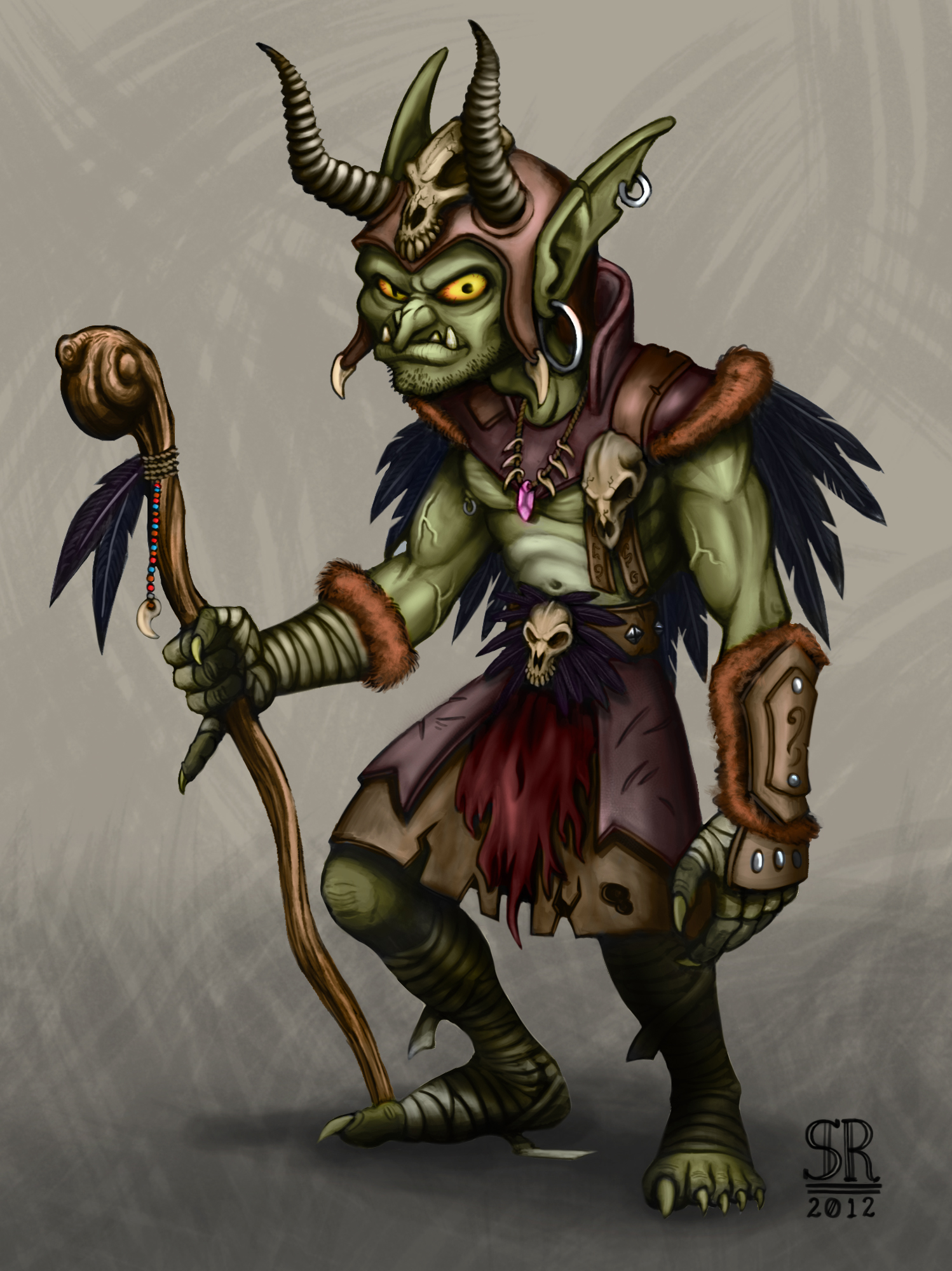
Optional NPC Class: the Goblin Shaman


source


This optional class is the spellcasting counterpart to the goblin warrior described earlier in this blog. The goblin shaman is traditionally the power behind the throne in goblin society - the goblin chief or king leads from the front, showing his power and brutality in battle while the goblin shaman whispers Machiavellian wisdom into his pointed ears. 

Although some goblin shamans worship Chaos in general, others worship particular chaotic gods, such as Bhael, Havok, Slargor or Pelepton. This does not necessarily affect the spells available, but may well influence the shaman's tactics and outlook.
 

Level Hit Dice THAC0 Name          1L 2L 3L 4L 5L 6L
1     1d6      20    Acolyte        1  -  -  -  -  -
2     2d6      19    Acolyte        2  -  -  -  -  -
3     3d6      19    Minor Shaman   2  1  -  -  -  -
4     4d6      18    Minor Shaman   3  2  -  -  -  -
5     5d6      17    Shaman         4  2  1  -  -  -
6     6d6      17    Shaman         4  3  2  -  -  -
7     7d6      16    Senior Shaman  4  3  2  1  -  -
8     8d6      15    Senior Shaman  5  3  2  2  -  -
9     9d6      15    Great Shaman   5  4  3  2  1  -
10    9d6+2    14    Great Shaman   5  4  3  2  2  -
11    9d6+4    13    Great Old One  6  4  3  3  2  1
12    9d6+6    13    Great Old One  6  5  4  3  2  2

Save as: cleric of same level
Alignment: Usually Chaotic, rarely Neutral, never Lawful.
Weapons allowed: Spear, Hand Axe, Club, Mace, Dagger, Shortsword, Quarterstaff, Sling
Armour Allowed: Leather Armour, Scale Armour, Chain Mail, Shield
Spells: Drawn from clerical spell lists. Non-standard spells possible if the Labyrinth Lord wishes to include them.
Magic Items: Any that a cleric can use unless it conflicts with armour or weapons restrictions
Racial Abilities: 60' infravision, -1 penalty to hit in sunlight, +2 dex -2 cha except to goblins, same movement rate as dwarves.

Although XP is not included (this is meant to be an NPC class), you could use the XP progression for Magic Users.

Monday, 13 June 2011

Adventuring bands of Teiglin

Adventurers have a mixed reputation in Teiglin. On the one hand they can be mighty heroes, defeating foul evil creatures that armies of normal soldiers could not stand against. On the other hand, they can be cynical, casually violent, headstrong, arrogant and sometimes outright criminal in their behavior. If the captain of the town guard asks a warrior to deal with an ogre or hellhound that the guard are terrified of, and he defeats that monster, do you really think he's going to be respectful of the captain when warned about not starting tavern brawls or told he should be paying taxes?

Adventurers tend to be motivated by three things - money, fame and magic items - and will gravitate to where these things are found. The most profitable place for adventurers, and happily the area where civilised folk need them the most, is the borderlands in between the current Kingdom of Teiglin and the ruined city of Erkhart. Here the army of Teiglin needs all the help it can get fending off the hordes of Chaos, while the ruins provide plenty of gold for looting and the occasional magic item. Mighty reputations can be forged in the fires of battle against the foes of humanity, and those who fight long and hard and survive to tell their tales (only slightly exaggerated!) may be offered a piece of land as way of thanks. This land is usually on the borderland, and the newly appointed lord has his work cut out for him.

Duty, honour and justice should not be forgotten. Some adventurers, particularly those of lawful alignment, fight the good fight because it is the right thing to do. For them, fame and fortune and cool magic items are merely additional benefits. Such noble heroes are very popular, and are more likely to build friendships and alliances with local rulers and people.


Glensor, Bauglir and Luthien are the three principle baronies where adventurers assemble, ready for expeditions into the borderlands. Castellan Keep, also known as the Keep on the Borderlands, is a classic starting place for adventurers, though Firebright Keep and the villages of Parnsus in Bauglir and Iridell in Glensor often have one or two bands of adventurers resting or preparing between forays.

There are no specific laws or regulations for the formation or maintainance of bands of adventurers but the local law will keep a close eye on them until they have earned some trust.

Notable bands include:

Erbick's Treasurefinders - an adventuring party that has roamed all over Teiglin looking for ruins to plunder. They do not intentionally get into trouble with the law, but neither are they heroic protectors of the innocent. They are currently planning an expedition into Erkhart, not to close the dreaded Chaos Portal but to loot the bank in the ruined city.
Yagreth Venius - 4th level magic user, align neutral, gender male
Thurgon the Resilient - 4th level dwarf warrior, align unaligned, gender male
Selminia - 5th level thief, align unaligned, gender female
Allysso Brighteye - 4th level elven spellsword, align neutral, gender female
Gurrumbor - 4th level fighter, align unaligned, gender male

Hawithin's Sylvan Scouts -These adventurers formed up in Glensor town and have since been involved in exploration and incidents around Glensor and the Shorgan Forest.
Ecthellion - 5th level elven spellsword, align lawful, gender male,
Shoonia Silverbow - 5th level elven ranger, align neutral, gender female
Darria Delliss - 6th level halfling scout, align lawful, gender female
Worvorp Tellamin - 5th level elven ranger, align unaligned, gender male
Lellishi - 5th level halfling defender, align lawful, gender female
Humbert Enkledink - 4th level halfling scout, align neutral, gender male


The Parnsus Avengers - These adventurers see themselves as heroes, but don't always act the part. They are based in the village of Parnsus in northern Bauglir and have ventured deep into Chaos territory, including Semendia and Brasstooth.
Jehosophat the Zealous - 3rd level cleric, align lawful, gender male
Sir Fallorius of the Blue Shield - 3rd level fighter, align lawful, gender male
Densaria - 3rd level magic user, align neutral, gender female
Perregrin the Deft - 3rd level halfling scout, align unaligned, gender male
Wellsian - 3rd level cleric, align lawful, gender female

The Reavers of the Borderlands - The Reavers claim to be adventurers, but they act more like bandits. They will attack anything they reckon they can get away with - humanoids, chaos cultists, villagers, rival adventuring groups and the like. They are considering moving on to other regions like the Godsblood Straits.
Gennedar the Avaricious - 5th level magic user, align Chaotic, gender male
Delsis Verran - 6th level fighter, align Unaligned, gender female
Broggon - 5th level dwarven warrior, align Chaotic, gender male
Thespist - 6th level thief, align Unaligned, gender male
Orrogal of Havok - 6th level cleric, align Chaotic, gender male

Friday, 10 June 2011

The Island of Lost Souls

One of the most spectacular results of the titanic battle between Bhael and Rhondus and Adonor was the emergence of the Island of Lost Souls from the sea bed at the same time as the Urdus Isthmus sank beneath the waves, forming the Godsblood Straits.
The village of Tearfall is remarkable in that although it was shaken violently and rose up and down, it was not submerged - instead it found itself with the sea on the other side of the village. The fishing boats to the south were stranded high and dry, while livestock and outlying farms drowned to the north.
These days there are 260 folks in Tearfall, and the buildings are in a ramshackled state - there is precious little timber to rebuild with, and many tools for carpentry and masonry have been washed away.


The island is not very fertile and there are still some very salty areas where the rain has pooled rather than washed away the salt. There are enough shrubs and shore plants growing on the rocky slopes for the folks of Tearfall to keep a herd of goats and try to grow some vegetables.

On the east side of the island a band of chaotic marauders have established a base, Raiders Beach. The core of the raiders is a company of 50 Traitor Legionnaires (human soldiers who have turned to Chaos) led by the notorious Captain Morbius but he has also brought over a number of gnolls and ogres as extra muscle from the Chaos Portal in Maquosmouth. Raiders Beach is currently a collection of huts surrounded by a crude stone wall, but Captain Morbius has grand ambitions of creating a mighty fortress of evil. To do this, he is looking for slave labour.

Hovelhold is a collection of huts built from wood salvaged from shipwrecks. The inhabitants (about 65 humans and halflings) are survivors of the Summoning and the sinking of the Isthmus. They live in fear of the warlike inhabitants of Raiders Beach and know it is only a matter of time before they are discovered and attacked. If civilized folks make contact with Hovelhold, they will beg to be taken away to a safer place.

The mountains in the centre are barren and mostly empty, but a flock of harpies has taken over the highest peaks. They are particularly hated and feared by the Tearfall villagers as the harpies have taken and devoured almost a dozen villagers, including an armed expedition that tried to battle the harpies.

The shores surrounding the Island of Lost Souls are populated by harmless wildlife, including seals, normal crabs and sea birds. However, there are some other creatures that could pose a threat - giant crabs, giant skuas and placodonts (sea-swimming reptiles with characteristics of manatees and turtles).

Wednesday, 8 June 2011

Ogres of Kaelaross


Name          Juvenile Ogre Adult Ogre  
No. Enc.      1d8 + adults  2d6 or more 
Alignment     Chaotic       Chaotic     
Movement      90'           90'         
Armor Class   6             5           
Hit Dice (hp) 2+1 (10 hp)   4+1 (19 hp) 
Attacks       1 Club        1 Club      
THAC0         17            15          
Damage        1d8           1d10        
Save As       F2            F4          
Hoard Class*  II            IV          
Size          Medium        Large       
Type          Humanoid      Humanoid    
Intelligence  7 (low)       8 (low)     
XP Value      35            140         

Name          Ogre Leader     Ogre Chief
No. Enc.      1 per 10 adults 1 per 3 leaders
Alignment     Chaotic         Chaotic
Movement      90'             90'
Armor Class   4               3
Hit Dice (hp) 6+2 (29 hp)     8+3 (39 hp)
Attacks       1 Axe           1 Giant Axe
THAC0         13              12
Damage        1d10+2          2d10+3
Save As       F6              F8
Hoard Class*  XX+1000gp       XXII
Size          Large           Huge
Type          Humanoid        Humanoid
Intelligence  9 (average)     10 (average)
XP Value      380             1220
*hoard class uses the Labyrinth Lord treasure tables

Ogres are large, ugly brutal humanoids tainted by Chaos. They will often be found in armies of Chaos or in the retinues of powerful chaotic leaders.

Juveniles stand about as tall as humans but stockier and a lot uglier. They dress in hides (treat as leather armour) and wield clubs in 2 hands. They are nearly always encountered with adults. Ogre juveniles take about 5-8 years to mature to adulthood.

Adult ogres are the same as described in either the Basic rulebook or Labyrinth Lord rules. They are considered the standard, default ogre. They wield blunt, crude clubs in two hands for 1d10 damage. If given effective two-handed weapons (such as oversized sword or axe) the ogre can do 1d10+2 damage.

Ogre Leaders stand  10-11' tall and wear patchwork armour with bits of chain mail and metal plates often stuck onto a leather or hide backing. They wield metal-headed axes too big for PCs to use. Any ogre within sight of a live ogre leader will share the leader's morale of 11.

Ogre Chiefs are huge, 12-13' tall as big as hill giants and wear effective armour, sometimes several layers of chain mail or custom bronze plates. Their axes are sharper and superior to those of leaders. Once per encounter an ogre cheif can roar. All non-ogres within 20' must save vs paralyzation or be stunned for 1d6 rounds. Any ogres within sight of a live ogre chief will share the leader's morale of 12.

Monday, 6 June 2011

Deities of Kaelaross: part 3

Slargor, Chaotic God of War, Death, Blood and Skulls
Symbol: Two crossed axes under a white skull
Slargor is in some ways the evil counterpart of Adonor, the chaotic rather than lawful god of combat. He is usually depicted as a skull-faced warrior encased in plate mail armour and wielding two axes, one in each hand. He is popular among the military forces of chaos, particularly among humanoids such as orcs, gnolls, ogres and hobgoblins, as well as chaotic human bandits and mercenaries. Although bloodthirsty, he is considered not as nihilistic and insanely destructive as Skreech.

Storshin, Chaotic God of Disease, Corruption and Undeath
Symbol: Green Skeletal hand on grey background
Storshin is the god of decay and entropy. All things crumble, all things fail, all things die, and Storshin oversees this and maybe speeds up the process a bit. He and his followers have a special interest in diseases, especially infectious ones, and spreading a virulent pestilence will please Storshin a lot. As King of the Undead, Storshin considers undeath to be the proper end to life - any process or person that turns living folk into undead is worthwhile to Storshin.

Partheusa, Neutral Goddess of Craftsmanship and Skill
Symbol: Blacksmith's Hammer on an orange background
Partheusa is similar in outlook to Sturnornel, though Partheusa is less interested in brute hard work and more interested in skill and ingenuity. Partheusa is also less concerned about how creations are put to use, and will look more kindly on a well-crafted instrument of torture than a shoddily-made plough. She is popular with many artisans and smiths, including some dwarves and those who wish to create magic items.

Eldara, Lawful Goddess of Music, Art, Literature and Romance
Symbol: Lyre on a mauve background
Although elves are generally not lawful, Eldrara is the one deity they often worship. Eldara is interested in all beautiful things and her followers include artists, writers, musicians and both those in love and those seeking love. Despite the terrible events that have happened over the last 50 years, Eldara has remained popular - this may be because the things she represents and promotes makes the current harsh situation tolerable.

Haaken, Neutral God of the Wilderness, Animals and Plants
Symbol: Brown Bear
Haaken is worshipped by those who live in or depend upon the wild for their living - trappers, hunters, woodcutters, explorers and herbalists all at least show him respect. He is considered the father of natural predators, so appeasing him is believed to keep livestock safe from wolves, foxes and eagles. A number of sylvan creatures and wild beings follow him: dryads, centaurs, actaeons and rakastas are all known to worship him from time to time. If druids are used in your campaign, he is the natural choice (no pun intended).

Valgar, Lawful God of the Earth, Mining and Dwarves
Symbol: Crossed pickaxes on brown and grey background
Valgar is the patron of dwarves and gnomes, and he is often portrayed as an archetypal dwarf, with a big reddish beard, chain mail vest, horned helmet and battleaxe. Any other folks who intend to go underground will also pay respect to him, including human miners and spelunkers. Valgar, along with Vought, Torthola and Derlona, is an elemental deity. His home is on the elemental plane of Earth.

See also
Deities of Kaelaross part 1
Deities of Kaelaross part 2